
University in Germany
Stuttgart, Baden-Württemberg, Germany
University profile
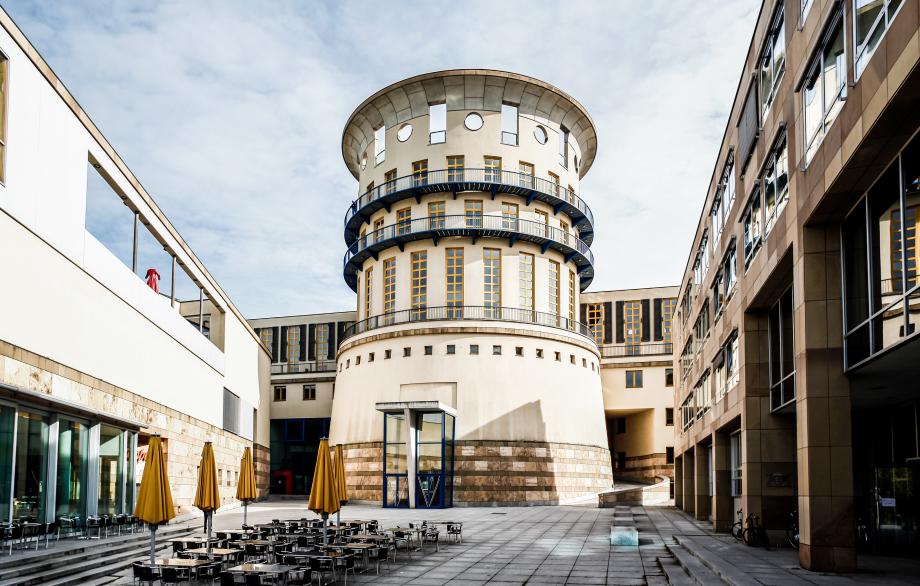
The State University of Music and Performing Arts Stuttgart (Staatliche Hochschule für Musik und Darstellende Kunst Stuttgart, HMDK) was founded in 1857 and is the oldest and, with around 800 students, the largest university of music and performing arts in Baden-Württemberg. It stands in the centre of the state capital, in the city's cultural mile beside the State Gallery and the state theatres, and teaches almost every subject in music and the performing arts together with music theory, academic and pedagogical disciplines.
The university is organised into four faculties, eleven institutes and six studios, alongside the state centre CAMPUS GEGENWART and the Wilhelma Theatre. Faculty I covers composition, music theory and aural training, musicology, music pedagogy and aesthetics. Faculty II covers wind instruments and percussion, strings and plucked string instruments, and jazz and pop. Faculty III covers piano, organ and historical keyboard instruments, and conductor training, vocal ensemble and orchestra. Faculty IV covers voice, spoken arts and communication pedagogy, and the performing arts (acting, opera, visual theatre and puppetry, performance).
Distinguishing features include a collection of eleven organs in different historical styles, a studio for electronic music, the Visual Theatre and Puppetry course, and the country's only degree programme in Speech Arts and Communication Education. Orchestra academies run with the SWR, the Württemberg State Orchestra and the Stirling-Phil-Academy, and a vocal ensemble academy with the SWR Vocal Ensemble. The university gives about 450 public concerts a year in its own building, with three concert halls of up to 500 seats, and around 100 further concert and theatre events at the Wilhelma Theatre, drawing about 85,000 visitors a year. It also maintains a music high school with around 100 pupils in cooperation with the Eberhard-Ludwigs-Gymnasium.
International students come from about 50 countries: roughly 130 students are from the EU (around 16.4%) and about 200 from outside the EU (around 25.2%), and the university has around 90 international partnerships. The International Office advises incoming and outgoing exchange students and supports Erasmus+ mobility, and the Vespa language network offers German and other language courses. The library, health and prevention programme (Healthy Playing, with counselling for musicians), a career service, an artist agency and the student committee AStA support students during their studies.
The HMDK is a state university of Baden-Württemberg (a public body under the Ministry of Science, Research and the Arts) with accredited degree programmes, 37 in all across the four faculties. It is a member of the Rectors' Conference of the German Universities of Music, the German Rectors' Conference (HRK) and the Association Européenne des Conservatoires (AEC).
Every student pays a semester contribution (Semesterbeitrag) of 176.50 euros per semester, made up of an administrative costs contribution of 80 euros and a Student Services contribution of 96.50 euros; this is not tuition. Students from outside the EU/EEA pay a tuition fee of 1,500 euros per semester under Baden-Württemberg rules. Further fees include 650 euros per semester for a second degree, 500 euros for continuing education Masters, 1,000 euros for the Concert/Stage Exam and 300 euros for supplementary studies in EMP/Rhythmics. A late fee of 40 euros applies to late re-enrolment.
300 euros per month, half from private sponsors and half from the federal government, independent of income and combinable with BAföG, for at least two semesters. All enrolled students may apply; selection looks at achievement, social engagement and personal circumstances. Applications go online by faculty with a motivation letter, CV and reference from the main subject teacher. Deutschlandstipendium
1,000 euros awarded annually to an international student with outstanding academic achievement and social or intercultural engagement; nominations go to the International Office with faculty support (deadline 1 July 2026 for the current round). DAAD Prize
1,500 euros for a year for female students in the main subject announced each year (wind instruments for 2026/27), Bachelor, Master or Concert Exam, income-independent, deadline 10 December. Soroptimist-Stipendium
The Society of Friends, with about 800 members, awards scholarships for competitions and master classes, scholarships to supplement living expenses, grants and loans for instruments and scholarships for preparatory classes. Funding and support
PROMOS provides 500 euros for workshops, masterclasses and courses abroad (deadline 6 July 2026), the Baden-Württemberg-Stipendium supports stays of 3 to 11 months with 600 to 1,400 euros per month, and Erasmus+ and Fulbright programmes are also supported. Scholarships
BAföG applications go to the BAföG office of Studierendenwerk Stuttgart, and the federal education loan is also an option for advanced students. Performance-based scholarships are exempt from BAföG income limits up to 300 euros per month. Tuition fees and contributions
Deutschlandstipendium at HMDK Stuttgart →
Soroptimist Scholarship for Female Students at HMDK Stuttgart →
DAAD Prize for International Students at HMDK Stuttgart →
Gesellschaft der Freunde der HMDK Stuttgart Student Support Grant →
Browse the scholarships listed for Hochschule für Musik und Darstellende Kunst Stuttgart and check each award’s eligibility.
View scholarships for Hochschule für Musik und Darstellende Kunst Stuttgart →Entrance examinations are required for all study programmes, and applications are made online through the HMDK application portal, with a separate application for each programme. Several programmes use a video pre-selection (a YouTube or Vimeo link) before an in-person audition. The usual entry qualification is the Abitur or equivalent; applicants without a general higher education entrance qualification take an aptitude test (a written exam of about 2.5 hours and a colloquium of about 30 minutes). Certain certificates (Gaokao, Turkish YKS, Korean CSAT, Taiwanese GSAT) can be submitted to have the aptitude test reconsidered. The Bachelor of Music lasts 8 semesters.
Summer semester 2027: 5 October to 9 November 2026. Winter semester 2027/28: 1 March to 2 April 2027. Summer semester 2028: 1 October to 3 November 2027. Winter-only programmes include Visual Theatre and Puppetry, Speech Arts, Elementary Music Pedagogy, Jazz & Pop, and several Master programmes; Acting starts only in the summer semester. A processing fee of 50 euros per application must be paid within the deadline and is refunded only if the university cancels the examination.
A tabular CV, proof of payment of the processing fee, a copy of the higher education entrance qualification (or latest school report), a Transcript of Records for applicants who have studied elsewhere, parental consent for applicants under 18, a medical certificate for Puppetry (physical requirements) and an ENT certificate for Speech Education and Speech Arts. Applicants from China and India submit an APS certificate where required.
International applicants to Bachelor and Master programmes need German at B2 (B2.1 and B2.2), and the Master in Music Pedagogical Research needs C2. The certificate must be presented by the end of the first semester, otherwise the student is deregistered; applicants should already have B1 before applying. German language courses are available through the Vespa network.
Master of Music and Master of Arts programmes last 4 semesters and build on the artistic main subject; entrance examination requirements are set per programme. Part-time continuing education Masters exist in Wind Orchestra Conducting, Choral Conducting and Instrumental and Vocal Pedagogy. Teaching degree programmes (music) require the university entrance qualification and an entrance examination, with proof of the Orientation Test for Baden-Württemberg at enrolment.
Admission to the doctoral process in musicology, music pedagogy or philosophy requires a scientific Master's degree from the HMDK or a comparable university. Candidates first contact the relevant professor to assess the project, and once supervision is assured submit a formal application to the doctoral committee through the examination office (see the Promotionsordnung). The artistic-scientific doctorate is in preparation.
After admission, students request enrolment in the portal and send the signed Antrag auf Immatrikulation with identity card or passport, proof of health insurance, proof of payment of the semester fee and, for international students, a residence permit allowing study.
The library holds 142,000 analogue media units (print and audiovisual) and 241,000 electronic media (e-books, e-scores, e-journals, digital audio and video) as of 31 December 2025, with special collections of bequests including those of Siegfried Barchet and Hermann Keller. It is open to the public. Opening hours in lecture periods are Monday to Friday 10:00 to 19:00. The recording studio, the Tower terrace, the Maker Space and the Klangmobil are further facilities. The health and prevention programme offers counselling, and the main building opens Monday to Friday 7:00-22:00 and weekends 8:00-22:00.
Study programmes offered at Hochschule für Musik und Darstellende Kunst Stuttgart.
Experiences shared by students of Hochschule für Musik und Darstellende Kunst Stuttgart.
Studied here? Share your experience to help other applicants.

Book a free consultation with our expert counsellors and take the first step towards your dream university.
Copyrights © 2026 StudyMapped. All rights reserved.

Enter your credentials to continue.
Join us and start your study abroad journey.


