
University in Germany
Karlsruhe, Baden-Württemberg, Germany
University profile
The Hochschule für Musik Karlsruhe (University of Music Karlsruhe) is a state music university of Baden-Württemberg in Karlsruhe. It trains instrumentalists, singers, conductors, composers, music theorists, music educators, school music teachers, musicologists, music informatics specialists, music journalists and music theatre directors. Its stated aim is highest artistic quality combined with reflection on music and social responsibility, preparing graduates for careers in art, scholarship and music education.
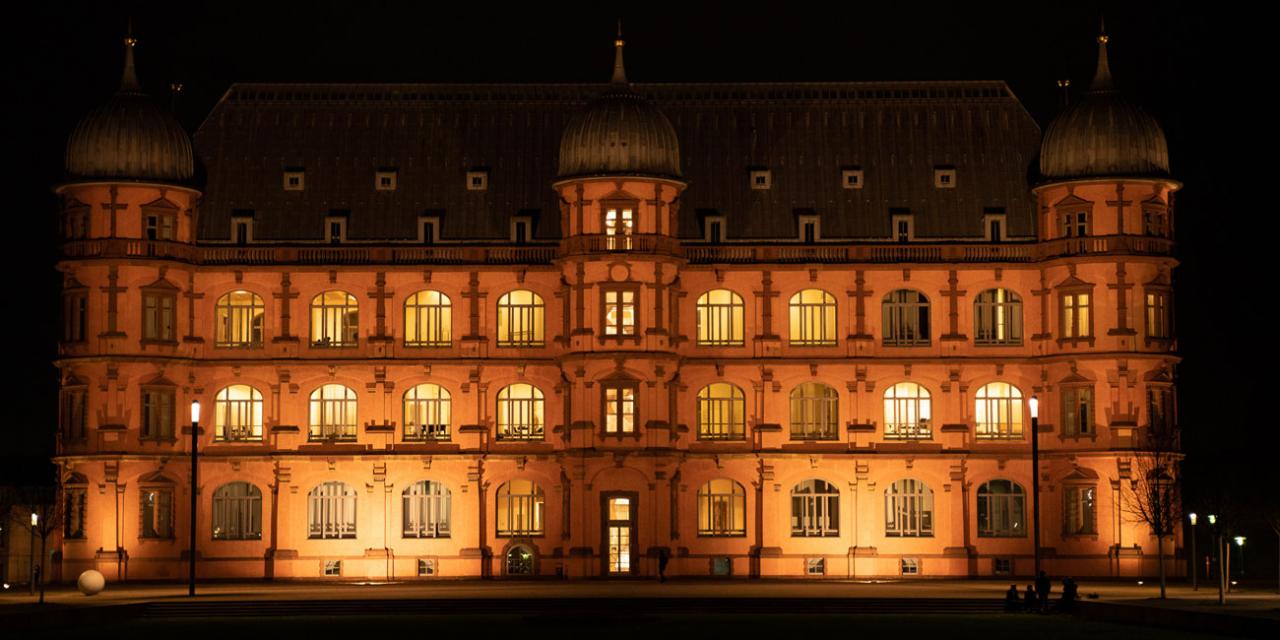
Since 2013 all teaching has been concentrated on CampusOne around the Renaissance Schloss Gottesaue in the east of Karlsruhe, after decades of being spread over four sites. The campus includes the Schloss itself (the Velte-Saal, the Genuit-Saal with organ, a lecture hall, teaching and practice rooms, the library and the cafeteria), the Multimedia, Concert and Theatre complex (MUT) with the Wolfgang-Rihm-Forum of about 400 seats, and the Marstall, Römerbau, Fuchsbau, Haus Schilling and Kavaliershäuser buildings.
Four institutes shape the profile of the university: the Institut für Musikinformatik und Musikwissenschaft (IMWI), the Institut für Musikjournalismus (Radio, TV, Internet), the Institut für MusikTheater (IMT) and the Institut für Neue Musik. The first two together form the Landeszentrum für Musikjournalismus und Musikinformatik, which holds excellence status within the Baden-Württemberg excellence initiative. Teaching is organised in subject groups by instrument and discipline, from strings, winds, brass, percussion, harp, guitar, piano and historical keyboards to voice, opera, Lied, conducting, composition and music theory.
The university offers Bachelor and Master degrees, the Künstlerisches Lehramt an Gymnasien (Schulmusik), the postgraduate Solistenexamen (Konzertexamen), supplementary and contact studies, a Certificate of Advanced Studies and doctorates. About 620 students study with roughly 80 full-time professors and lecturers and about 180 part-time teachers. More than 400 events are held each year, which makes the university one of the main concert organisers in Karlsruhe and the region. Ensembles include the Sinfonieorchester, Kammerorchester, Sinfonisches Blasorchester, BigBand, Hochschulchor, Kammerchor, Vokalensemble and Ensemble für Neue Musik.
Students come from more than 60 nations. The Rotary-Haus student residence on the campus, run by the Studierendenwerk Karlsruhe, offers 58 places with sound insulation for practising; the Studierendenwerk also runs the cafeteria, housing advice and counselling. A health service for musicians (Musikermedizin) offers seminars and individual coaching, and students may use the sports programme of the Karlsruhe Institute of Technology. The university is a member of the Association Européenne des Conservatoires (AEC), the Rectors' Conference of the German music universities and the DAAD, among other bodies.
Under the Baden-Württemberg Landeshochschulgebührengesetz, the university charges tuition fees of EUR 1,500 per semester to students who are not citizens of an EU or EEA member state, in Bachelor, other undergraduate and consecutive Master programmes. Students who already have a firm connection to Germany or hold a German entrance qualification are exempt. A second degree (Zweitstudium) costs EUR 650 per semester. The Solistenexamen costs EUR 1,400 per semester, supplementary programmes EUR 1,000 per semester, the Master Advanced (CAS) EUR 1,000 per semester and the Kontaktstudium (private-law fee) EUR 2,200 per semester. A first degree up to and including a consecutive Master is free of tuition for German and EU/EEA students. The application fee is EUR 50 per programme.
The university runs an internal system of full and partial scholarships, fee subsidies and other support open to its international student body. Social need, including the parents' financial situation, is considered especially for awards funded by the DAAD and the Freundeskreis; other awards are given on artistic merit, usually after a competition judged by a jury.
Erasmus+ exchanges, DAAD PROMOS grants (study stays, study trips, internships, competition travel and courses abroad) and the Baden-Württemberg-STIPENDIUM (for three to eleven months, deadlines 30 April for the following winter semester and 31 October for the following summer semester) are administered by the International Office (Kati Reeb, [email protected]). Incoming exchange students apply by 31 March for the winter semester or 30 November for the summer semester. Doctoral students can use the Landesgraduiertenförderung of the Baden-Württemberg ministry and the Studienstiftung des Deutschen Volkes (application by mid-October); the university's Vertrauensdozent for the Studienstiftung is Prof. Laurent Albrecht Breuninger. Student financing advice (BAföG, education credit, KfW student loan) is available through the Studierendenwerk Karlsruhe. The semester contribution to the student services is separate from tuition fees.
Official pages: scholarships and funding, internal scholarships, tuition fees.
Deutschlandstipendium at Hochschule für Musik Karlsruhe →
Studienförderung for Students in Need (Freundeskreis, DAAD STIBET and other sponsors) →
Browse the scholarships listed for Hochschule für Musik Karlsruhe and check each award’s eligibility.
View scholarships for Hochschule für Musik Karlsruhe →Admission requires passing an entrance examination (Aufnahmeprüfung) and fulfilling the requirements of the study and examination regulations; places are allocated by the admission score achieved, according to the number of free places. Applicants need a higher education entrance qualification (Abitur or equivalent). Applicants to artistic subjects without one can sit an additional general education test: an essay on a music or culture topic in German (about 120 minutes) and a suitability interview (about 15 minutes). Applicants to the Künstlerisches Lehramt (Schulmusik) must hold a general or subject-specific university entrance qualification. International applicants submit certified translations of their certificates.
The Bachelor entrance examination for instrumental subjects, voice, music theory, conducting and composition has four parts: a general test in aural training and music theory (written part of about 2 hours and an oral part of about 10 minutes), a supplementary subject (piano for instrumentalists and singers), the main-subject examination of about 10 minutes from a prepared repertoire list, and a language test for applicants whose first language is not German. Bachelor Musikjournalismus consists of an instrumental audition (video submitted beforehand, three pieces from three periods), aural training, music theory and music history, and an interview of about 20 minutes. Bachelor Musikinformatik/Musikwissenschaft uses an interview of about 20 minutes covering subject knowledge, German, motivation, English, music notation and basic keyboard skills. Bachelor MusikTheaterRegie requires a staging concept of up to 5 pages after invitation, practical directing exercises (about 30 minutes) and an interview (about 30 minutes).
Applications are made to the university directly, not through uni-assist or hochschulstart. The application is registered in the university's online portal with a full CV, proof of the entrance qualification, proof of German language skills for applicants from non-German-speaking countries, certified translations and proof of payment of the application fee of EUR 50 per applicant and per degree programme (EUR 150 for a late registration accepted after the deadline). Applications for the winter semester are due by 1 April (Musikjournalismus by 15 May; Musikinformatik/Musikwissenschaft by 30 June), and for the summer semester by 1 November. MusikTheaterRegie, Musikjournalismus and the Musikinformatik/Musikwissenschaft programmes admit mainly for the winter semester. For the entrance examinations of summer semester 2027, applications are submitted by e-mail to [email protected] as PDF files in a single message by 15 November 2026, 23:59, and all examinations take place on site; the examination period is 13 to 19 February 2027, with Schulmusik on 10 and 11 January 2027, conducting on 20 January 2027 and the examination for applicants without Abitur on 25 January 2027. The winter semester 2027/28 examinations are planned for 5 to 11 June 2027.
Applicants from non-German-speaking countries must show adequate German. General evidence, for example a German course, accompanies the application. For enrolment: Bachelor in instrumental subjects including MusikTheaterRegie requires Zertifikat Deutsch B1 at enrolment or by the end of the first semester and B2 or TestDaF 3 by the end of the second semester; Master in instrumental subjects including MusikTheaterRegie requires B1 at enrolment and B2 or TestDaF 3 by the end of the first semester; Bachelor, Master and Solistenexamen in voice and opera require B2 or TestDaF 3 at enrolment or by the end of the first semester, and enrolment is possible with B1 if B2 is not yet available.
Master programmes in instrumental music, voice, opera, chamber music, Lied, conducting, composition, music theory, music education and contemporary music require a completed Bachelor degree in a relevant subject with 240 credit points, and an entrance examination made up of a main-subject examination and a language test for applicants whose first language is not German. Master Musikjournalismus has a written and oral examination of about 120 minutes (media and music knowledge, language competence), and Master Musikinformatik and Master Musikwissenschaft use an interview of about 20 minutes. The Master in Schulmusik is open to those moving from another university who can show specified conducting, teaching practice and academic credits.
The postgraduate Solistenexamen (Konzertexamen) requires a completed Master degree or comparable qualification and a submitted programme of 45 to 60 minutes; instrumental and vocal subjects have two rounds, the second only on the recommendation of the committee. Doctorates (Promotion) are possible in music informatics, music journalism, music education and musicology under the Promotionsordnung of 6 June 2019; applications go to the chair of the doctoral committee ([email protected]).
All teaching takes place on CampusOne in Karlsruhe, around Schloss Gottesaue (Am Schloss Gottesaue 7, 76131 Karlsruhe).
Facilities include the main library (open to members of the university, with Henle Library access and electronic journals), a recording studio supporting concert recordings and productions, the SAM-ComputerStudio with four 3D immersive audio project studios, two radio studios and a video studio at the Institut für Musikjournalismus (with the institute's own FM frequency 104.8 MHz), the Rotary-Haus residence with 58 places, a cafeteria run by the Studierendenwerk and a Musikermedizin service.
Study programmes offered at Hochschule für Musik Karlsruhe.
Experiences shared by students of Hochschule für Musik Karlsruhe.
Studied here? Share your experience to help other applicants.

Book a free consultation with our expert counsellors and take the first step towards your dream university.
Copyrights © 2026 StudyMapped. All rights reserved.

Enter your credentials to continue.
Join us and start your study abroad journey.


