
University in Germany
Freiburg im Breisgau, Baden-Württemberg, Germany
University profile
The Hochschule für Musik Freiburg (Freiburg University of Music) is a state music university in Freiburg im Breisgau, Baden-Württemberg, founded in 1946 as a reform institution in the Germany–France–Switzerland border region. It educates about 700 students and more than 60 doctoral candidates across the full range of music professions, from classical instruments and voice to a growing jazz and pop area, and describes itself as one of the leading music universities in Europe.
Teaching is organised around main subjects (Hauptfächer) rather than faculties: around 35 main subjects are offered in eight degree programmes, ranging from the eight-semester Bachelor Musik (28 instrumental, vocal and other main subjects with an artistic or artistic-pedagogical profile) and the four-semester Master Musik to Bachelor and Master Kirchenmusik, the teacher-training programmes for music at Gymnasien (Lehramt Musik, studied with a second subject at the Albert-Ludwigs-Universität Freiburg), the postgraduate Konzertexamen/Meisterklasse, the Freiburger Opernstudio and doctoral study in musicology and music education.
Specialised institutes shape the profile: the Institut für Neue Musik (founded 1964, with composition classes, an ensemble, the electronic music and acoustics studio selma and a specialist library), the Institut für Musiktheater, the Institut für Historische Aufführungspraxis, the Institut für Kirchenmusik, and the Freiburger Institut für Musikermedizin (FIM, run jointly with the Medical Faculty and University Hospital of the University of Freiburg since 2005). The Freiburger Akademie zur Begabtenförderung (FAB) offers a pre-college course for highly gifted young musicians from the age of twelve.
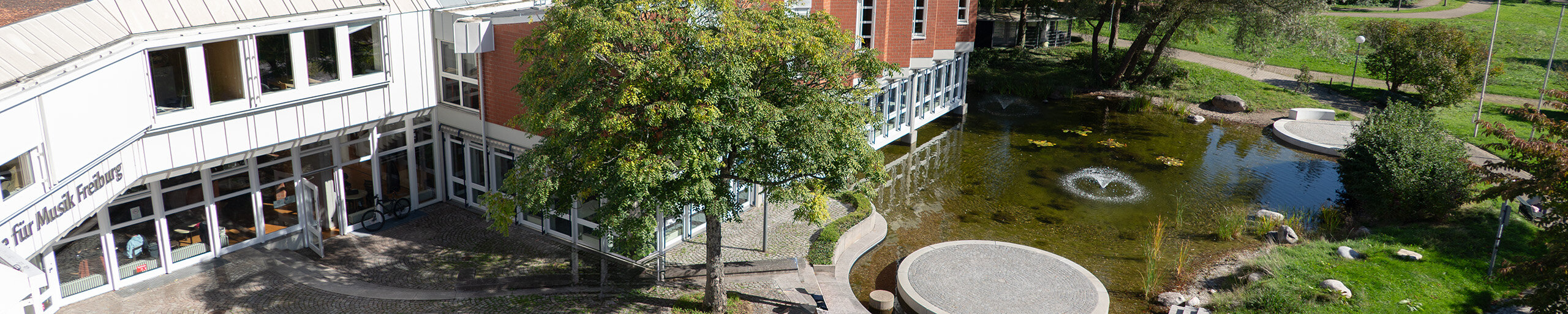
Student life centres on performance: the university presents about 600 concerts, opera productions, solo evenings and master classes a year, and students play in the university orchestra, choir, chamber orchestra, chamber choir, big band, the Freiburger Schlagzeugensemble and other ensembles. The main building stands on a green campus in the east of the city, with the university library and the library of the Institut für Neue Musik in the building and the university library of the Albert-Ludwigs-Universität nearby. Students can use the university sport programme of the Universität Freiburg, and the Studierendenwerk Freiburg-Schwarzwald runs student residences, canteens, BAföG advice and counselling.
International students come from many countries; exchange students are welcomed through Erasmus+ and eight direct partnerships, including the Eastman School of Music in Rochester, the Jacobs School of Music at Indiana University, the University of Toronto and the Sydney Conservatorium of Music. Applicants from non-German-speaking countries must show German language skills.
Bachelor and consecutive Master programmes carry no tuition fee. Every student pays the semester contribution (Semesterbeitrag) of 203 EUR, which is not tuition: 103 EUR to the Studierendenwerk, 80 EUR administration costs and 20 EUR to the student body (AStA). The reduced contribution is 175 EUR for students on leave and 123 EUR for exchange students. Tuition fees apply to the Konzertexamen/Meisterklasse (1,000 EUR per semester), international students in Bachelor and Master programmes (1,500 EUR, charged in addition to the semester contribution), a second degree (650 EUR), non-consecutive Master study (500 EUR per started semester according to the Master Musik information) and the continuing-education Master (700 EUR per semester); the pre-college FAB costs 750 EUR per semester. Students enrolled under state, federal or international agreements, or university agreements guaranteeing fee waiver, are exempt, and a statute on exemption from the international student fee under the Landeshochschulgebührengesetz (§ 6 paras 4 and 5) applies. Instalments, deferral or remission can be applied for.
Students of the Freiburger Opernstudio receive a university scholarship equal to the tuition fees, so that no fees are charged, and a monthly grant of 1,300 EUR from the TheaterFreunde Freiburg for 24 months (from 1 September 2026). Information on which voice types are advertised follows in early December 2026.
The university takes part in the Deutschlandstipendium and other scholarship programmes; applications and information go through Jacqueline Pfann at the International Office. The Gesellschaft zur Förderung der Hochschule für Musik Freiburg, with more than 450 members, supports gifted students and awards its own prizes. See Deutschlandstipendium statute and advice and funding.
Erasmus+ study stays support 490 to 600 EUR per month depending on the host country, with no tuition at the partner institution; students may go abroad from the third Bachelor semester or the first Master semester. Students of direct partner universities coming to Freiburg, and Freiburg students going to them, can be supported by the Baden-Württemberg-STIPENDIUM of about 600 to 1,400 EUR per month; there is no entitlement to funding.
The Studierendenwerk Freiburg-Schwarzwald administers BAföG, job placement, loans and other funding information and runs the canteens and student residences. The semester contribution includes insurance against theft and accidents through the Studierendenwerk and a semester ticket component for the regional transport association.
Deutschlandstipendium at Hochschule für Musik Freiburg →
Browse the scholarships listed for Hochschule für Musik Freiburg and check each award’s eligibility.
View scholarships for Hochschule für Musik Freiburg →Admission to every degree programme is through an artistic aptitude examination (Eignungsprüfung) in the main subject, plus theory and aural training in most programmes, and registration online followed by a paper application sent by post. There is no uni-assist or central allocation route and no Studienkolleg stage for artistic degrees: the application goes directly to the Hochschule für Musik Freiburg.
Registration for the aptitude examination closes on 1 April for the winter semester and on 1 November for the summer semester. For the summer semester 2027, online registration runs from 1 October to 1 November 2026 (23.59) and the application documents must be posted by 2 November 2026 (postmark); the examinations take place from 25 to 30 January 2027, with special dates for orchestral conducting (16, 18 and 19 January 2027) and Master Kirchenmusik and choral conducting (11 January 2027). First-year entry to the Master Musik main subject Musikpädagogik and to the polyvalent two-subject Bachelor for teaching music at Gymnasien is only in the winter semester. No aptitude examination is held for Master Musik Ensemblegesang or for saxophone.
Applicants need the general higher education entrance qualification (Abitur) or equivalent, in certified copy; foreign-language certificates need a certified German or English translation. Applicants without the entrance qualification may sit an additional general knowledge test (Nachweis der Allgemeinbildung) if artistically gifted. Other documents are the completed application form with photo, a full CV, proof of payment of the 50 EUR application fee, and certified copies of any university certificates and transcripts. Minors need a parental consent form.
Applicants from non-German-speaking countries must show German language skills: DSH-1, TestDaF level 3 (TDN 3), the German part of the Studienkolleg Feststellungsprüfung or DSD II, or alternatively CEFR B1 for most programmes, B2 for Bachelor and Master Musik in music theory, musicology and music education and the programmes at the FZM, and C1 for the teacher-training programmes (Lehramt an Gymnasien), which must be shown at the aptitude examination. Bachelor students may be admitted on condition that the proof is supplied by the end of the second semester, and particularly gifted applicants may be admitted if they attend the university's German course for musicians during the first two semesters. Konzertexamen/Meisterklasse applicants may instead prove sufficient English. Master main subjects Orgel - Interprétation à l'orgue and Orgelimprovisation - Improvisation à l'orgue also require French level B1 for applicants from non-French-speaking countries.
Admission requires a completed music-related Bachelor of 240 ECTS from a German music university, a German university with doctoral rights or a comparable institution in Germany or abroad, together with the aptitude examination. Applicants with fewer than 240 ECTS may be admitted if they show the required competence in the examination. Master Kirchenmusik requires a completed Bachelor Kirchenmusik. The non-consecutive Master routes are Elementare Musikpädagogik, Ensemblegesang, Filmmusik, Gehörbildung, Historische Aufführungspraxis, Kunstlied, Musik und Bewegung/Rhythmik and Musiktheorie. The two organ main subjects with Strasbourg also require a separate application to the Université de Strasbourg through the Mon Master portal.
This four-semester postgraduate artistic programme requires a completed Master or equivalent and is assessed in two examination rounds. The Freiburger Opernstudio, run with the Theater Freiburg, is a focus within the programme for outstanding singers with a Master; in exceptional cases a Bachelor graduate may be admitted.
The Dr. phil. in musicology and music education requires a Master, Magister, Diplom or First State Examination in a music-related subject from an institution with doctoral rights, and a supervisor (Betreuer) from the university who accepts the project; the application for acceptance goes to the Promotionsausschuss at least two weeks before its meeting (25 November 2026 and 27 January 2027 in winter semester 2026/27) under the Promotionsordnung. The artistic-scientific doctorate adds an artistic performance and an admission procedure in the artistic subject. Structured PhD programmes in artistic research are run through the Collège Glarean with the Université de Strasbourg and HEAR, and through binational graduate schools with the Hochschule der Künste Bern and the Hochschule Luzern - Musik, whose own admission procedures come first.
After passing the examination and being allocated a place, applicants enrol with the printed application, proof of German statutory health insurance reporting (Meldegrund 10; students from EU countries present an EHIC through a German statutory insurer), and payment of the enrolment fee of 213 EUR (203 EUR semester contribution plus 10 EUR deposit for the student card), plus tuition where applicable. Non-EU students need a residence permit permitting study, applied for at the Ausländerbehörde of the City of Freiburg. Pre-college (FAB) applicants are admitted from age 12 with a school certificate.
Erasmus students apply through the EASY-MO platform (winter semester 1 February to 1 April; summer semester 1 October to 1 November from summer semester 2027) with photo, CV, motivation letter and application videos of three works from different periods (about 15 to 20 minutes in total). Students of direct partner institutions apply through their home university's international office by 1 April or 1 November.
The university is based in Freiburg im Breisgau.
Student services include instrument lockers in the foyer, the MH-Card for printing and canteen payments, a student football team and WLAN via MHS and eduroam. Student housing is provided through the Studierendenwerk Freiburg-Schwarzwald, which operates residences and a room and flat exchange.
Study programmes offered at Hochschule für Musik Freiburg.
Experiences shared by students of Hochschule für Musik Freiburg.
Studied here? Share your experience to help other applicants.

Book a free consultation with our expert counsellors and take the first step towards your dream university.
Copyrights © 2026 StudyMapped. All rights reserved.

Enter your credentials to continue.
Join us and start your study abroad journey.


