

University in Germany
Weimar, Thüringen, Germany
University profile
The Hochschule für Musik FRANZ LISZT Weimar is a state music university in Weimar, Thuringia, named after Franz Liszt since 1956. It describes itself as an international university-level institution for training and research, rooted in the European musical tradition and based in the cultural city of Weimar. Its teaching rests on three pillars: musical practice, pedagogy and scholarship.
Teaching is organised in three faculties (Fakultät I to III) and ten institutes:
The Zentrum für Musiktheorie, the Franz-Liszt-Zentrum and the Hochbegabtenzentrum (Musikgymnasium Schloss Belvedere) complete the structure.
Degrees offered are Bachelor of Music, Bachelor of Arts, Bachelor of Education, Master of Music, Master of Arts, Master of Education, the Erste Staatsprüfung für das Lehramt, Diplom Kirchenmusik A, the postgraduate artistic Konzertexamen and the doctorate. The Thüringer Opernstudio is a postgraduate course for young singers run with several Thuringian theatres, and a paid Weiterbildendes Studium and guest student status (Gasthörerschaft) are also available. Master of Music students can choose profiles such as orchestral music, chamber music, historical performance practice, new music, instrumental pedagogy, elementary music education/rhythmics, musicology and cultural management.
Performance is part of the curriculum: the university holds more than 300 concerts and performances a year, the Weimar Master Classes for more than 60 years, and four international competitions for piano, violin and chamber music. The Institut für Musikwissenschaft, with nine professorships, is the largest of its kind in Germany according to the university, and teaching is linked with the Bauhaus-Universität Weimar (shared studio for electroacoustic music, Digital Bauhaus Orchestra, Hochschulchor and Collegium Musicum) and the Friedrich-Schiller-Universität Jena (second school subject for teacher training and a supplementary subject for the Bachelor of Arts). Students attend performances at the Deutsches Nationaltheater Weimar through a semester ticket.
Student life includes the Hochschulchor, Hochschulorchester, Kammerchor, jazz and big-band ensembles and a Studierendenrat. Students use the language centre and the sports centre of the Bauhaus-Universität Weimar, and a buddy programme, health and counselling services and a flexible childcare scheme (Bauhäuschen) are offered. Housing is available in halls of the Thüringer Studierendenwerk, shared flats and private rentals. The International Office supports international students, exchange (Erasmus+, PROMOS) and a network of more than 100 partner universities. The university is system-accredited.
The semester contribution (Semesterbeitrag, not tuition) for the winter semester 2026/27 is 341.30 euros: 95.00 euros for the Studierendenwerk, 226.80 euros for the Deutschlandsemesterticket and 19.50 euros for the Studierendenrat (including the DNT ticket and Klassik Stiftung). Students who exceed the standard period of study by more than four semesters pay a long-term study fee of 500 euros per semester. The Weiterbildendes Studium is fee-based, and guest student status costs 50 euros per semester (25 euros for pensioners).
The university awards Deutschlandstipendien each winter semester: 300 euros per month, normally for two semesters (October to September), awarded irrespective of income and not offset against BAföG. Eligible are students in a first degree or first Master within the standard period of study. Selection looks at entrance-audition results or study results, competition prizes and master classes, and social, political or voluntary commitment and personal circumstances. Details: Stipendien und Förderprogramme.
The foundation funds artistic projects of outstanding musicians, with attention to financial need, including fees, travel, accommodation, instrument hire and accompanist costs for competitions, master classes and concerts; instrument purchase and repairs are not funded. Applicants must study at the university or the Musikgymnasium Schloss Belvedere, be at least 12 and normally no older than 27, and show good artistic achievement. Decisions are made quarterly (by 30 March, 30 June, 30 September and 30 December). Foerderprogramme.
The Studierendenrat funds student-organised concerts, exhibitions, workshops and trips. Werkstatt MUSIK:FORSCHUNG awards up to 4,000 euros per project to teachers and Master/Konzertexamen students of Faculty III (applications by 31 October 2026). The International Office offers STIBET support for international students and Erasmus+ and PROMOS for stays abroad. BAföG and student jobs are advised through the Studierendenwerk Thüringen. Students pay half the fees for the Weimar Master Classes.
Deutschlandstipendium (Germany Scholarship) at Hochschule für Musik FRANZ LISZT Weimar →
STIBET I Scholarship for International Students (DAAD funds) →
Charlotte Krupp Scholarship (Neue Liszt Stiftung) →
Browse the scholarships listed for Hochschule für Musik Franz Liszt Weimar and check each award’s eligibility.
View scholarships for Hochschule für Musik Franz Liszt Weimar →The general higher education entrance qualification (allgemeine Hochschulreife, e.g. Abitur) is normally required; for teacher training in music at Gymnasien and for Musikwissenschaft it is required. In the other courses it can be waived for exceptional artistic talent. Every artistic and pedagogical applicant must pass an entrance audition (Eignungsprüfung) under the university's audition regulations; Bachelor of Arts Musikwissenschaft, the supplementary subject Interkulturelles Musik- und Veranstaltungsmanagement, and the Master of Arts in Musikwissenschaft and Kulturmanagement have no audition. Applications are made through the online application portal of the university, for both summer and winter semesters.
Application documents: application form, tabular CV, audition programme and scores for the main subject, proof of the entrance qualification (or a declaration that it will be obtained before the start), proof of a completed degree for postgraduate study, parental consent for applicants under 18, and proof of payment of the audition fee. The audition fee is 50 euros for artistic degrees (B.Mus., M.Mus., Konzertexamen, Weiterbildendes Studium), pedagogical degrees and the Musikpraxis profiles. Foreign qualifications must be submitted as certified copies in German or English.
Auditions for most instruments are held in Weimar over one or two consecutive days; a first round by video upload applies in many subjects (for example strings, flute, oboe, clarinet, trombone, percussion, voice, piano, jazz, early music, organ and church music), while composition begins with submitted scores. Videos run 10 to 15 minutes, include a personal introduction and may not exceed 1.5 GB. Artistic auditions last 20 to 30 minutes before a commission of at least three examiners; the music theory written test lasts 45 minutes. A piano minor-subject test is also taken in Bachelor auditions. Three works of different style periods are performed in the main-subject test.
For the summer semester 2027: artistic degrees (B.Mus., M.Mus.) and Lehramt Musik 1 October to 2 November 2026; Musikwissenschaft, Kulturmanagement and Interkulturelles Musik- und Veranstaltungsmanagement 1 October 2026 to 15 January 2027. For the winter semester 2027/28: artistic degrees and Lehramt Musik 15 February to 15 March 2027; Kulturmanagement, Musikwissenschaft and the management supplementary subject 15 February to 30 June 2027. Auditions for the winter semester 2027/28 take place from 28 May to 3 June 2027. For the summer semester 2027 several subjects are not open to applications, among them accordion, early music instruments, choral and orchestral conducting, opera coaching, voice, guitar, horn, trumpet, trombone, tuba, piano, instrumental composition, Konzertexamen and music theory.
German proof is needed at the latest at enrolment. For artistic and instrumental pedagogy degrees: TestDaF level 3, DSH 1, Goethe-Institut B2 or telc B2. For academic and teacher-training degrees (Musikwissenschaft, Kulturmanagement, Lehramt): TestDaF level 4, DSH 2, Goethe-Institut C1 or telc C1. Doctoral candidates need sufficient German and the foreign languages relevant to their field. Language certificates must be original or certified copies.
Postgraduate study requires a completed degree (or a declaration that it will be completed before the start); the artistic postgraduate Aufbaustudium additionally requires the degree in the subject chosen as the main subject, and a teacher-training degree is not sufficient. The Konzertexamen applicant brings their own accompanist. The Ph.D. programme for artists, run with the Bauhaus-Universität Weimar, lasts four years, requires a Master or Diplom from an artistic or design university, a mentor from the Bauhaus-Universität Weimar, and a prior contact with a professor with a short motivation letter and research summary; applications go through the Bauhaus.CampusPortal.
Applicants from outside the EU need a student visa from the German embassy in their home country.
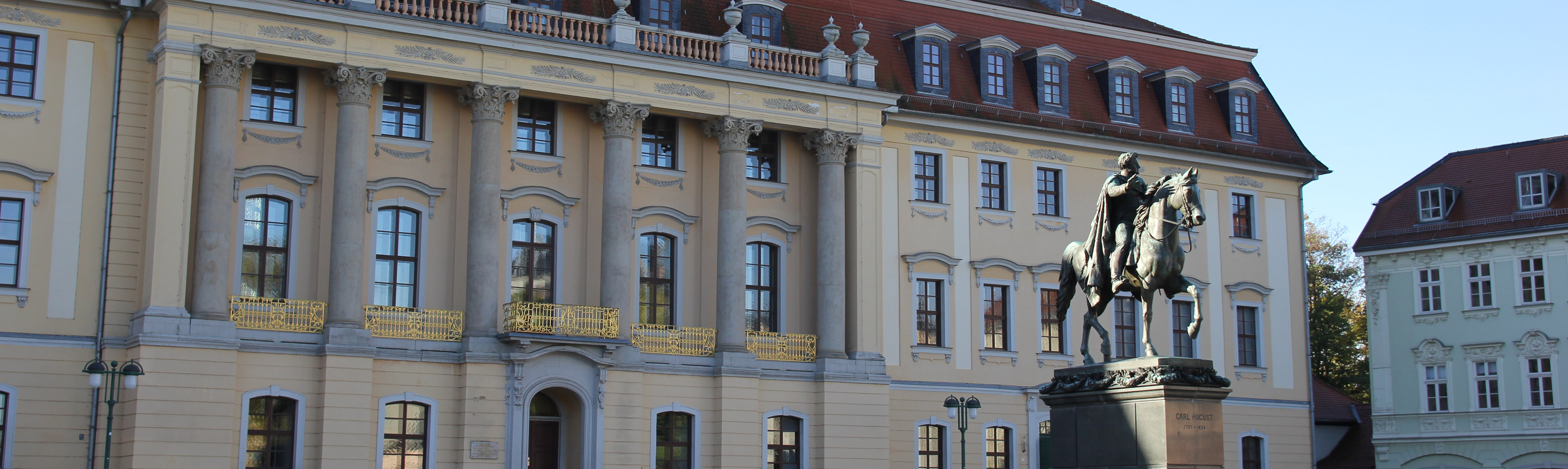
The university is spread across several historic sites in and near Weimar.
The library, at two locations, holds about 75,000 scores, about 50,000 books and journals, about 15,000 CDs, DVDs and other media and about 11,000 records, with e-journals, e-books and databases, and lends iPads and recording equipment. A sports programme is open through the Bauhaus-Universität Weimar sports centre.
Study programmes offered at Hochschule für Musik Franz Liszt Weimar.
Experiences shared by students of Hochschule für Musik Franz Liszt Weimar.
Studied here? Share your experience to help other applicants.

Book a free consultation with our expert counsellors and take the first step towards your dream university.
Copyrights © 2026 StudyMapped. All rights reserved.

Enter your credentials to continue.
Join us and start your study abroad journey.


