

University in Germany
Dresden, Sachsen, Germany
University profile
The Hochschule für Bildende Künste Dresden (HfBK Dresden) is an autonomous art academy with university status in the Saxon capital. It was founded in 1764 as the Haupt-Kunst-Akademie and is among the oldest institutions for fine art education in Europe. Its teaching combines fine art, artistic craftsmanship, the preservation of cultural heritage and theatre-related design, and it holds the right to award doctorates in its scientific disciplines.
About 550 students are enrolled across the Diplom programmes Bildende Kunst, Kunsttechnologie, Konservierung und Restaurierung von Kunst- und Kulturgut, Bühnen- und Kostümbild and Theaterdesign, and the postgraduate programme KunstTherapie. Around 120 staff work at the academy, alongside student, artistic and scientific assistants and visiting lecturers. Courses in art history, philosophy and aesthetics, architecture and spatial design, applied theatre studies and artistic anatomy complement the studio work.
The academy is organised in two faculties. Fakultät I covers Bildende Kunst, taught in 13 classes led by artist-professors. Fakultät II covers Restaurierung (with three specialist classes: wall painting and architectural colour, painting on mobile supports, and sculpture and interior furnishings), Bühnen- und Kostümbild, Theaterdesign (Kostümdesign, Maskenbild, Szenische Malerei and Theaterplastik) and the postgraduate KunstTherapie. Master-student (Meisterschüler) study is open to graduates in Bildende Kunst, Bühnen- und Kostümbild and Theaterdesign.
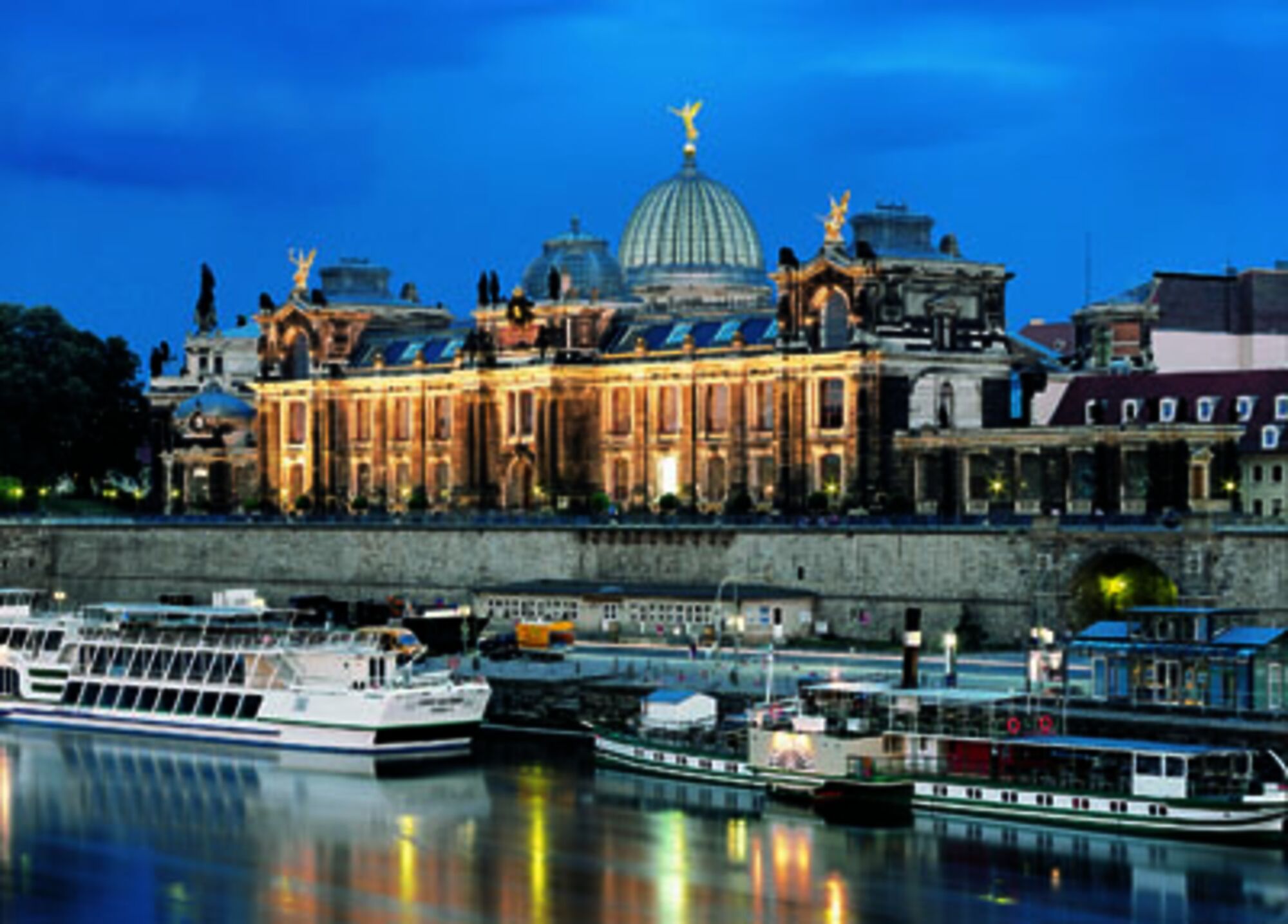
Studios and workshops are spread over sites in central Dresden, including the 1894 academy building on the Brühlsche Terrasse with the Oktogon exhibition hall, the sculpture site on Pfotenhauerstraße and the Güntzstraße building with the library, lecture halls and administration. The academy has 23 laboratories and workshops, a laboratory theatre, three galleries and central facilities including the archive and custodianship with the historic anatomy collection, the library with mediathek, the career service and the IT centre. Lunch is served at the Mensa Brühl, run by the Studentenwerk Dresden, beside the academy building, and the student-run Café OHA is on campus.
International students apply on largely the same terms as German applicants, with proof of a school-leaving qualification equivalent to the German Hochschulzugangsberechtigung and German language skills. The academy takes part in the Erasmus+ programme (Erasmus code D DRESDEN04), belongs to the EU4ART alliance with art academies in Budapest, Riga and Rome, and has an International Office. Study can begin only in the winter semester.
The academy charges no tuition fee for its Diplom programmes. Enrolled students pay the semester contribution (Semesterbeitrag), which is not tuition and whose amount is shown at enrolment. Guest auditors pay EUR 50 per semester under the fee and charges regulations of 15 January 2025.
The academy awards 12 Deutschlandstipendien across both faculties for particularly gifted students. Two are reserved for Meisterschüler of Fakultät I as Hegenbarth scholarships, which also include an exhibition in the project space Neue Galerie of the Städtische Galerie Dresden. Selection considers talent and achievement as well as commitment, personal background, educational background, social and family circumstances or need. Awards follow the Stipendienprogrammgesetz and the academy's own regulation. Scholarships are funded by supporters such as the Dresdner Stiftung Kunst und Kultur der Ostsächsischen Sparkasse Dresden, the Staatliche Kunstsammlungen Dresden ("The Artist's Advocat") and the Gerd-Jaeger-Stipendium. Deutschlandstipendium
Two scholarships of EUR 3,600 each are awarded annually for outstanding artistic achievement in Meisterschüler study, paid in 12 monthly instalments of EUR 300. Hegenbarth Stipendium
The Sammelstiftungen des Bezirkes Dresden and the academy award the Robert-Sterl-Preis of EUR 3,000 annually to a Meisterschüler. Robert-Sterl-Preis
Using funds of the DAAD STIBET programme, the academy awards each year the DAAD Prize of EUR 1,000 for outstanding achievement by an international student, for students in at least their second year of the Diplom (or second Meisterschüler semester) or doctoral candidates who combine strong results with social or intercultural engagement; the jury decides from applications submitted in the summer semester. STIBET scholarships go to international students and doctoral candidates in three forms: final-degree scholarships for those expected to complete within a year or in unforeseen hardship, scholarships for particularly engaged students, and a scholarship for greater equity of opportunity for refugees, students with disabilities or chronic illness, or students with care responsibilities. Current calls are published in the download area. DAAD funding
The Meisterschüler application page refers to the Landesgraduiertenstipendium of the Free State of Saxony. The academy's page on external funding links to arbeiterkind.de, the Begabtenförderungswerke, the DAAD scholarship database and the Kulturstiftung des Freistaats Sachsen. State student finance (BAföG) is administered by the Studentenwerk Dresden. The Freundeskreis of the academy also supports class and individual projects, a Diplompreis and a Jahrespreis of Fakultät II. External funding
DAAD Prize for Outstanding International Students (DAAD-Preis), HfBK Dresden →
Deutschlandstipendium at HfBK Dresden →
Hegenbarth Scholarship (Deutschlandstipendium programme), HfBK Dresden →
Robert Sterl Prize for Meisterschueler, HfBK Dresden →
Browse the scholarships listed for Hochschule für Bildende Künste Dresden and check each award’s eligibility.
View scholarships for Hochschule für Bildende Künste Dresden →Admission to the Diplom programmes Bildende Kunst, Restaurierung, Bühnen- und Kostümbild and Theaterdesign requires the general higher education entrance qualification (Allgemeine Hochschulreife) or, for Bildende Kunst and Bühnen- und Kostümbild, proof of exceptionally high artistic talent, plus a passed aptitude test (Eignungsprüfung). For Bildende Kunst the minimum school qualification is the Mittlere Reife. Restaurierung additionally requires a ten-month preparatory internship, which must be completed by enrolment. Study starts in the winter semester only. Places are allocated according to the number of vacancies.
Applications are made online through the academy's application portal, with a portfolio of own work uploaded as a single PDF of up to 30 MB. Bildende Kunst asks for 25 to 30 works, Restaurierung for 15 works plus an internship report of 5 to 10 pages. A CV, a list of the submitted works with dimensions and materials, a signed declaration that the works are the applicant's own, and certificates are also required. Originals and certified documents are sent by post after admission. The portfolio is assessed in a pre-selection, after which the aptitude test takes place on site (for Bildende Kunst a practical task of 5 to 10 hours and an interview of 10 to 60 minutes). A passed result remains valid for the following winter semester and the winter semester after that.
Application periods: Bildende Kunst 1 November to 15 January (the 2026 round closed on 15 March; the 15 January deadline applies from 2027); Theaterdesign (Maskenbild, Theaterplastik, Kostümdesign) 15 November to 15 January; Theaterdesign Szenische Malerei 1 January to 15 March; Restaurierung 1 December to 31 January; Bühnen- und Kostümbild 1 December to 1 March. The deadlines are final. Fakultät I and II aptitude tests take place between February and June.
International applicants must show a qualification equivalent to the German Hochschulzugangsberechtigung, which can be checked in the anabin database. Country-specific rules apply: an APS certificate is required for China, India, Mongolia and Vietnam, documents for Georgia need an apostille, and documents for Iran need copies certified by the German embassy in Tehran. Foreign certificates are submitted in German or English, otherwise with an officially certified translation, and originals or certified copies are needed. The academy advises allowing at least one year from first enquiry to the start of study.
For the Diplom programmes, German at level B2 (TestDaF, DSH or Goethe certificate) is required for study in full at the academy. For Meisterschüler study, German or English at B2 is required. For the postgraduate KunstTherapie programme, German at level C1 is required: TestDaF with TDN 4 in all four parts, DSH-2, DSD II, telc Deutsch C1 Hochschule, the Goethe-Zertifikat C2 (GDS) or the Deutsche Sprachprüfung II of the Sprachen- und Dolmetscherinstitut München.
Meisterschülerstudium (four semesters, after the Diplom): Bildende Kunst requires a Diplom, consecutive Master or equivalent in art graded very good (270 ECTS), or a three-year art degree graded very good with several years of artistic practice, a written description of the planned artistic project and the written consent of a professor as mentor. Applicants without a graded degree submit a portfolio of at least ten works. Bühnen- und Kostümbild requires a first degree graded at least good with at least 300 ECTS or nine semesters; Theaterdesign requires a first degree graded very good with at least 240 ECTS or eight semesters. The application period for the winter semester is 1 June to 1 July; Meisterschüler Bildende Kunst can also start in the summer semester (1 November to 15 December).
Aufbaustudiengang KunstTherapie (four semesters, Diplom): requires a university entrance qualification, a completed artistic degree or another degree with artistic orientation, a three to six week placement in an art therapy or related field, a one-page motivation letter and a portfolio.
Doctorates are possible in Kunsttechnologie, Konservierung und Restaurierung, KunstTherapie, Philosophie/Ästhetik and Kunstgeschichte under the academy's Promotionsordnungen. Doctoral applicants are enrolled by submitting the application for enrolment, the application form for doctoral study and confirmation of admission to the list of doctoral candidates to the Referat für Studienangelegenheiten within the re-registration period.
Applicants are advised to check entry rules in good time, both for the aptitude test and for the start of study, through the German Federal Foreign Office. Guest auditors (Gasthörer) pay EUR 50 per semester and apply by 15 July for the winter semester or 15 January for the summer semester; guest students enrolled elsewhere pay the regular semester contribution (Semesterbeitrag).
Facilities include 23 workshops and laboratories (lithography, screen printing, etching and woodcut, typography, book and paper workshop, photography, digital media lab, 3D lab, video studio, sound studio, ceramics, bronze and metal casting, metalworking, woodworking, plastics, laser cutting, textile dyeing, plaster, gilding), the laboratory theatre with up to 200 audience places, the library at Güntzstraße 34 (open Monday to Thursday 10:00 to 18:00 and Friday 10:00 to 12:30 during semester, with catalogue access shared with SLUB Dresden and other collections, JSTOR and Prometheus), and the Mensa Brühl with 90 seats. Student health, counselling, sport and housing services are provided through the Studentenwerk Dresden and the Dresdner Hochschulsportzentrum.
Study programmes offered at Hochschule für Bildende Künste Dresden.
Experiences shared by students of Hochschule für Bildende Künste Dresden.
Studied here? Share your experience to help other applicants.

Book a free consultation with our expert counsellors and take the first step towards your dream university.
Copyrights © 2026 StudyMapped. All rights reserved.

Enter your credentials to continue.
Join us and start your study abroad journey.


