
University in Germany
Hamburg, Hamburg, Germany
University profile
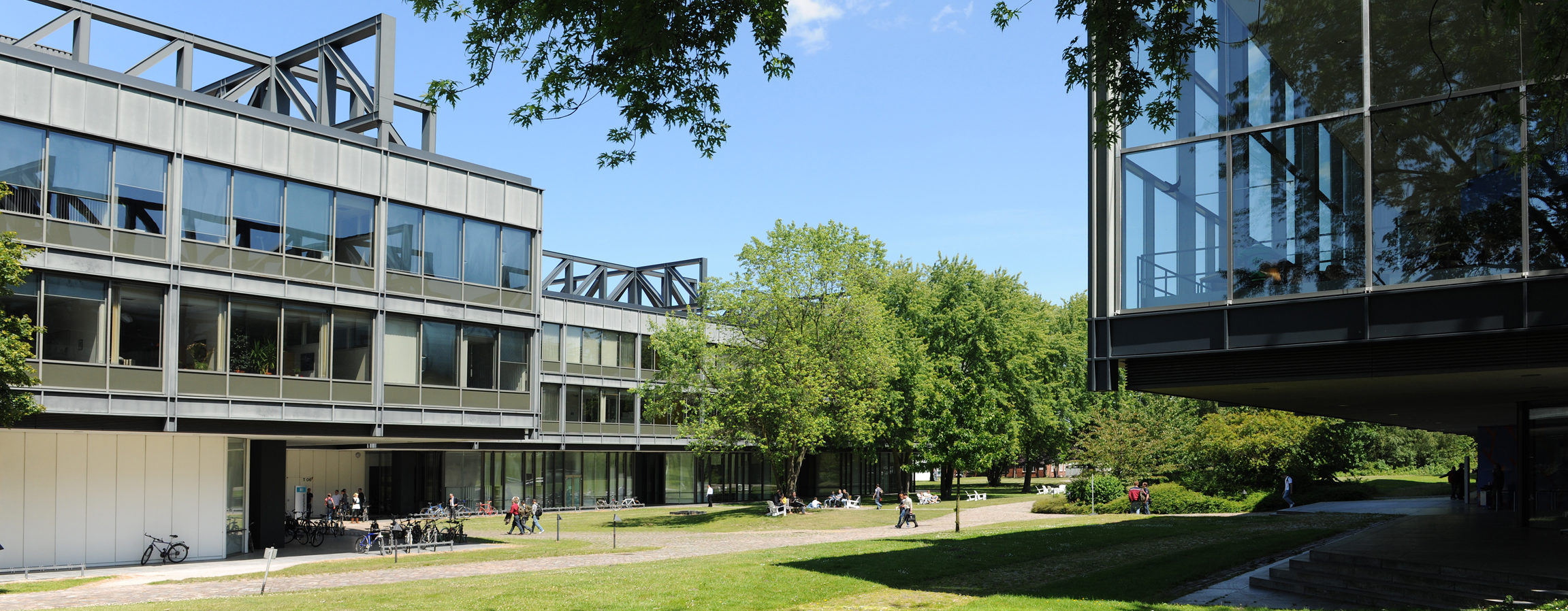
Helmut Schmidt University / University of the Bundeswehr Hamburg (HSU/UniBw H) is a state-recognised campus university in the Jenfeld and Wandsbek area of Hamburg. It is one of two universities of the German Armed Forces, the other being in Munich, and exists primarily for the university education of the Bundeswehr officer corps. Its degrees are equivalent to those of the civilian universities, and it is organised in tasks, structure and rights according to Hamburg higher education law, with research and teaching free and academic affairs managed by the university itself.
Teaching is organised in four faculties: Electrical Engineering; Mechanical and Civil Engineering; Humanities and Social Sciences (GeiSo); and Economics and Social Sciences (WiSo). WiSo, the largest, has six subject groups (Business Administration, Economics, Political Science, Public Administration, Mathematics/Statistics and Law), 45 professorships and more than 1,000 students; GeiSo has nine subject groups, 32 professorships and about 750 students. Altogether the university has around 2,500 students and more than 900 employees, with roughly 100 professors and 300 research staff.
The academic year is divided into three twelve-week trimesters followed by one lecture-free period from July to September. All programmes are intensive: a Bachelor's degree takes seven trimesters and a Master's a further five, so a Master's is reached in four years, with up to 75 ECTS credits per academic year. Most classes have no more than 25 participants. Every student also takes compulsory Interdisciplinary Study Units (ISA), foreign-language training and work-experience placements. All programmes are accredited, and the portfolio comprises 13 Bachelor's and 20 specialised Master's programmes, with the Master's degree as the standard degree for students of the Bundeswehr universities.
Central institutions include the Library, Centre for Interdisciplinary Courses, Media Engineering Centre, Computing Centre, Sports Centre, Language Centre, Central Workshop, the Center for Technology Based Education and Training (ZtB) and the Centre for Postgraduate Education (ZWW). Student life is concentrated on the campus: lecture halls, laboratories, library, canteen (Mensa), cafe, swimming pool, sports facilities, gym, doctors, an OpenLab with public 3D printing, and Protestant and Catholic parishes are all within walking distance. Student groups include the Eleven-O-Six Racing Team and a theatre workshop, and the student body is represented by the Studentischer Konvent.
Admission is not open in the usual way. Officer candidates are selected by the Bundeswehr, and civilians can study only when sent by a cooperation partner such as a ministry, agency or company, or as departing soldiers funded through the Berufsförderungsdienst (BFD). Self-paying enrolment is not possible. International students come mainly as exchange students from partner universities (Erasmus+ and bilateral agreements), with more than 50 partner universities; the International Office and the Welcome Office look after incoming students and guest researchers, and the university holds an Erasmus Charter for 2021 to 2027.
The university does not enrol self-paying students. Students who are officer candidates or officers receive their salary, depending on age, rank and family status, during their studies. For civilian students, partial tuition fees are charged and are covered by the sending cooperation partner (Industriestipendium); fees for the whole programme are, for engineering, 23,962.50 euros (Bachelor's) and 18,637.50 euros (Master's); for humanities 20,587.50 euros and 16,012.50 euros; and for law, economics and social sciences 30,825.00 euros and 23,975.00 euros. Departing soldiers funded by the BFD pay a reduced 1,250 euros per trimester, totalling 8,750 euros for a Bachelor's and 6,250 euros for a Master's.
The Federal Waterways and Shipping Administration (WSV) offers 18 scholarships per year in Civil Engineering (Bachelor's and Master's), covering costs and paying a study allowance. In cooperation with the Federal Office for Personnel Management of the Bundeswehr, 50 places per year in Law for Public Administration (LL.B.) go to civilian applicants, who receive 1,625 euros per month with all fees covered. Applications go directly to the partner. Information: https://www.hsu-hh.de/hsm/ziviles-studium/foerderung
Researchers may apply for a Böttcher Congress Grant for international conferences after a DAAD application has been refused, and may invite visiting scholars for several months through the president's office. Exchange students pay room rents of 260 to 300 euros per month in university residences. The Cactus Starfighter Squadron Scholarship funds study at Arizona State University for HSU students.
WSV Stipendium Bauingenieurwesen (B.Sc./M.Sc.) at Helmut Schmidt University →
Browse the scholarships listed for Helmut Schmidt University / University of the Bundeswehr Hamburg and check each award’s eligibility.
View scholarships for Helmut Schmidt University / University of the Bundeswehr Hamburg →The university serves the officer corps of the Bundeswehr first. Officer candidates apply to the Bundeswehr, not to the university: selection is run by the Federal Office for Personnel Management of the Bundeswehr at the Assessment Centre for Executives of the Bundeswehr in Cologne, which tests suitability for the officer career and for study. Admission to the officer programmes requires the general higher education entrance qualification (Abitur), the passed officer examination and a 13-year commitment as a temporary-career soldier in the officer career.
Civilians can study within free capacity in two ways: by being sent by a cooperation partner (ministries, agencies, or companies close to the Bundeswehr), or as departing soldiers funded by the Berufsförderungsdienst. Self-paying enrolment is not possible. Cooperation students are applied for by their sending organisation. For BFD applicants there is no formal deadline, although applications should reach the university at least four months before the start; Bachelor's programmes start on 1 October and Master's programmes on 1 January. The application contains a cover letter with motivation, a CV, proof of the higher education entrance qualification under sections 37 or 38 of the Hamburg Higher Education Act (for example the Abitur certificate) for a Bachelor's, a relevant Bachelor's degree with a grade of at least 'good' (2.5) or the transcript of records for a Master's, and a copy of the BFD entitlement notice.
A Master's programme requires a relevant Bachelor's degree with an overall grade of at least 'good' (2.5 or better), as set out in the general examination regulations, and the subject-specific regulations may add further conditions such as pre-placements. Students of the HSU Bachelor's programmes continue to the Master's if they complete 180 credits by the seventh (at the latest eighth) trimester; in the Engineering Science programme a Bachelor's grade of 3.0 or better by the eighth trimester gives access, and a grade up to 3.4 gives access after an additional qualification interview.
Most programmes are taught in German. Digital Governance and Administration (M.A.), Engineering Science (B.Sc.) and Engineering Science: Defence Systems (M.Sc.) are taught entirely in English; Engineering Science requires English at standardised language profile SLP 3332.
Exchange students must be nominated by an Erasmus+ partner university or a bilateral partner; free movers and independent exchange applications are not accepted. Study mobility lasts one to three trimesters. Nomination deadlines are 31 May for the fall trimester, 1 October for the winter trimester and 15 January for the spring trimester; internship mobility has no fixed deadline, but nomination is requested at least eight weeks before the start. Documents (German or English): proof of enrolment, transcript of records, biometric photo, German language certificate at B1/B2 level, arrival/departure sheet, passport or EU ID copy, proof of health insurance, enrolment application and housing application. Students staying more than 90 days must register their address in Hamburg within 14 days of arrival.
Doctorates and habilitations are awarded by the faculties under their own regulations (Promotionsordnung and Habilitationsordnung); the faculty council decides on admission to the doctorate and acceptance of doctoral candidates.
Residences are run by the student battalion, with about 15 students per floor sharing a living area, shower area and fully equipped kitchen. Room rents for exchange students are between 260 and 300 euros per month. Protestant and Catholic chaplaincies, doctors and a psychological counselling centre for students are on or near campus.
Study programmes offered at Helmut Schmidt University / University of the Bundeswehr Hamburg.
Experiences shared by students of Helmut Schmidt University / University of the Bundeswehr Hamburg.
Studied here? Share your experience to help other applicants.

Book a free consultation with our expert counsellors and take the first step towards your dream university.
Copyrights © 2026 StudyMapped. All rights reserved.

Enter your credentials to continue.
Join us and start your study abroad journey.


