

University in Germany
Hamburg, Hamburg, Germany
University profile
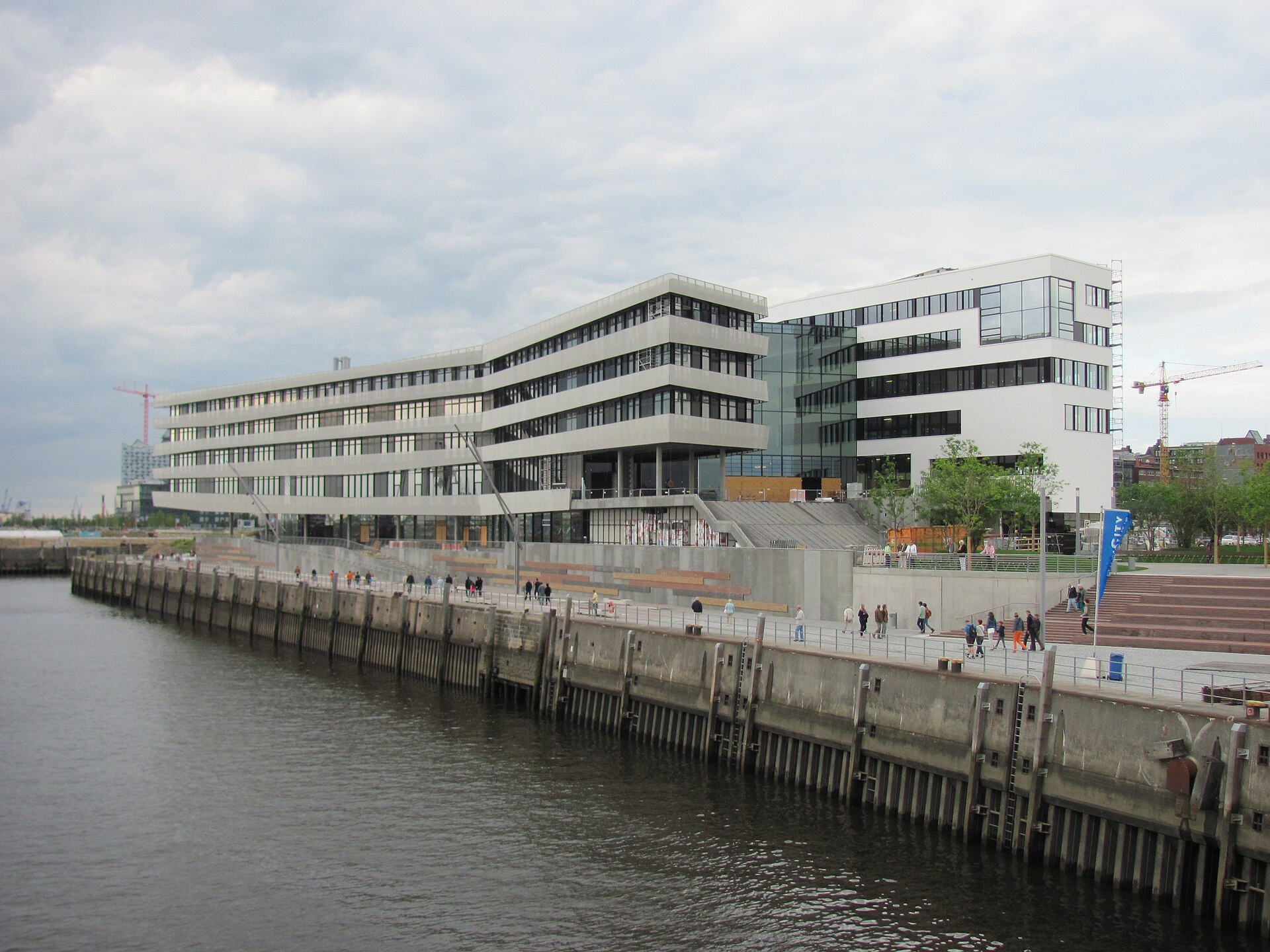
HafenCity Universität Hamburg (HCU), formally the University for Built Environment and Metropolitan Development (Universität für Baukunst und Metropolenentwicklung), is a public university in Hamburg focused entirely on the built environment. It brings design and architecture, engineering and natural sciences, and the humanities and social sciences under one roof, and its main research themes are climate and sustainability, social justice and digitalisation.
The university stands in the HafenCity district, which it describes as Europe's largest inner-city urban development project and which serves as a city laboratory on its doorstep. The main building is at Henning-Voscherau-Platz 1, with further space in the Campus Tower at Versmannstrasse 4. About 2,500 students study at the HCU, supported by 206 academic staff including professors and 162 non-academic staff.
Teaching is organised in three Fachbereiche: ATR (Architektur, Technische Gebäudeausrüstung mit Digitaler Infrastruktur and Resource Efficiency in Architecture and Planning), BG (Bauingenieurwesen and Geodäsie und Geoinformatik) and SKU (Stadtplanung, Kultur - Digitalisierung - Metropole and Urban Design). Bachelor programmes are Architektur, Bauingenieurwesen, Geodäsie und Geoinformatik, Stadtplanung, Kultur - Digitalisierung - Metropole (B.A.) and Technische Gebäudeausrüstung mit Digitaler Infrastruktur; master programmes are Architektur, Architectural / Infrastructural Engineering, Stadtplanung, Geodäsie und Geoinformatik, Resource Efficiency in Architecture and Planning (REAP) and Urban Design.
A cross-cutting teaching strand, the Fachübergreifende Studienangebote (FaSt), runs across all programmes with about 70 courses, including the [Q] STUDIES studium generale developed with Universität Witten/Herdecke and the Hochschule für Musik und Theater Hamburg. Notable research units include the CityScienceLab (a cooperation with the MIT Media Lab), the BIMLab@HCU and the DFG research training group Urban future-making.
Student life centres on the HafenCity building, which has workshops (CNC and wood), laboratories, a PC pool, student workspaces, a library and a quiet room. Students are represented through the Studierendenparlament (StuPa), the AStA and programme-level Fachschaften. International students can apply through uni-assist, join the orientation week (OE-Woche) and use German language courses. The Studierendenwerk Hamburg and the Stiftung Haus Bauhütte offer housing. Programmes are accredited through programme accreditation, and the Hydrography specialisation in the Geodäsie und Geoinformatik master is certified at Category A of the international Standards of Competence for Hydrographic Surveyors.
The HCU does not charge tuition fees in the programmes described. Every student pays the Semesterbeitrag: 381.00 euros for summer semester 2026 and 399.00 euros for winter semester 2026/27. It consists of the Studierendenwerk social contribution (101.00 euros), student self-administration (20.20 euros), the SemesterTicket (208.80 euros in summer 2026, 226.80 euros in winter 2026/27), the SemesterTicket hardship fund (1.00 euro) and an administrative fee (50.00 euros). Separate administrative fees apply, for example for late re-registration, re-enrolment or a replacement HCU-Card.
The Deutschlandstipendium pays 300 euros a month for twelve months (summer semester to summer semester). It is financed half by the Federal Ministry of Education and Research and half by private donors. All enrolled students may apply; selection looks at excellent study results, voluntary and social engagement and special achievements. Applicants submit a motivation letter, CV and evidence of engagement. Contact: hcu-deutschlandstipendium(at)vw.hcu-hamburg.de. See the official page.
The DAAD STIBET I scholarship rewards international students with outstanding international engagement at the HCU. It is advertised once a year and usually runs for six months at no less than 400 euros a month. Applicants must not hold German citizenship, must have obtained their school qualification abroad, must be enrolled at the HCU, must not receive another scholarship in the funding period and must not be entitled to BAföG. The 2026 deadline was 21 June 2026 and the next call is expected in spring 2027. The Leistungsstipendium of the Free and Hanseatic City of Hamburg supports academically excellent international students: at least two semesters (Bachelor) or one semester (Master) at the HCU, above-average results, no BAföG entitlement; usually six months at no less than 400 euros a month; applications go online through the International Office with CV, enrolment certificate, transcript, a one-page motivation letter, residence permit or ID copy and a professor's reference. The Examensstipendium of the City of Hamburg, handled by the Studierendenwerk Hamburg, helps international students in the final twelve months of study; deadlines are 15 June and 15 December. See the official funding page.
HCU students can receive the WTM Engineers award (2,000 euros for an excellent Master thesis in Bauingenieurwesen / Architectural Engineering), the Preis der Stiftung der Bauindustrie Hamburg (1,000, 800 and 600 euros for the three best Bachelor graduates in Bauingenieurwesen) and grants from the Professor Dr. Egon Peter Stiftung for theses and stays abroad. See Stipendien und Preise.
The Studierendenwerk Hamburg offers more than 4,400 places in 26 residences, and the Stiftung Haus Bauhütte gives preference to HCU students in its hall of residence for building students.
Deutschlandstipendium at HafenCity University Hamburg →
Browse the scholarships listed for HafenCity University Hamburg and check each award’s eligibility.
View scholarships for HafenCity University Hamburg →Entry requires a Hochschulzugangsberechtigung (general, subject-specific or Fachhochschulreife, or admission for vocationally qualified applicants without a school qualification) and proof of participation in the university's online self-assessment (Online-Studienorientierung) for the chosen programme; no online orientation is currently available for Technische Gebäudeausrüstung mit Digitaler Infrastruktur. All Bachelor programmes except Geodäsie und Geoinformatik and Technische Gebäudeausrüstung mit Digitaler Infrastruktur are admission-restricted. Places are allocated by quota: 10% foreign-national quota, 5% hardship, 2% elite athletes and 3% vocationally qualified applicants without a school qualification are set aside first, and the remainder goes 90% by performance and 10% by waiting time. Architektur and Bauingenieurwesen award extra points for a completed relevant vocational training.
Applicants with a school-leaving or first degree qualification obtained outside Germany must also apply through uni-assist (My assist portal) in addition to the HCU's own ahoi portal. Graduates of a German Studienkolleg who passed the Feststellungsprüfung can apply with the T-course (Architektur, Bauingenieurwesen, Geodäsie und Geoinformatik, Stadtplanung, Technische Gebäudeausrüstung mit Digitaler Infrastruktur), the G-course (Kultur - Digitalisierung - Metropole) or the W-course (Stadtplanung), and must submit the uni-assist Vorprüfungsdokumentation. Bachelor applicants register on hochschulstart.de as part of the coordinated procedure.
Applications for the summer semester are not possible for first-semester places. The deadlines are exclusion deadlines and applicants may apply for only one programme.
Required for applicants with a foreign school qualification (Bachelor) or foreign first degree (German-taught Master programmes Architektur, Bauingenieurwesen, Stadtplanung and Geodäsie und Geoinformatik except the Hydrography specialisation). Accepted proofs: DSH at least level 2, TestDaF with at least 15 points (three parts at level 4 and one at level 3), Goethe-Zertifikat C1, telc Deutsch C1 Hochschule, C1 or C2, Deutsches Sprachdiplom der KMK Stufe II, or the Feststellungsprüfung at a Studienkolleg. Certificates may not be older than three years unless a German university study followed.
Required for the English-taught Master programmes REAP, Urban Design and Geodäsie und Geoinformatik (Hydrography). REAP: TOEFL iBT at least 88 (ITP 570), IELTS Academic at least 7, telc at least C1, Cambridge CAE level B or CPE level C. Urban Design and Hydrography: TOEFL iBT at least 88 (ITP 570), IELTS Academic at least 6.0, telc at least B2, Pearson PTE Academic at least 70, or alternative proofs such as one year of full-time study in an English-language programme.
A completed first professional university degree is required. If the degree is not yet complete, a transcript of records showing at least 130 credit points is needed and no more than 15 credit points may remain outstanding at the start. Selection is by performance and motivation under the Besondere Zulassungsordnung of each programme (for example in Master Architektur, a minimum of 35 points from ECTS grade, absolute grade, relevant professional experience and a portfolio of up to 15 A3 pages). All Master programmes except Geodäsie und Geoinformatik are admission-restricted. Applicants upload the documents listed in the programme checklist to the HCU cloud as one PDF (maximum 70 MB) after submitting the ahoi application.
Doctoral candidates apply to the Promotionsausschuss with a supervision commitment (Betreuungszusage), a research proposal (Exposé) and degree certificates, under the Promotionsordnungen. The Referat für Forschung und Internationalisierung supports the process, and candidates can join the Promotionskolleg and the Hamburg Research Academy events.
A study-applicant visa can be requested with the application confirmation (Bewerbungsbestätigung) that the HCU emails after the ahoi application is submitted; it is usually valid for three months. A student visa requires the admission notice and proof of financing. Processing can take two to three months.
The HCU has one campus in the HafenCity district of Hamburg, with two locations:
The university library is a hybrid library with about 80,000 printed volumes (80,269 volumes at 31 December 2025), 119 current printed journals, 26,105 licensed electronic journals and 197,069 e-books; it is also open to citizens of the city and region and runs the repOS publication server. Food and drink are provided by the Studierendenwerk canteen and cafeteria. Access is by underground (U4, station HafenCity Universität) or bus 111 (Shanghaiallee); the main station is a 25-minute walk. The underground car park is not open to students or guests, except disabled students with the mark aG.
Study programmes offered at HafenCity University Hamburg.
Experiences shared by students of HafenCity University Hamburg.
Studied here? Share your experience to help other applicants.

Book a free consultation with our expert counsellors and take the first step towards your dream university.
Copyrights © 2026 StudyMapped. All rights reserved.

Enter your credentials to continue.
Join us and start your study abroad journey.


