
University in Germany
Frankfurt am Main, Hessen, Germany
University profile
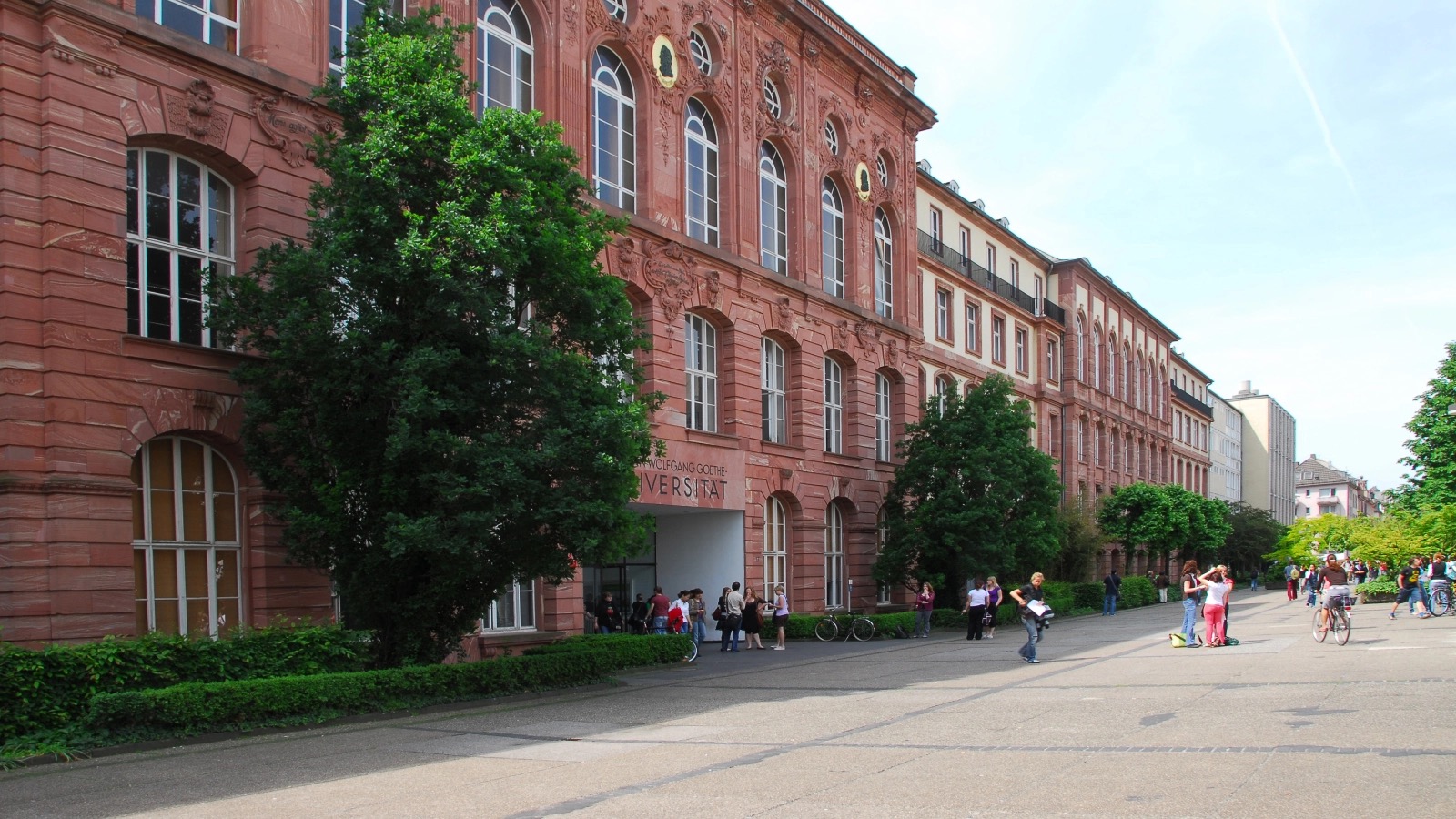
Goethe University Frankfurt (Goethe-Universität Frankfurt am Main) is a large, comprehensive university in the Frankfurt am Main metropolitan area. It was founded in 1914 by and for the citizens of Frankfurt and has been an autonomous foundation university since 2008. It offers 159 study programmes across 16 faculties and is one of the ten largest universities in Germany, with 40,684 students in winter semester 2025/26.
Teaching and research are spread over five campuses: Westend (most disciplines and the central administration), Riedberg (natural sciences), Niederrad (medicine and the University Hospital), Bockenheim (the historic campus) and Ginnheim (sport sciences). The 16 faculties are Law; Economics and Business; Social Sciences; Educational Sciences; Psychology and Sport Sciences; Protestant Theology; Catholic Theology; Philosophy and History; Linguistics, Cultures and Arts; Modern Languages; Geosciences and Geography; Computer Science and Mathematics; Physics; Biochemistry, Chemistry and Pharmacy; Biological Sciences; and Medicine.
Research is organised in six interdisciplinary profile areas, among them Science for Health, Structure and Dynamics of Life, Space, Time and Matter, and Sustainability and Biodiversity. The university leads two Clusters of Excellence, the Cardio-Pulmonary Institute (CPI) and SCALE, and counts 19 Nobel Prize winners and 19 Leibniz Prize recipients since its establishment. Together with TU Darmstadt and the University of Mainz it forms the Rhine-Main Universities (RMU) alliance, and it is a member of the German U15 group of research universities.
Campus life includes more than 30 student groups and initiatives, the University Sports Centre (Hochschulsport), cafeterias and cafes on every campus, the J.C. Senckenberg University Library with specialised libraries, and the Science Garden on the Riedberg Campus. The university does not run its own residences; student housing is provided mainly by the Studierendenwerk Frankfurt. The Goethe Card serves as student ID and, through the semester fee, carries the Deutschland semester ticket for regional transport.
International students are supported by the Academic and Global Affairs team (Studium Lehre Internationales) in the PEG Building on Westend Campus, the International Study Center (ISZ) with its Preparatory School (Studienkolleg) and DSH courses, and the Global Office for exchange students. The university maintains partnerships with over 450 universities worldwide. Goethe University is a state-funded public foundation university in Hesse, and its degrees are state-recognised.
Students at Goethe University pay the semester fee (Semesterbeitrag), which is not tuition. For winter semester 2026/27 it totals EUR 408.28 and includes the Deutschland semester ticket contribution (EUR 226.80), the Studierendenwerk contribution (EUR 106.50), the administrative fee (EUR 50.00) and student body, hardship fund, cultural ticket, Palmengarten ticket and Campus-Bike contributions. Some Master's programmes may carry programme-specific fees stated on their own pages.
The university awards Deutschlandstipendien to committed students of all disciplines with very good performance and social engagement or the ability to overcome obstacles. The award is EUR 300 per month, half from the federal government and half from private donors. 620 scholarships were awarded in 2025/26. Applications are made through an online portal during a spring application window (4 to 20 May for 2026/27); the next window is expected in spring 2027. Details: Deutschlandstipendium.
The Scholarship Service advises students of all degree programmes and nationalities on scholarship opportunities, deadlines and applications, with individual consultations and peer advice from scholarship holders. Doctoral candidates are advised through GRADE and refugee students through the Servicestelle Studium und Flucht. Details: Scholarship Service for students.
BAföG, student loans, start-up assistance for first-semester students and housing through the Studierendenwerk Frankfurt are described on the university's financing and housing page.
Deutschlandstipendium at Goethe University Frankfurt →
Graduation Scholarship for International Students (Studienabschlussstipendium) →
GRADE Completion Scholarships for International Doctoral Candidates →
Browse the scholarships listed for Goethe University Frankfurt and check each award’s eligibility.
View scholarships for Goethe University Frankfurt →A school-leaving certificate equivalent to the German Abitur is required. Applicants can check their certificate in the anabin database and the DAAD admission database. Applicants whose qualification gives only indirect access must take the assessment test (Feststellungsprüfung) after preparation at the Preparatory School (Studienkolleg) of the International Study Center (ISZ), which runs over two semesters. Applying to the Studienkolleg requires TestAS (MIN module, in German) and at least German level B1 (CEFR).
Applications with a foreign school diploma generally go through uni-assist; applicants with a German Abitur or a diploma from a German school abroad, or with a recognition notice from a certificate recognition office in Germany, apply directly to the university. Medicine, Dentistry and Pharmacy applicants treated as equivalent to Germans apply via hochschulstart.de. Some programmes also require registration with Hochschulstart (DoSV) first. Winter semester: programmes with admission restrictions 1 June to 15 July; programmes without restrictions 1 June to 30 September. Summer semester: restricted programmes 1 December to 15 January; unrestricted programmes 1 December to 28/29 February. Preparatory School deadlines are 1 May (winter) and 1 November (summer); DSH course deadlines are 1 June and 1 December. Documents needed include the certificate with subjects and grades and a sworn translation into German or English, proof of German, a passport copy and, for applicants from India, Vietnam and the People's Republic of China, an original APS certificate. Certified copies are required for enrolment, and proof of health insurance is needed to enrol.
Undergraduate programmes require DSH-2 at the time of application (Medicine and Dentistry DSH-3), which generally also applies to German-taught Master's programmes. Accepted proof for DSH-2 includes TestDaF with TDN 4 in all parts, Goethe-Zertifikat C2, telc Deutsch C1 Hochschule (satisfactory or better), DSD II, and the Studienkolleg assessment test. DSH-3 equivalents include TestDaF TDN 5 in all parts and Goethe-Zertifikat C2 with at least 'good'. The DSH preparation course and the Preparatory School require at least B1. The DSH examination fee is EUR 115 for ISZ course participants and EUR 160 for other candidates.
Applicants need a relevant first degree, as a rule a Bachelor's degree of at least 180 credit points, with programme-specific requirements set out in the examination regulations. Many programmes also ask for a letter of motivation, subject-specific coursework, proof of aptitude or foreign-language proof. Applicants still studying may apply with at least 80% of the required credit points and a transcript of records, and receive conditional admission; the degree certificate must follow by 31 March or 30 September at the end of the first semester. German-taught Master's programmes usually require DSH-2 or equivalent (for example TestDaF 4x4) at application; English-taught programmes require no German, with English requirements set by each programme. Most Master's applications go through uni-assist (fee EUR 75 for the first programme and EUR 30 for each further programme for applicants with a foreign degree); some go directly to the department. Applicants from India, Vietnam and the People's Republic of China must submit an APS certificate. Admission decisions for restricted programmes usually follow four to eight weeks after the closing date.
Doctoral studies require a completed master's degree, Diplom, Magister or State Examination; special rules apply to Bachelor's holders under the doctoral regulations. Candidates first find a supervisor or join a structured programme (information through GRADE), are accepted by the faculty's doctoral committee, and may then enrol as doctoral students via Goethe-Campus; enrolment is not compulsory. Recommended enrolment dates are 30 April and 31 October. German-working-language candidates need DSH-2 at enrolment; a dissertation in another language can be approved by the faculty. Medicine doctoral candidates follow a decentralised process through Faculty 16.
The Science Garden on Riedberg Campus is open to visitors Monday to Friday 9:00 to 15:00 and on Saturdays April to October 11:00 to 17:00.
Study programmes offered at Goethe University Frankfurt.
Experiences shared by students of Goethe University Frankfurt.
Studied here? Share your experience to help other applicants.

Book a free consultation with our expert counsellors and take the first step towards your dream university.
Copyrights © 2026 StudyMapped. All rights reserved.

Enter your credentials to continue.
Join us and start your study abroad journey.


