

University in Germany
Jena, Thüringen, Germany
University profile
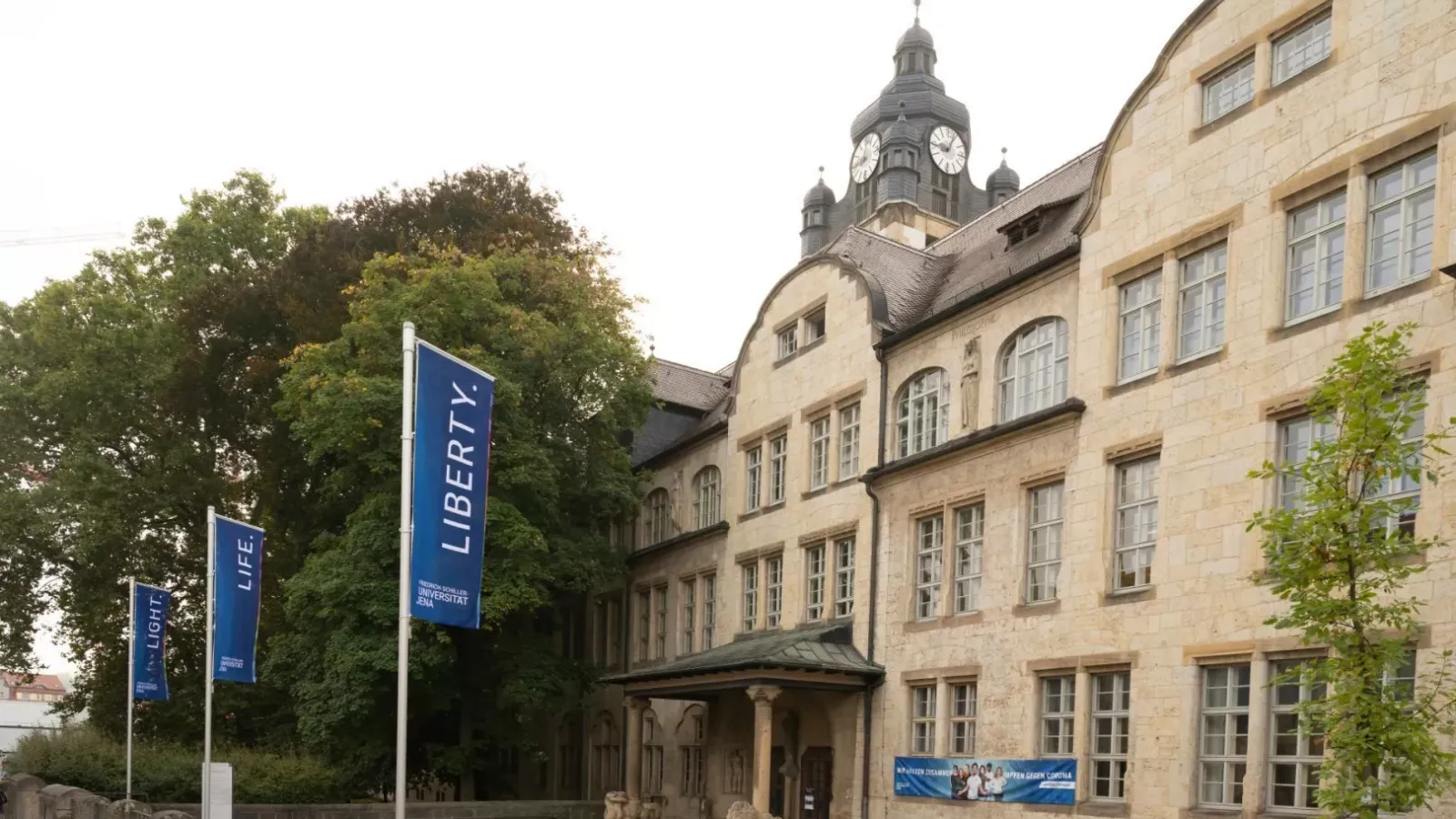
Friedrich Schiller University Jena (Friedrich-Schiller-Universität Jena, commonly Uni Jena) is a comprehensive university in the Thuringian city of Jena. It has around 17,000 students and about 10,000 employees, and offers more than 200 study programmes. Its institutional profile is summed up as Light. Life. Liberty., and it is set to receive University of Excellence status in 2027 under the Excellence Strategy.
The university is organised into ten faculties: Theology; Law; Economics and Business Administration; Arts and Humanities; Social and Behavioural Sciences; Mathematics and Computer Science; Physics and Astronomy; Chemistry and Earth Sciences; Biological Sciences; and Medicine. Physics and Astronomy focuses on optics and photonics, solid-state physics, quantum physics and gravitational theory, while Biological Sciences concentrates on biodiversity, microbial communication, evolution and ageing.
The university is centred on the Ernst-Abbe-Platz campus and the main building at Fürstengraben 1. The new Inselplatz campus in central Jena houses the Institute of Psychology, the Faculty of Mathematics and Computer Science, a branch library of the Thuringian University and State Library, a cafeteria and the University Computer Centre. Central institutions, a Graduate Academy for doctoral candidates and a Student Service Centre support study and research.
More than 2,400 students from around the world study at Jena. The International Office advises incoming students, and the university takes part in the EC2U alliance. It holds the HR Excellence in Research award and is a Partner University of High Performance Sports; it is also a member of initiatives including Charta der Vielfalt and Total E-Quality.
Most degree subjects are admission-free; a number of subjects have local or nationwide admission restrictions. Study is free of tuition fees, with students paying only the semester contribution.
No tuition fees are charged. The semester contribution (Semesterbeitrag), which is not tuition, is 353.05 euros for the winter semester 2026/27; it includes the Studierendenwerk fee, semester ticket, culture ticket, student council contribution and a one-off 20 euro Thoska fee in the first semester.
The Deutschlandstipendium awards 300 euros per month, for an initial period of one year, with no repayment; about 60 students at Jena receive it each year. Private sponsors and the federal government fund it in equal parts. It is open to students of all nationalities and subjects, in bachelor's and master's programmes, including prospective students not yet admitted; doctoral candidates are not eligible. Awards are based on academic achievement, social commitment and personal background. The call is issued once a year for the winter semester (the 2026/27 deadline was 15 April 2026). Applicants upload a tabular CV, an enrolment certificate or admission letter and proof of academic achievement through the online portal. Continued funding needs a new extension request. See Deutschlandstipendium and Apply for a scholarship.
Deutschlandstipendium at Friedrich Schiller University Jena →
Commitment Scholarship for International Students (Engagementstipendium), University of Jena →
End-of-Studies Scholarship (DAAD funds) for International Students, University of Jena →
Browse the scholarships listed for Friedrich Schiller University Jena and check each award’s eligibility.
View scholarships for Friedrich Schiller University Jena →Most degree subjects are admission-free; some have local or nationwide admission restrictions (for example Biology and Psychology locally, and Medicine, Pharmacy and Dentistry nationwide). Applicants need a higher education entrance qualification (Hochschulzugangsberechtigung) valid for German universities under Section 60 of the Thuringian Higher Education Act. Foreign certificates can be checked in the DAAD or anabin database. Applicants without a suitable qualification can attend the Studienkolleg in Nordhausen (one year of subject teaching and German training, ending in an assessment test), or enter through the International Pathway Programme, an entrance examination for a first degree in an admission-free subject for applicants with a very good TestAS result and sufficient German; after two semesters at least 30 credit points are needed.
Applications are made online through the Friedolin 2.0 portal; restricted subjects at Jena are allocated through hochschulstart.de, and nationwide restricted subjects go through hochschulstart.de, except that non-EU applicants without a German Abitur apply via Friedolin 2.0. International applicants without a German Abitur: winter semester 1 May to 15 July, summer semester 1 December to 15 January. DSH course: winter semester 1 May to 15 July, summer semester 15 October to 15 January. Studienkolleg: winter semester 1 April to 31 May, summer semester 1 October to 30 November. Admission-restricted subjects: winter semester 1 May to 15 July, higher semesters in summer 15 December to 15 January.
Applicants with foreign citizenship and no German Abitur need DSH-2 (DSH-1 is not sufficient) or an equivalent: Goethe-Zertifikat C2 (GDS), DSD II, TestDaF with at least TDN 4 in all four parts, telc Deutsch C1 Hochschule with at least befriedigend, or the German exam of a Studienkolleg assessment test. Conditional admission is possible with proof of a C1-level German course; the certificate must be submitted by enrolment. The university's DSH preparatory course requires at least CEFR B1.
A master's programme builds on a first degree, and requirements (previous degrees, knowledge, language proficiency) vary by programme and are set in each programme's study regulations. Applications run through Friedolin 2.0 with documents uploaded as single PDFs of no more than 5 MB; documents not in English or German need official translations. Winter semester applications open on 1 April; summer semester applications run from 1 December to 15 January or 15 February depending on nationality. Applicants to German-taught master's programmes with a foreign certificate prove German with the certificates above; graduates of German-taught bachelor's programmes in Germany, Austria, Switzerland or Liechtenstein, and holders of a German Abitur, Austrian Matura or Swiss Maturität are exempt. Proof of B2 German plus registration for a C1 course or test can be uploaded if no certificate is available yet. Some programmes require proof of foreign languages.
Doctoral candidates are admitted and enrolled through the Doc-in portal, supported by the Graduate Academy.
Visa applications use the Consular Services Portal: passport (valid at least six more months), admission letter, proof of financial resources such as a blocked account, health insurance, language certificates and a motivation letter. Health insurance is required for enrolment (statutory insurance is standard for students under 30).
Study programmes offered at Friedrich Schiller University Jena.
Experiences shared by students of Friedrich Schiller University Jena.
Studied here? Share your experience to help other applicants.

Book a free consultation with our expert counsellors and take the first step towards your dream university.
Copyrights © 2026 StudyMapped. All rights reserved.

Enter your credentials to continue.
Join us and start your study abroad journey.


