

University in Germany
Erlangen, Bayern, Germany
University profile
Friedrich-Alexander-Universität Erlangen-Nürnberg (FAU) is a state comprehensive university in Franconia, northern Bavaria, with its main seat at Freyeslebenstraße 1 in Erlangen. Founded in 1743, it is one of the largest universities in Germany, with 39,857 students in winter semester 2025/26 and more than 275 degree programmes (278 in 2025/26: 85 Bachelor, 101 Master and 92 Staatsexamen programmes). It combines the range of a classic Volluniversität with the engineering and natural science disciplines of a technical university, and describes research, teaching and innovation transfer as its core tasks.
Teaching is organised in five faculties: the Philosophische Fakultät und Fachbereich Theologie (about 115 subjects across the humanities, cultural, social and behavioural sciences and religion-related disciplines, including Islamic-Religious Studies), the Rechts- und Wirtschaftswissenschaftliche Fakultät (Fachbereich Rechtswissenschaft in Erlangen and Fachbereich Wirtschafts- und Sozialwissenschaften, WiSo, in Nuremberg), the Medizinische Fakultät, the Naturwissenschaftliche Fakultät (Departments of Mathematics, Physics, Biology, Chemistry and Pharmacy, and Geography and Geosciences, plus Data Science) and the Technische Fakultät (six departments, including Computer Science, Mechanical Engineering and Artificial Intelligence in Biomedical Engineering, founded in 2020). The Technische Fakultät is the largest with 10,747 students, followed by the Rechts- und Wirtschaftswissenschaftliche Fakultät with 9,912.
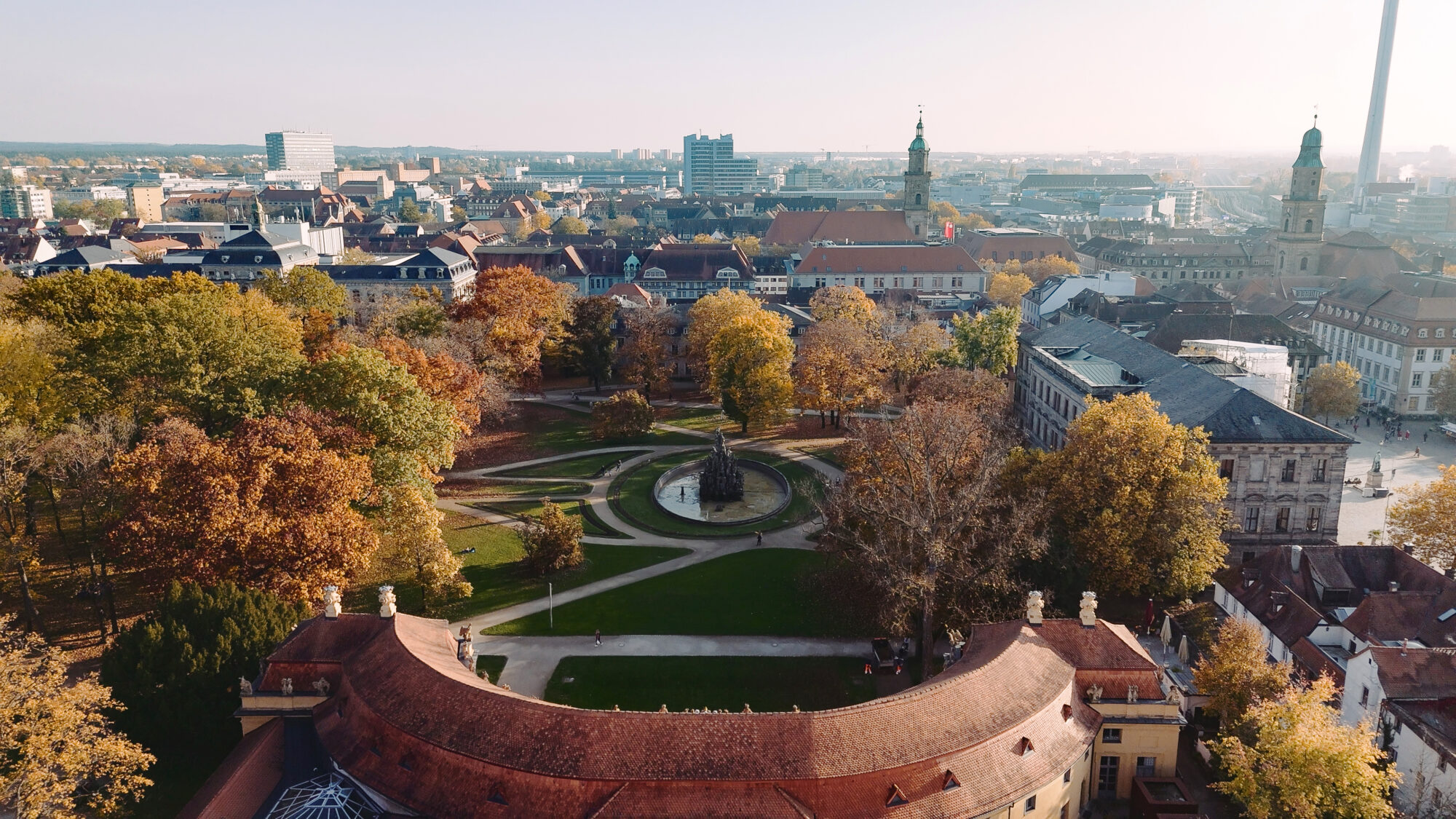
The university has sites in Erlangen, Nuremberg and Fürth, with further locations in Bayreuth (Medizincampus Oberfranken), Bamberg (Dr. Remeis Observatory), Pleinfeld on Lake Brombach (water sports centre) and Schlungenhof on the Altmühlsee. Erlangen, one of the best preserved Baroque planned towns in Germany, hosts the Kollegienhaus and the Campus Erlangen Mitte and Süd. The Studierendenwerk runs canteens and cafeterias at eight locations in Erlangen and Nuremberg, and Erlangen Süd has halls, a swimming pool, a climbing tower and playing fields.
FAU is strongly international: 10,143 of its students in winter semester 2025/26 are international students, it cooperates with more than 500 international partners, and it offers 35 English-taught degree programmes. The English-taught Bachelor programmes Artificial Intelligence, Autonomy Technologies, Clean Energy Processes, International Business Studies and International Economic Studies require no German language certificate. Newcomers can join welcome events, a buddy programme and an international student network. Research is organised around five research priorities, profile centres, research centres and competence centres, with industry partners such as Siemens, Schaeffler and adidas.
Elitenetzwerk Bayern programmes at FAU include Advanced Optical Technologies, Earth System Dynamics and Evolution, Ethics of Textual Cultures and Integrated Immunology.
Studying at FAU is in general free of tuition. Every student pays a semester contribution (Studierendenwerksbeitrag) of 82 euros per semester, which is not tuition. From summer semester 2027, FAU charges tuition to students from non-EU countries who newly enrol or change subject in Bachelor and Master programmes. The fees are 1,000, 2,000 or 3,000 euros per semester for Bachelor programmes and 2,000, 4,000 or 6,000 euros per semester for Master programmes, with half the fee for part-time study. Examples: most Bachelor programmes in the Philosophische Fakultät und Fachbereich Theologie 1,000 euros, Psychologie B.Sc. 2,000 euros, Molekulare Medizin and Logopädie 3,000 euros; International Information Systems M.Sc. 4,000 euros and Molecular Medicine M.Sc. 6,000 euros. Staatsexamen programmes (Medicine, Dentistry, Law, Pharmacy), teacher-training programmes, doctoral studies, exchange students and further education programmes are not charged. EU and EEA nationals, holders of a German entrance qualification and persons with a consolidated domestic connection are exempt, as are students on leave and, on request, students with a significant disability and certain asylum seekers. Fee-paying students receive a guaranteed place in a free German course. Fee details are at fau.de, tuition fees for students from non-EU states.
FAU awards the Deutschlandstipendium, funded half by the federal government and half by private sponsors, at 300 euros per month, initially for up to two semesters and renewable until the end of the standard period of study with a new application. Applicants must be enrolled in a Bachelor, Master or Staatsexamen programme, with an entrance grade of 1.5 or better for first-semester undergraduates, 2.0 or better for first-semester postgraduates, and an average of 2.0 or better in higher semesters. Doctoral and exchange students are excluded. Applications go through campo once a year; the winter semester 2027/28 window runs from 15 September to 15 October 2027. Details are at fau.de, Deutschlandstipendium.
The Abschlussstipendium for international students, funded from special DAAD and Bavarian funds, pays 1,000 euros in one instalment to international Master and Staatsexamen students in their final semester. Applicants need an average of 1.0 to 2.3, at least 75 ECTS, a basic knowledge of German, expected completion by the end of March 2027 and a monthly income below 992 euros; applicants from least developed countries and those with voluntary engagement receive particular consideration. The deadline for winter semester 2026/27 is 28 October 2026, 12:00. See fau.de, Abschlussstipendium.
The FAU scholarship pages list external scholarship providers, talent promotion organisations, foundations, funding for stays abroad (DAAD, Erasmus, FAU travel scholarships) and doctoral funding. The Studierendenwerk Erlangen-Nürnberg offers housing and canteens. Further information: fau.de, scholarship providers.
FAU Deutschlandstipendium (Germany Scholarship) →
FAU Oskar-Karl-Forster Scholarship (study materials grant) →
Browse the scholarships listed for Friedrich-Alexander-Universität Erlangen-Nürnberg (FAU) and check each award’s eligibility.
View scholarships for Friedrich-Alexander-Universität Erlangen-Nürnberg (FAU) →Applicants without German nationality or a German university entrance qualification apply directly to FAU through the online portal campo (maximum three applications). Applicants who need a decision on their foreign school-leaving certificate are assessed by the admissions office in line with the recommendations of the Kultusministerkonferenz. Certificates that give direct access may be limited to certain subjects or require a minimum grade. FAU has no Studienkolleg of its own; the Studienkolleg of all Bavarian universities is in Munich and FAU allocates applicants to it. Admission to the Studienkolleg requires German at B2 level, and after passing the Feststellungsprüfung applicants must apply again for a degree place.
Documents include a tabular CV without photograph, all pages of the school-leaving certificate, and German language certificates. Foreign documents not issued in German, English or French need a certified translation, and copies must be officially certified. Where applicable, a Voruniversitätsjahr, a home-country university entrance examination, the Feststellungsprüfung certificate or earlier transcripts are added. Applicants with Indian, Chinese or Vietnamese qualifications must upload the APS certificate. Applications to subjects with a local admission restriction are signed and posted to the admissions office (Zulassungsstelle, Freyeslebenstraße 1, 91058 Erlangen) with the required documents.
Almost all Bachelor programmes start in the winter semester only. International Business Studies, International Economic Studies, Lebensmittelchemie, Molekulare Medizin and Psychologie also require registration through the DoSV procedure of hochschulstart.de for EU applicants, Bildungsinländer and similar groups. Medicine, Medizin Erlangen/Bayreuth and Pharmacy are nationally restricted and allocated centrally. Applicants for Lebensmittelchemie, Medicine, Pharmacy and Dentistry must submit proof of DSH-2 or an equivalent examination.
The allgemeine Hochschulreife (Abitur) entitles holders to study any subject. Other routes include a completed degree of at least six semesters, the Begabtenprüfung, or a Meisterprüfung with a counselling interview at a Bavarian university. Bildungsinländer, who obtained their entrance qualification in Germany or at a German school abroad, apply as German applicants do.
German is the language of instruction for almost all programmes. Accepted certificates for matriculation include DSH (level 2 is sufficient for all programmes), TestDaF (level 4 in each of the four parts), Goethe-Zertifikat C2, ÖSD C2, DSD II of the Kultusministerkonferenz (at least B2 in all parts), the German language examination II of the Sprachen- und Dolmetscher-Institut München, telc Deutsch C1 Hochschule, telc Deutsch C2, and the German part of the Feststellungsprüfung. Applicants with good German at B2 may apply and take the DSH at FAU immediately before the semester starts (the preparatory course costs 160 euros and the examination 80 euros); this is excluded for Medicine, Medizin Erlangen/Bayreuth, Dentistry and Pharmacy. The purely English-taught Bachelor programmes Artificial Intelligence, Autonomy Technologies, Clean Energy Processes, International Business Studies and International Economic Studies require no proof of German; students whose first language is not German must show A1 German or equivalent during the first year.
Admission requires a first degree (for example a Bachelor) from a state-recognised higher education institution. Applications go through campo, with all documents uploaded as PDF and no postal submission. Applicants from non-EU countries who cannot yet present the degree must submit it on enrolment; provisional certificates are not accepted. Faculties set minimum credits at the time of application, usually about 135 to 150 ECTS from completed modules (for example 140 ECTS in the Philosophische Fakultät und Fachbereich Theologie and Technische Fakultät; 135 to 189 ECTS in the Rechts- und Wirtschaftswissenschaftliche Fakultät depending on the length of the Bachelor; 135 to 150 ECTS in the Naturwissenschaftliche Fakultät). Many programmes use a Qualifikationsfeststellungsverfahren, and application documents may include a motivation letter, internship evidence and language certificates. Application windows differ per programme: for example 15 February or 15 April to 15 July for the winter semester and 15 September or 15 October to 15 January for the summer semester in the Philosophische Fakultät und Fachbereich Theologie. Required German and English levels differ per programme. The APS certificate is mandatory for applicants whose degree is from China, Vietnam or India.
Doctoral candidates first agree a topic with a supervisor (Betreuerin or Betreuer), register the project in the database docDaten, apply for admission to the doctorate within three months, and are encouraged to enrol as doctoral students. They may join a structured doctoral programme or pursue an individual doctorate; cooperative doctorates with universities of applied sciences and external doctorates are possible. The PhD programme Advanced ImmunoMedicine requires a master's degree in a medical or natural science subject, a supervision commitment and a selection interview.
EU students need no visa and must register with the local registration office within seven days of arrival. Students from non-EU countries must apply for a visa at the German embassy or consulate before travelling; processing can take six to eight weeks.
From winter semester 2026/27 FAU charges applicants from non-EU states 100 euros per application, up to three applications per application phase. Applicants with German nationality, a German university entrance qualification, a Feststellungsprüfung from a state-recognised Studienkolleg, EU or EEA nationality, a German Bachelor degree of at least six semesters, or a consolidated domestic connection are exempt.
The University Library (ub.fau.de) serves research, teaching and study with learning spaces, databases, e-journals and the open-access repository OPEN FAU. The Studierendenwerk Erlangen-Nürnberg provides student housing and canteens; payment in canteens is cashless with the FAUcard.
Study programmes offered at Friedrich-Alexander-Universität Erlangen-Nürnberg (FAU).
Experiences shared by students of Friedrich-Alexander-Universität Erlangen-Nürnberg (FAU).
Studied here? Share your experience to help other applicants.

Book a free consultation with our expert counsellors and take the first step towards your dream university.
Copyrights © 2026 StudyMapped. All rights reserved.

Enter your credentials to continue.
Join us and start your study abroad journey.


