
University in Germany
Berlin, Berlin, Germany
University profile
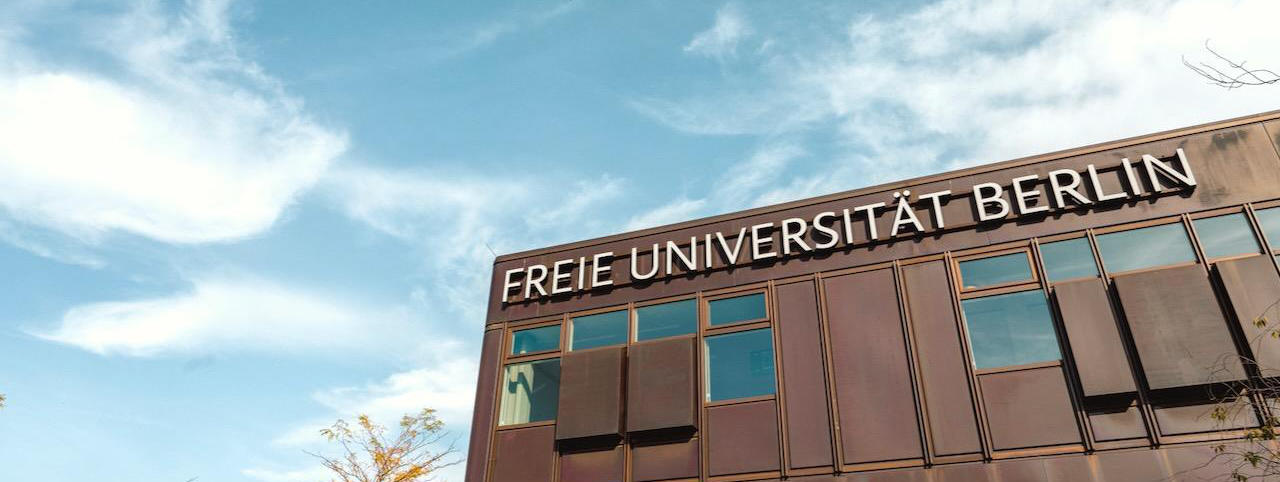
Freie Universität Berlin is an internationally oriented research university in the south-west of the German capital, with its main campus in the Dahlem district. Around 34,400 students were enrolled in the winter semester 2024/2025, and about 3,300 doctoral candidates carry out research there. It is a full-spectrum university (Volluniversität) covering the humanities and social sciences as well as the natural and life sciences, with more than 150 degree programmes.
Teaching and research are organised in departments and central institutes. The departments are Veterinary Medicine; Biology, Chemistry and Pharmacy; Earth Sciences; Physics; Mathematics and Computer Science; History and Cultural Studies; Philosophy and Humanities; Education and Psychology; Law; Political and Social Sciences; and the School of Business and Economics (Business Administration and Economics). Area studies are pursued in the central institutes, among them the John F. Kennedy Institute for North American Studies, the Institute for Latin American Studies and the Institute for East European Studies. Charité – Universitätsmedizin Berlin is the joint medical school of Freie Universität and Humboldt-Universität zu Berlin.
The Dahlem campus holds the large Habelschwerdter Allee 45 and Fabeckstrasse 23-25 complex (the Rost- und Silberlaube and the Holzlaube) with humanities and social science subjects, while law, business and economics, political science, the Henry Ford Building and the Central Library are close by. Mathematics and computer science, biology, chemistry and pharmacy, physics and the John F. Kennedy Institute lie north of the Philological Library. The Botanic Garden and Botanical Museum Berlin-Dahlem, with 22,000 plant species, belongs to the university. The University Library operates 14 locations, including the Philological Library, which holds the books and media of eleven sub-libraries.
Freie Universität has students from over 80 countries; in the winter semester 2024/2025, 13 percent of bachelor's students and 33 percent of master's students came from abroad, as did 42 percent of doctoral students. It maintains more than 200 bilateral partnerships worldwide and more than 400 university partnerships within Erasmus+, plus four international liaison offices (Cairo, Tbilisi for Eastern Europe, New Delhi and São Paulo). Exchange, short-term programmes (Global Campus, FUBiS, FU-BEST), an International Club and a peer mentoring programme support international students. The university does not offer dormitories to degree-seeking students; the Studierendenwerk Berlin runs residence halls across the city.
Freie Universität Berlin was recognised as a German University of Excellence after the 2006/2007, 2012 and 2019 Excellence competitions, and since 2019 receives long-term funding within the Berlin University Alliance with Humboldt-Universität zu Berlin, Technische Universität Berlin and Charité. Its academic ethos is expressed in the three values veritas, iustitia, libertas (truth, justice, freedom).
Freie Universität Berlin charges no tuition fees, except for continuing education master's programmes. All students pay semester fees and contributions (Semestergebühren und -beiträge), which are not tuition. For new enrolment in winter semester 2026/27 the total is €376.80: Studierendenwerk social contribution €85.00, administration fee €50.00, student government (AStA) contribution €10.00, social fund €5.00 and the public transport semester ticket €226.80 for eligible students. A late fee of €19.94 applies if the re-registration deadline is missed. Amounts change from semester to semester.
For degree students (Bachelor, State Exam, Master) already enrolled at Freie Universität who obtained their entrance qualification abroad and are not German citizens, ten STIBET I scholarships of €250 per month for ten months (March to December 2026) were offered for students with a refugee background, children under 12, caring responsibilities, or a disability or chronic illness. Funding comes from the DAAD with funds from the Federal Foreign Office. Academic grades are not considered; applicants must be enrolled throughout the funding period and have regularly attended classes. Application is online; the deadline for that round was 11 January 2026. See the official page.
The Deutschlandstipendium gives €300 per month (€150 from the federal government and €150 from private donors) for at least two semesters, starting in the winter semester only, with renewal possible. Students enrolled within the standard period of study, or holding an admission notice, may apply online. See the official page.
Freie Universität directs students to the DAAD scholarship database, BAföG through the studierendenWERK BERLIN (non-German nationals qualify only in exceptional cases), education loans, the Studentische Darlehnskasse e.V. loan society, and the profund start-up funding. Doctoral candidates can apply for Elsa Neumann Scholarships (see the Dahlem Research School). Erasmus+ mobility grants for study abroad are €700 per month plus travel grants. Information: fees and dues, study funding.
Deutschlandstipendium at Freie Universität Berlin →
STIBET Expanding-Access Scholarships for International Students at Freie Universität Berlin →
Browse the scholarships listed for Freie Universität Berlin and check each award’s eligibility.
View scholarships for Freie Universität Berlin →Applicants need a higher education entrance qualification (Hochschulzugangsberechtigung, HZB). The German Abitur, or the European Baccalaureate, entitles holders to study any subject. A subject-specific entrance qualification (fachgebundene HZB) allows only certain subjects. The Fachhochschulreife does not entitle holders to study at Freie Universität Berlin. Applicants with an international HZB generally apply first for a preliminary review documentation (VPD, Vorprüfungsdokumentation) from uni-assist, which they then upload to the Freie Universität application portal within the university's deadlines; processing can take several weeks. Whether a foreign school-leaving certificate qualifies for direct entry is assessed using the DAAD admissions database and anabin. Applicants whose certificate does not qualify attend the Studienkolleg (a one-year preparatory course taught in German, shared with Humboldt-Universität and Charité, with no summer-semester intake) and pass the Feststellungsprüfung (assessment exam, held once a year in May/June), or may sit the exam without the course. Admission to the Studienkolleg requires proof of German and an entry test; applications go through uni-assist.
Many arts and science programmes are combined bachelor's degrees (one core subject plus modules of 30 credit points each, or one 60-credit module). Some programmes with limited admission apply a numerus clausus; programmes with unrestricted admission still require an application.
Bachelor's programmes with limited admission: 1 June to 15 July 2026. Programmes with unrestricted admission: 1 June to 1 September 2026. Applicants without a German HZB use the same deadlines and must also obtain the VPD. Pharmacy and veterinary medicine applications run through hochschulstart.de (28 April to 31 May 2026 for earlier school-leavers, 28 April to 15 July 2026 for recent school-leavers). Consecutive master's programmes with limited admission: 20 April to 31 May 2026; with unrestricted admission: 20 April to 15 August 2026.
German at a high level is required for most programmes. For application, proof of at least level C1 CEFR is needed, for example TestDaF with at least 4/4/3/3, DSH 1, telc C1-Hochschule with the result befriedigend or ausreichend, DSD II, or an OnSet/OnDaF test at C1. For enrolment, the following are accepted: DSH 2, telc C1-Hochschule with at least gut, the Goethe-Institut C2 certificate, DSD II with C1 in all parts, the Studienkolleg Feststellungsprüfung, or TestDaF with at least level 4 in all four parts. Deutsche Philologie (Bachelor's) and Deutschsprachige Literatur (Master's) require TestDaF level 5 in all four parts or DSH 3 for enrolment. Certificates must not be older than three years. Applicants who lack a certificate but meet the minimum for application can take the DSH at the university after admission. For the Studienkolleg, level B2 is sufficient (for example DSH 1 or TestDaF level 3 in all four parts). No German is required for the programmes taught in English listed on the university's English-language programmes page, although some English-taught master's programmes (for example Biodiversity, Evolution, Ecology and Biology) require A1 and Interdisciplinary Latin American Studies requires B2 at application.
English can be shown by school records or tests. Level B2 corresponds, for example, to IELTS 5.5 to 6.5, TOEFL iBT 72 to 94, or UNIcert II; level C1 corresponds, for example, to IELTS 7.0, TOEFL iBT at least 95 or PTE Academic at least 76. Individual programmes state which level they require and may differ.
Applicants need a first professional degree (usually a bachelor's) by enrolment or by the end of the first semester at the latest; it is possible to begin with two-thirds of the bachelor's completed and to prove the remainder by the end of the first semester. The final grade must be shown on the certificate or transcript. Each consecutive master's programme lists its own specific requirements (for example subject credits, language, additional documents). Applicants with a non-German degree must obtain a VPD from uni-assist (valid for one year, issued for Freie Universität Berlin) and upload it with their application, official transcript, degree certificate, translations where documents are not in German or English, and language proof. Applicants with certificates from China, India or Vietnam must also submit an APS certificate. A fee is charged by uni-assist for the VPD.
Doctorates can be pursued individually or in structured programmes; the Dahlem Research School advises on supervision, admission and enrolment in PhD programmes. Enrolment in doctoral programmes is handled separately from undergraduate enrolment.
Non-EU students need a student visa; at border control they may be asked for the admission letter, visa and proof of accommodation. Health insurance is compulsory from the first day and is needed for enrolment, and students from non-EU/EFTA countries need a residence permit from the Berlin Immigration Office (LEA), for which the university's Pass-Service offers support to enrolled students. Applicants contact the Student Services Center (Info-Service Studium) at +49 30 838 70000 or [email protected].
The University Library has 14 locations: Central Library (Garystr. 39), Campus Library (Fabeckstr. 23/25), Philological Library (Habelschwerdter Allee 45, open Monday to Friday 9 a.m. to 10 p.m. and weekends 10 a.m. to 8 p.m.), Law Library, Library of Economics, Library of Social Sciences and East European Studies, Library of North American Studies, History and Art History Library, Earth Sciences, Biology, Veterinary, Theatre Studies and Meteorology libraries. The Student Services Center (Info-Service Studium) is at Iltisstrasse 4, with an info counter at Mensa II, Otto-von-Simson-Strasse 26. Freie Universität does not itself offer accommodation to degree-seeking students; the Studierendenwerk Berlin offers rooms in over 30 residence halls across the city.
Study programmes offered at Freie Universität Berlin.
Experiences shared by students of Freie Universität Berlin.
Studied here? Share your experience to help other applicants.

Book a free consultation with our expert counsellors and take the first step towards your dream university.
Copyrights © 2026 StudyMapped. All rights reserved.

Enter your credentials to continue.
Join us and start your study abroad journey.


