
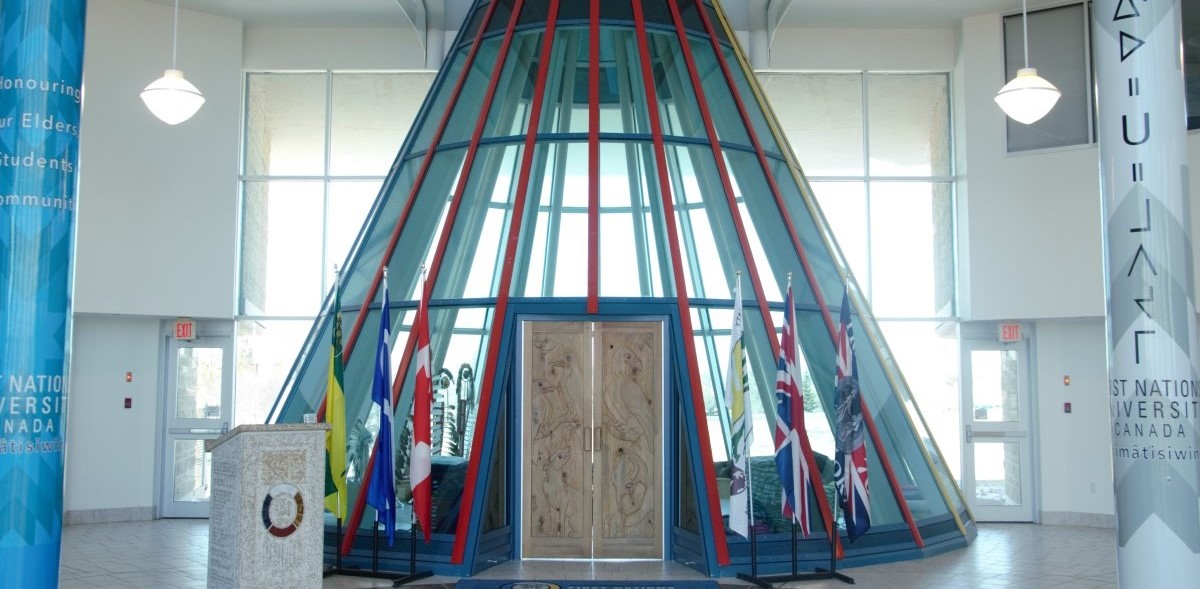

First Nations University of Canada campus

University in Canada

First Nations University of Canada

Regina, Saskatchewan, Canada

University profile

About First Nations University of Canada

First Nations University of Canada (FNUniv) is a First Nations-owned post-secondary institution in Saskatchewan, offering education rooted in Indigenous knowledge, cultures, languages and values. It operates as a federated college of the University of Regina, and its courses, programs and instructors are accredited by the University of Regina; all University of Regina classes are open to FNUniv students. Programs span business, humanities, social sciences and sciences, many incorporating Indigenous worldviews, traditions and languages.

FNUniv has four campuses: the Regina Campus (1 First Nations Way, on the atim ka-mihkosit Red Dog Urban Reserve), the Saskatoon Campus, the Northern Campus in Prince Albert, and the nēwoskan Traditional Campus, a land-based learning centre near St. Louis, Saskatchewan, focused on Indigenous traditions and environmental stewardship.

Academic work is organised in ten undergraduate program areas:

  • Indigenous Business and Public Administration
  • Indigenous Education
  • Indigenous Fine Arts
  • Indigenous Health Studies
  • Indigenous Journalism and Communication Arts
  • Indigenous Knowledge and Science
  • Indigenous Languages
  • Indigenous Literatures in English
  • Indigenous Social Work
  • Indigenous Studies

Community-based programs and a Certificate in Reconciliation Studies are also offered. Graduate programs, all awarded through the University of Regina Faculty of Graduate Studies and Research, include the Master of Indigenous Education, the Master of Indigenous Language Education, the Master of Indigenous Social Work and a Graduate Certificate in Indigenous Nation-Building. The Indigenous Social Work programs are nationally accredited, and Indigenous Education is approved by the Saskatchewan Teachers' Professional Regulatory Board for teacher certification.

Student life centres on Elder Services: each campus has Elders present, monthly Pipe Ceremonies are held on every campus, and workshops and guest lectures on traditions and teachings are offered. Other services include Student Success Services, counselling, a career centre, the pamināwasowin Child Care Centre, athletics and recreation services, a student association at each of the three main campuses, libraries at the Regina, Saskatoon and Northern campuses, and the First Nations Veterans Memorial Tipi.

International students are admitted through the University of Regina International Office. FNUniv is led by a Board of Governors and runs a Research Office and the Indigenous Peoples' Health Research Centre.

University information

How to apply

Scholarships, awards and bursaries are applied for online through the AwardSpring platform; paper and email applications are not accepted. For 2026 the application window runs from October 1 to October 31, 2026. Enquiries: [email protected], 306-790-5950. Official page: Scholarships, Awards and Bursaries.

Co-operators Group Limited Scholarship and Bursary

One $2,500 scholarship and one $2,500 bursary. Applicants must be full-time Indigenous students at FNUniv, have completed at least 60 credit hours, be enrolled in the Business Administration program, and hold a GPA of at least 65% in the semester of application.

Innovation Federal Credit Union No Essay Scholarships

Ten scholarships of $2,500 each for full-time FNUniv students in any field of study with a PGPA of at least 60%. Recipients agree to have their name, photo and program announced on social media and to provide an impact statement or testimonial.

Student Success Services Emergency Bursary

Short-term urgent assistance for students facing an unexpected financial challenge, such as groceries, housing, utilities, medication or day-care fees. Students may apply once per academic year, should have explored other funding first, and apply by emailing Student Success Services.

Other funding routes

Treaty status students registered with a First Nation Band can contact their band's post-secondary counsellor for funding; Métis students can contact their Métis local. The Hellamaid Scholarship ($500 per semester, 700-word essay) is listed as an external award open to students at accredited Canadian institutions.

Co-operators Group Limited Scholarship and Bursary →

Find scholarships on our site

Browse the scholarships listed for First Nations University of Canada and check each award’s eligibility.

View scholarships for First Nations University of Canada →

Applying and application fee

Applications are made online through the University of Regina application form, selecting FNUniv as the campus. The one-time application fee is $100; post-secondary transfer students pay $200, which includes a transfer credit assessment fee. In October 2026 (1-31 October), eligible Indigenous students who self-declare their ancestry can have the fee waived using code INDIGOCT2026. Supporting documents such as high school transcripts are submitted with the application; final admission requirements are those of the University of Regina for each program.

Undergraduate deadlines

  • Fall term (September-December): early application March 15; final deadline for new, re-admission and transfer applicants August 15; Bachelor of Fine Arts and Certificate in Visual Arts or Indigenous Fine Arts (portfolio) April 1; Continuing Education August 31; Indigenous Education After Degree Elementary March 31 (first intake) and June 30 (second intake); Bachelor of Indigenous Social Work May 15; petition deadline July 1.
  • Winter term (January-April): early application November 1; final deadline December 15; fine arts portfolio December 1; Continuing Education December 15; Indigenous Education After Degree Elementary September 30; Bachelor of Indigenous Social Work January 15; petition deadline November 1.
  • Spring/Summer term (May-August): final deadline April 15. Indigenous Education does not admit to the spring/summer term.

The early deadline is recommended for best course selection and access to scholarships, residence and parking. March 15 gives preference to rural and remote students living more than 100 km from Regina or Saskatoon.

High school admission (Saskatchewan courses)

  • Business and Public Administration: minimum 70% average in English Language Arts A30 and B30, Foundations of Math 30 or Pre-Calculus 30, and two additional approved 30-level Math, Science, Language, Social Science, or Business and Management courses.
  • Indigenous Education: minimum 65% average in English Language Arts A30 and B30, two approved 30-level Math, Science, Language or Social Science courses and one additional approved 30-level course; qualified applicants are interviewed.
  • Fine Arts: same 65% requirements; a portfolio is required for the Bachelor of Fine Arts and the certificate.
  • Health Studies: minimum 70% average in English Language Arts A30 and B30, Foundations of Math 30 (Bachelor of Health Studies only) or Pre-Calculus 30, one approved 30-level Math, Science, Language or Social Science course and one additional approved 30-level course.
  • Journalism and Communication Arts: minimum 65% average in the same course pattern; English proficiency and basic computer skills are required.
  • Indigenous Knowledge and Science: minimum 70% average in English Language Arts A30 and B30, Pre-Calculus 30, and two of Biology 30, Calculus 30, Chemistry 30, Computer Science 30, Earth Science 30 or Physics 30.
  • Indigenous Languages and Indigenous Literatures in English: minimum 70% average in English Language Arts A30 and B30, two approved 30-level Math, Science, Language or Social Science courses and one additional approved 30-level course.
  • Indigenous Social Work: not admitted directly from high school; applicants complete the 24-credit-hour Indigenous Social Work Qualifying program, with a minimum 70% average in the high school course pattern above.

Applicants from high school supply a high school transcript; Saskatchewan transcripts can be sent electronically by the Ministry of Education.

Transfer, re-admission and Indigenous Education

Applicants with previous post-secondary study arrange for two official transcripts to be sent directly to University of Regina Admissions. Students returning after more than one year away, or changing faculty, submit a Re-Admission/Faculty Transfer form through the University of Regina. Indigenous Education applicants submit a separate application forwarded to the Indigenous Education Admissions Committee.

International applicants

International students are admitted by the University of Regina International Office. UR International Student Services: [email protected], 306-585-5082.

Graduate admission

  • Master of Indigenous Education: admission average 75%; deadlines October 15 and February 15.
  • Master of Indigenous Language Education: admission average 75%; deadlines October 15 and February 15; delivered mainly online with some in-person components.
  • Master of Indigenous Social Work: deadline March 15 in alternating years (2026, 2028, 2030).
  • Graduate Certificate in Indigenous Nation-Building: deadlines May 1 (fall), October 1 (winter), February 1 (spring); offered with the Johnson Shoyama Graduate School of Public Policy.

Graduate applications follow University of Regina Faculty of Graduate Studies and Research procedures.

  • Regina Campus, 1 First Nations Way, Regina: the main campus on the atim ka-mihkosit (Red Dog) Urban Reserve; houses the Research Office, Registrar's Office, library, Elder Services, Student Success Services, child care centre and fine arts studios (2-dimensional, 3-dimensional, historic materials and preparation studios). Teaches business, education, fine arts, health, journalism, science, languages, English, social work and Indigenous studies.
  • Saskatoon Campus, 230 - 103B Packham Avenue, Saskatoon: library, Elder Services and Student Success Services; social work, English and other program classes.
  • Northern Campus, 1301 Central Avenue, Prince Albert: library, Elder Services and Student Success Services; classes in business, health, science, languages, English and social work, with some online and remote delivery.
  • nēwoskan Traditional Campus, near St. Louis, Saskatchewan: land-based learning centre for Indigenous traditions and environmental stewardship.

Each of the Regina, Saskatoon and Northern campuses has a library with a circulation desk and online catalogue, databases and research guides, and hosts monthly Pipe Ceremonies through its Elder's Office.

Explore Study Programmes

Study programmes offered at First Nations University of Canada.

Bachelor of Administration (BAdmin)
Bachelor'sCanadaIntake : Fall term (September - December), Winter term (January - April) and Spring/Summer term (May - August
 
Bachelor of Arts Honours Major in English
Bachelor'sCanadaIntake : Fall term (September - December), Winter term (January - April) and Spring/Summer term (May - August
 
Bachelor of Arts Honours in Indigenous Studies
Bachelor'sCanadaIntake : Application deadlines: August 15, December 15
 
Bachelor of Arts Major in English
Bachelor'sCanadaIntake : Fall term (September - December), Winter term (January - April) and Spring/Summer term (May - August
 
Bachelor of Arts in Anihšināpēmowin Language Literacy
Bachelor'sCanadaIntake : Fall term (September - December), Winter term (January - April) and Spring/Summer term (May - August
 
Bachelor of Arts in Cree Language Literacy
Bachelor'sCanadaIntake : Fall term (September - December), Winter term (January - April) and Spring/Summer term (May - August
 
Bachelor of Arts in Indigenous Art
Bachelor'sCanadaIntake : Fall term (September - December), Winter term (January - April) and Spring/Summer term (May - August
 
Bachelor of Arts in Indigenous Art (Special Three-Year)
Bachelor'sCanadaIntake : Fall term (September - December), Winter term (January - April) and Spring/Summer term (May - August
 
Bachelor of Arts in Indigenous Art History
Bachelor'sCanadaIntake : Fall term (September - December), Winter term (January - April) and Spring/Summer term (May - August
 
Bachelor of Arts in Indigenous Journalism and Communication Arts
Bachelor'sCanadaIntake : Fall term (September - December), Winter term (January - April) and Spring/Summer term (May - August
 
Bachelor of Arts in Indigenous Journalism and Communication Arts After Degree
Bachelor'sCanadaIntake : Fall term (September - December), Winter term (January - April) and Spring/Summer term (May - August
 
Bachelor of Arts in Indigenous Studies
Bachelor'sCanadaIntake : Application deadlines: August 15, December 15
 

Student Reviews

Experiences shared by students of First Nations University of Canada.

No student reviews yet

Studied here? Share your experience to help other applicants.

Sign in to write a review →

Ready to start your study abroad journey?

Book a free consultation with our expert counsellors and take the first step towards your dream university.

Copyrights © 2026 StudyMapped. All rights reserved.