
University in Germany
Flensburg, Schleswig-Holstein, Germany
University profile
The Europa-Universität Flensburg (EUF) is a university in Flensburg, Schleswig-Holstein, on the Danish border at the head of the Flensburg Fjord. Its subjects span educational sciences, economics, social sciences, humanities, natural sciences and technology, with a focus on teacher education and international management. The university describes its aim as developing into an internationally oriented European university with a strength in the educational sciences, and its guiding principles are justice, sustainability and diversity.
Teaching and research are organised in three faculties. Faculty I covers biology, chemistry, mathematics, physics, health and nutrition sciences, sport science, technology, primary-school general studies (Sachunterricht) and vocational education (biat). Faculty II covers English and American studies, aesthetic-cultural studies, British and Irish studies, Danish, Frisian studies and minority research, German, Romance languages and special needs education. Faculty III covers educational sciences, social sciences and theology, the Interdisciplinary Institute for Environmental, Social and Human Sciences, and the International Institute for Management and Economic Education.
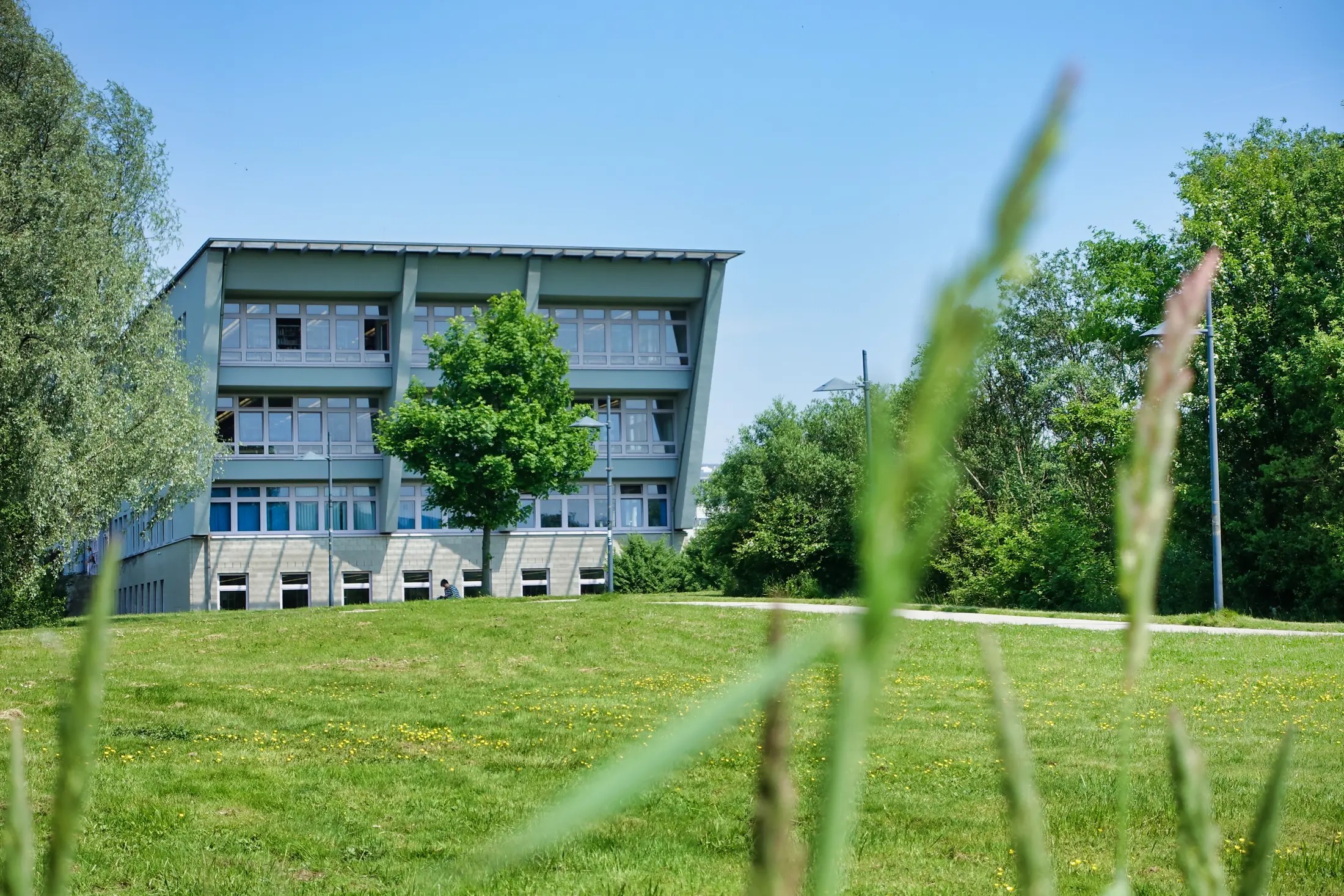
The central campus on the Sandberg is green and spacious, and is shared with Flensburg University of Applied Sciences (Hochschule Flensburg), with joint facilities including the refectory (Mensa), the central library (ZHB) and the lecture-hall centre with its Audimax. Campus buildings are named after European cities (Oslo, Helsinki, Dublin, Tallinn, Göteborg and others). Economics is taught at the Madrid building near the main station (Munketoft).
Student life includes a university sports centre with a fitness studio (CampusFitness), cafés and refectories, a campus chapel (Campelle), a community garden and many student groups. The Studentenwerk Schleswig-Holstein runs five halls of residence on campus and three nearby, with 880 places in total, in single apartments or shared flats for two to four people with their own kitchens and bathrooms. A family office supports students with children.
EUF is a member of EMERGE, an alliance of nine European higher-education institutions that has held the status of European University since 2025. In winter semester 2025/26 the university had 5,648 students, of whom 8.6% were international. Its International Center supports degree-seeking and exchange students, and the university offers an English-taught M.A. in European Studies and an M.Eng. in Sustainable Energy.
The semester contribution (Semesterbeitrag, not tuition) was 403.80 EUR in winter semester 2024 and includes the Semesterticket.
The Deutschlandstipendium supports students of all subjects with outstanding academic results, voluntary engagement or personal challenges overcome. It is normally 300 EUR per month, granted for one year (September to August) and extendable. Around 64 scholarships were advertised in the most recent call. Applications run from 1 July to 15 September each year. Official page.
For international students enrolled in a Bachelor or Master programme: degree-completion grants for students in financial difficulty in the final phase of study, grants for particularly engaged students, and contact grants for exchange students of partner universities. Applications go to [email protected] with a motivation letter, CV, enrolment certificate, transcript, a lecturer's recommendation and, for completion grants, proof of financial circumstances. Official page.
Doctoral candidates can apply for Landespromotionsstipendien awarded by the university or for external doctoral scholarships. Official page.
A loan fund of the Fördergesellschaft der Universität Flensburg e.V., funded by the E. W. Kuhlmann-Stiftung Hamburg, offers entry and bridging loans to refugee students and ProRef participants. The Protestant and Catholic student congregations provide social advice and, under conditions, financial help.
The central student advisory service offers scholarship group advice and holds an information event during orientation week; faculty contacts exist for foundations such as Friedrich-Ebert-Stiftung, Hans-Böckler-Stiftung, Heinrich-Böll-Stiftung, Rosa-Luxemburg-Stiftung and the Studienstiftung des deutschen Volkes. See also Stipendien.
Hall of residence rent ranges from 255 to 380 EUR per month with a 500 EUR refundable deposit; a monthly budget of at least 850 EUR including accommodation is recommended; statutory health insurance costs about 140 to 150 EUR per month.
Browse the scholarships listed for Europa-Universität Flensburg and check each award’s eligibility.
View scholarships for Europa-Universität Flensburg →All applications, including those of international applicants, are made online through the EUF portal; documents are uploaded there and nothing is posted. The M.Eng. Sustainable Energy is applied for directly through the programme. Applicants register once, activate their access by e-mail, select a programme and upload all certificates by the deadline; documents cannot be submitted after the closing date.
A general or subject-specific university entrance qualification is required. International applicants should submit certified copies of their school-leaving certificate with certified German or English translations, ideally before the official application start so that the admissions office can evaluate them. Applicants from outside the EU are covered by a pre-quota of 8% of places in the B.A. Bildungswissenschaften. In that programme two subjects are chosen alongside the compulsory element Bildung, Erziehung, Gesellschaft; Sachunterricht GeWi, Sachunterricht NaWi and Textil und Mode are admission-restricted and all other subjects are open. Of the remaining places 20% go by Abitur grade, 20% by waiting time and 60% through the university selection procedure, which assesses the Abitur grade. Deadlines for the first semester (winter): application opens 15 May and closes 15 July for restricted subjects and 15 August for open subjects. For the spring semester (higher semesters) applications run 3 December to 15 January. Music, sport, art, Danish, English, French and Spanish require additional qualifications.
Applicants without Abitur may enter through the university aptitude examination (Hochschuleignungsprüfung; registration by 1 March, examinations mid-May to end of June, fee 140 EUR, requiring a vocational qualification of at least two years, three years' relevant work experience and a prior study consultation), through a master craftsperson qualification or through a Fachschule qualification.
Applicants without a German-language entrance qualification need German at level C1: DSH-2, TestDaF with level 4 in all parts, the German part of the Studienkolleg Feststellungsprüfung, DSD II, Goethe-Zertifikat C1 or telc Deutsch C1 Hochschule.
A first degree is required, or completion in the application semester. Winter semester applications to the M.A. International Management Studies run from 15 May to 31 August and spring semester applications from 3 December to 15 January; the M.A. European Studies accepts first-semester applications from 1 December to 31 August (spring semester: 1 December to 15 January). Provisional admission is possible if the degree proof is delivered by 1 November.
Doctoral candidates first agree a topic and a supervisor and sign a supervision agreement, then apply to the faculty's doctoral committee (Promotionsausschuss) for admission to the doctoral procedure. After admission they enrol as doctoral students through the portal, uploading their entrance qualification, degree certificates and the committee's admission decision; foreign degrees are checked separately. Enrolment: winter semester 15 May to 15 November, spring semester 1 December to 15 April.
Most non-EU students need a student visa; the process can take up to two months. Documents normally include a valid passport, proof of health insurance, proof of financing (minimum 992 EUR per month, 11,904 EUR for twelve months; via a scholarship letter, a declaration of commitment by a third party or a blocked account) and the admission letter. Enrolment requires an electronic confirmation (M10) of statutory health insurance status sent to the university by a German statutory health insurer.
Campus facilities include CampusFitness and the sports hall, cafés such as Mind & Mocha, the Campelle chapel, a community garden, beehives and a disc-golf course. Halls of residence (880 places in eight buildings, five on campus) are run by the Studentenwerk Schleswig-Holstein, among them the Emmy-Hennings-Haus and the Wohnheim Sandberg.
Study programmes offered at Europa-Universität Flensburg.
Experiences shared by students of Europa-Universität Flensburg.
Studied here? Share your experience to help other applicants.

Book a free consultation with our expert counsellors and take the first step towards your dream university.
Copyrights © 2026 StudyMapped. All rights reserved.

Enter your credentials to continue.
Join us and start your study abroad journey.


