

University in France
Évry-Courcouronnes, Île-de-France, France
University profile
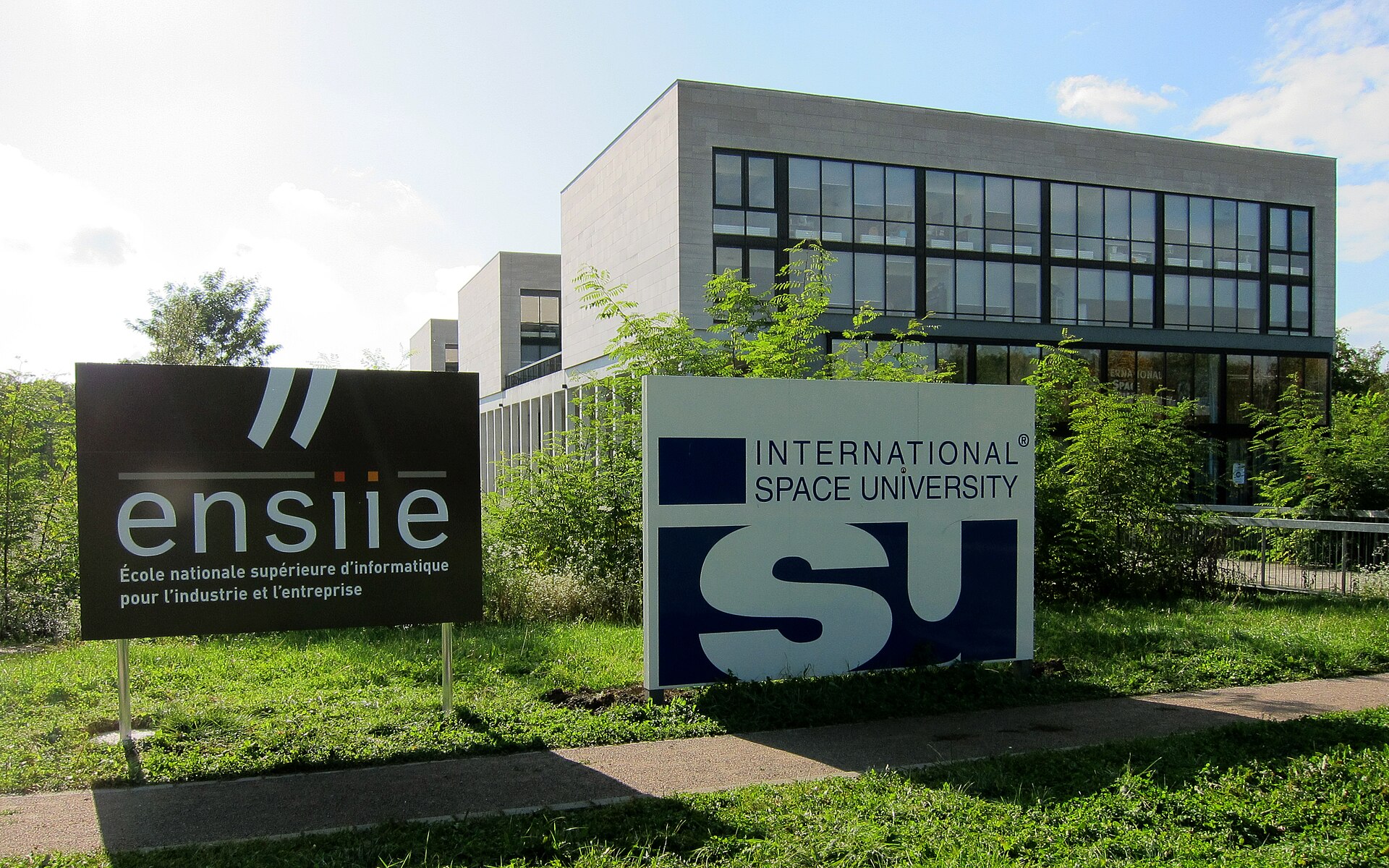
ENSIIE (École nationale supérieure d'informatique pour l'industrie et l'entreprise, written ensIIE) is a public grande école d'ingénieurs in Évry-Courcouronnes, in the Essonne south of Paris. It trains generalist engineers in computer science, with applied mathematics, business management and entrepreneurship alongside. The school describes itself as a state-run engineering school with more than 58 years of experience and has trained more than 5,000 engineers since 1968. It holds the status of établissement public à caractère administratif (EPA) under the Ministry of Higher Education and Research and is an associated school of the Institut Mines-Télécom.
The engineering degree is Ingénieur ENSIIE, specialty Informatique, recognised by the Commission des Titres d'Ingénieur (CTI). It can be taken as a three-year, six-semester course under student status (FISE) or by work-study under apprentice status (FISA), run with the CFA-EVE, in which apprentices alternate two days in a company and three days at school. A validation of professional experience route (VAE) and continuing education complete the offer.
The curriculum is organised around four axes: advanced computer science, applied mathematics (probability, statistics, optimisation, financial mathematics), business management (economics, law, project management, company creation) and entrepreneurship. From the second year FISE students choose among five pathways: Applied Mathematics, Software Engineering (with sub-tracks in safe programming and digital security), Digital Interactions (video games, human-computer interaction, virtual and augmented reality, intelligent systems) and High-Performance Computing and Big Data. These give access to twelve bi-curriculum masters in the third year, run with Université Paris-Saclay and Institut Polytechnique de Paris. Internships last 8 weeks after year one, 10 weeks after year two and six months in year three. A double-degree engineer-manager course with Institut Mines-Télécom Business School lasts four years.
The school stands in central Évry-Courcouronnes, between the town hall and the prefecture, near the RER D station. Student life is built around more than fifty associations, including the sports bureau (BdS), music groups, video-game and board-game clubs, virtual reality and robotics clubs, a student newspaper, humanitarian associations and the student union (BdE). Housing is available through partner residences, with a quota reserved with the CROUS and La Maisel for incoming exchange and double-degree students and for non-scholarship students.
International experience is compulsory: every engineering student must complete at least four months abroad through an academic stay, an internship in a company or laboratory, or a VIE. Partnerships include Erasmus+ programmes, double degrees and exchange agreements. Incoming exchange students follow courses in French at level B1 and can take a French-as-a-foreign-language course at the end of August before the start of term. Languages taught include English (compulsory first language), German, Chinese, Spanish, French as a foreign language, Italian, Japanese and Russian.
Annual fee for engineering students: 628 EUR, plus optional complementary fees of 100 EUR per semester (200 EUR per year). Master students: 254 EUR plus optional fees of 100 EUR per year. Mastère spécialisé: 13,500 EUR for non-EU holders of a Bac+5, 9,500 EUR for EU students, 12,000 EUR for professionals in post. These are listed separately from the CVEC (contribution vie étudiante et de campus) of 105 EUR per year; apprentices are exempt from the CVEC.
Students leaving for study or internships abroad can receive the Ministry's international mobility aid via the CROUS (scholarship holders only, 400 EUR per month for 2 to 6 months) and the Erasmus+ grant: 390 to 450 EUR per month for an academic stay in Europe, 540 to 600 EUR per month for an internship in Europe, for 2 to 6 months, with an extra 250 EUR per month for scholarship holders at level 6 or 7, students with disabilities or long-term illness. Questions go to the International Relations Service at [email protected]. Further details are in the 2026-2027 mobility aid guide.
Scholarships are handled mainly through the CROUS (messervices.etudiant.gouv.fr) and Campus France for international students; the International Relations Service helps applicants prepare grant files.
Browse the scholarships listed for ENSIIE and check each award’s eligibility.
View scholarships for ENSIIE →Entry is at post-baccalaureate level through selective routes only; there is no direct entry from the baccalauréat. Candidates from classes préparatoires in the MP, MPI, PC, PSI and TSI streams enter through the Concours Mines-Télécom, which has offered ENSIIE places in the 2027 session as follows: MP 55, MPI 20, PC 14, PSI 18, TSI 2. Admission is decided by rank in the concours and the ranking of the candidate's choices.
Candidates from other backgrounds apply on file. For entry in first year (1A) a minimum of Bac+2 is required (Licence, BUT, or BTS followed by an ATS class) in a computer science and/or mathematics-oriented programme; at least 120 ECTS must be shown. For second year (2A), Bac+3 minimum, preferably Bac+4, in a similar field. Direct entry at Bac+5 is not possible; a Master 1 holder can apply. Only one admission route can be used per year, but one file can cover several years of entry, and FISE and FISA can be applied for together by the AST route. Required documents include an identity document or, for non-EU applicants, a residence permit allowing employment, baccalauréat and later transcripts, a notice of continued study (avis de poursuite d'études), a presentation video with a description of a personal project, and for FISA a CV. Selected candidates are interviewed on their background, motivation and projects, with technical questions in mathematics and computer science. The 2026-2027 round is closed and the 2027 round opens in early 2027.
Non-EU applicants without access to the concours apply by AST through the Études en France platform where their country is covered; applicants who already hold a French student visa need not use Études en France again. Admitted students need social security affiliation and a student visa or residence permit. Exchange and double-degree students are nominated by their home institution's international office and need French at level B1; a Master of Applied Mathematics (M1) is taught in English.
Doctoral research takes place with Université Paris-Saclay (École Doctorale de Mathématiques Hadamard, with LaMME and the Centre Borelli) and with EDITE (with SAMOVAR). Engineering students may follow a bi-curriculum Licence in Mathematics (year 1), M1 in Applied Mathematics (year 2) and a research M2 (year 3).
The school had an outpost in Strasbourg from 2009 to 2017, now closed.
Study programmes offered at ENSIIE.
Experiences shared by students of ENSIIE.
Studied here? Share your experience to help other applicants.

Book a free consultation with our expert counsellors and take the first step towards your dream university.
Copyrights © 2026 StudyMapped. All rights reserved.

Enter your credentials to continue.
Join us and start your study abroad journey.


