
University in France
Cergy, Île-de-France, France
University profile
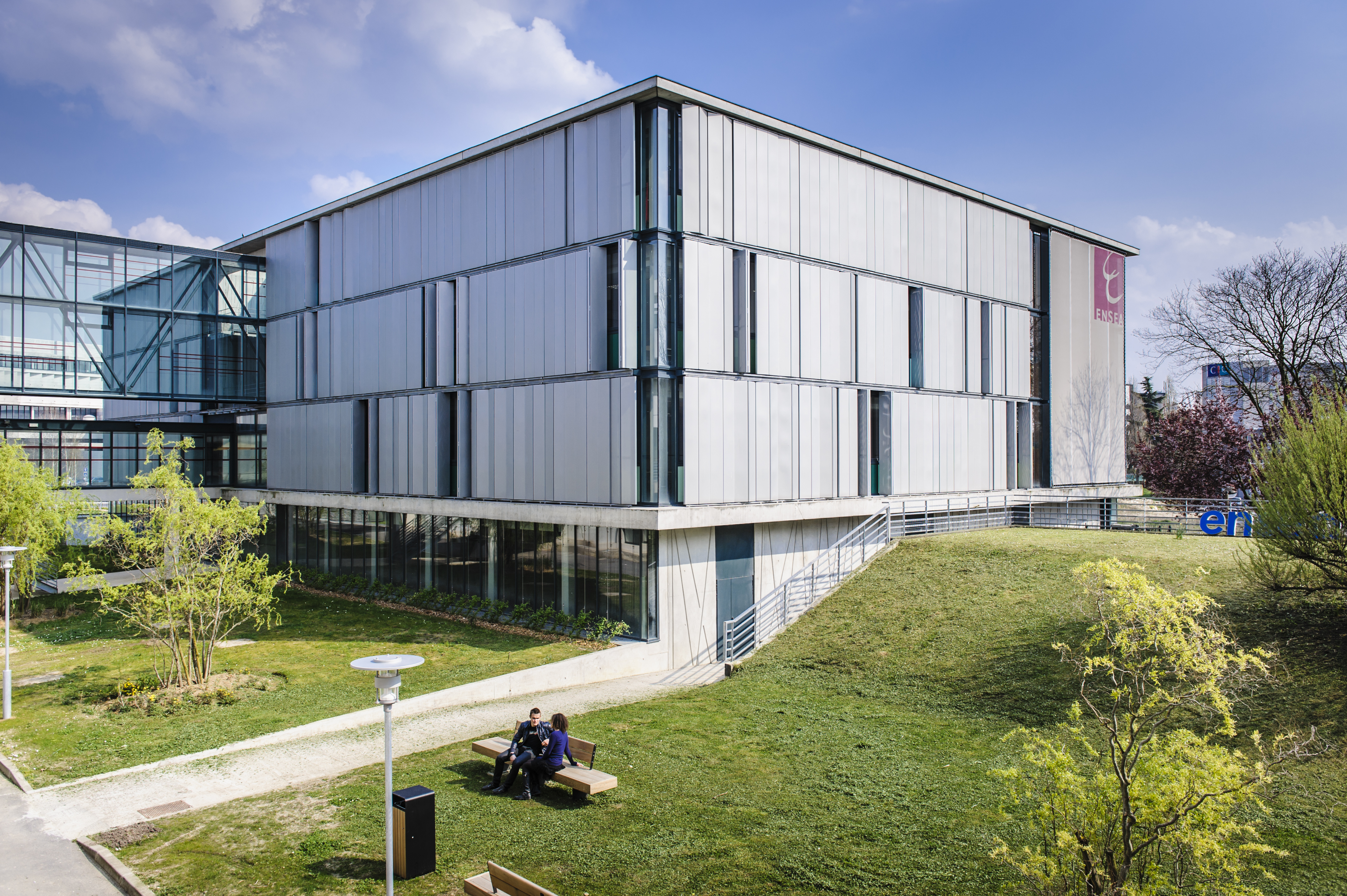
ENSEA (École Nationale Supérieure de l'Électronique et de ses Applications) is a French public grande école d'ingénieurs in Cergy, west of Paris, under the Ministry of Higher Education and Research. It trains generalist engineers in electronics, information technology and telecommunications, as well as energy management and embedded systems, and has done so since 1952.
The school awards six qualifications: the state engineering diploma under student status, the same diploma under apprentice status (electronics and industrial computing), the Bachelor Human-IT in Technologies de l'Information et Société (a bachelor's degree conferring the grade of Licence), the Master 2 Recherche in Informatique et Ingénierie des Systèmes Complexes (in partnership with CY Cergy Paris Université), and two Mastère Spécialisé programmes, AASP (Audio, Acoustics & Signal Processing) and EDESI (Electromagnetic Disturbance & Electronic System Integrity).
The engineering cycle lasts three years at 60 ECTS per year, with a common generalist core, second-year majors and options (including Drones, IoT, Microelectronics, Human-Centered Design, AI and Big Data, Electric Vehicles and MAKER) and eight specialisations in the third year. Teaching is in French and English, with fewer than ten students per teacher quoted for the engineering programme.
ENSEA has belonged to CY Alliance, a grouping of higher education and research institutions in the western Île-de-France region, since 2020, and has been a strategic partner of Institut Mines-Télécom since April 2024. Its research is carried out in two laboratories on campus, ETIS and LÉA, and five technology platforms. Its strategic plan is SYNERGY 2024-2028.
The campus has an on-site student services team, more than 35 student associations, a doctor under agreement and a social worker present one day a week. About 10% of students are international, and the school holds the highest (three-star) level of the Bienvenue en France label from Campus France, awarded in 2024. Its engineering training is accredited by the CTI and holds the European EUR-ACE label; it also holds the Erasmus+ Good Practices label.
ENSEA is a public institution. For the 2025 intake, the engineering cycle costs 628 EUR in registration fees (waived for scholarship holders) plus 295 EUR in school fees payable by all. The Bachelor Human-IT costs 3,100 EUR per year, 1,550 EUR for scholarship holders and 5,200 EUR for non-EU students; apprentices have fees paid by the host company.
ENSEA takes part in awarding the Eiffel Excellence Scholarship (master level applications sent to [email protected]; see Campus France). The Student Life department advises on CROUS scholarships, the Georges Besse aid programme and Égalité des Chances du Val-d'Oise, state-guaranteed student loans (up to 20,000 EUR, State guarantee of 70%) and student jobs; some students are recruited each year by the documentation service. CROUS emergency aid and the Studapart housing guarantee are also relayed. More: Student services.
Bourse Eiffel (candidatures présentées par l'ENSEA, niveau master) →
Browse the scholarships listed for ENSEA and check each award’s eligibility.
View scholarships for ENSEA →Applicants from general, technological or vocational baccalauréat tracks, or university students changing course, apply through Parcoursup. Shortlisted candidates take a 15-minute oral (a 5-minute presentation of motivation followed by a 10-minute discussion with the jury). Under the 2026 Parcoursup calendar, wishes are formulated from 19 January to 12 March 2026 and responses arrive from 2 June to 11 July 2026.
Students from MP, MPI, PC and PSI classes join through the Centrale-Supélec concours (grands admissibles are exempt from orals; admissibles sit orals at ENSEA in mathematics, physics and English). PT and TSI students use the Arts et Métiers ParisTech concours (registration December to January), and ATS students the ATS concours.
Admission sur titre for holders of a foreign diploma is made directly to the school by email; ENSEA is not connected to the Études en France platform. Entry is possible into first year (Bac+3 validated) or second year (Bac+4 validated, or a US senior year). Third-year entry is possible but does not lead to the ENSEA engineering diploma. Applications are accepted for 1 September intake only, with a deadline of 15 April and a reply towards the end of April. The file contains the application form, the curricular plan, transcripts of all higher education years with ranking (translated and certified if not in French or English), a language certificate (TCF or DELF for French; TOEIC, IELTS, TOEFL or Cambridge for English), CV, motivation letter in French or English, a copy of an identity document, and a 56 EUR application fee. Selection criteria are academic results, language level, a clear career plan and motivation. Exchange students come through partner agreements, Erasmus+, the FAME programme (US third-year electrical engineering or computer science students, spring semester, deadline 15 October) or double-degree agreements. The second year can be taken entirely in English, along with two third-year specialisations.
The Master 2 Recherche (Systèmes Intelligents et Communicants) is taken in parallel with the third engineering year or by holders of a Bac+4/engineering diploma on file application. The Mastères Spécialisés AASP and EDESI admit engineers or equivalent in electronics, mechanics, acoustics or signal processing (AASP) and electronics or electrical engineering (EDESI) on file and interview. Doctoral positions in ETIS or LÉA are by unsolicited application.
EU, Norwegian, Icelandic and Swiss citizens do not need a visa. Other students follow French embassy or consulate procedures; the International Relations Office assists after admission with registration, accommodation and an International Welcome Desk. Students must arrange supplementary medical, liability and repatriation insurance where needed.
Cergy campus (6 avenue du Ponceau, Cergy-Pontoise, Val-d'Oise) is the school's single site, where all engineering, bachelor, master and Mastère Spécialisé programmes and both laboratories are located.
Housing: the school partners with Studapart for private accommodation, and the CROUS of Versailles manages six residences in and around Cergy; applications go through the CROUS Dossier Social Étudiant (15 January to 30 April before the academic year).
Study programmes offered at ENSEA.
Experiences shared by students of ENSEA.
Studied here? Share your experience to help other applicants.

Book a free consultation with our expert counsellors and take the first step towards your dream university.
Copyrights © 2026 StudyMapped. All rights reserved.

Enter your credentials to continue.
Join us and start your study abroad journey.


