
University in France
Brest, Bretagne, France
University profile
The École navale is the French naval academy: a military higher-education institution that trains the officers of the Marine nationale and awards the engineer title (titre d'ingénieur). Created under that name by a royal ordinance of Louis-Philippe on 1 November 1830, it has had the status of an établissement public à caractère scientifique, culturel et professionnel – grand établissement (EPSCP-GE) since 1 January 2017.
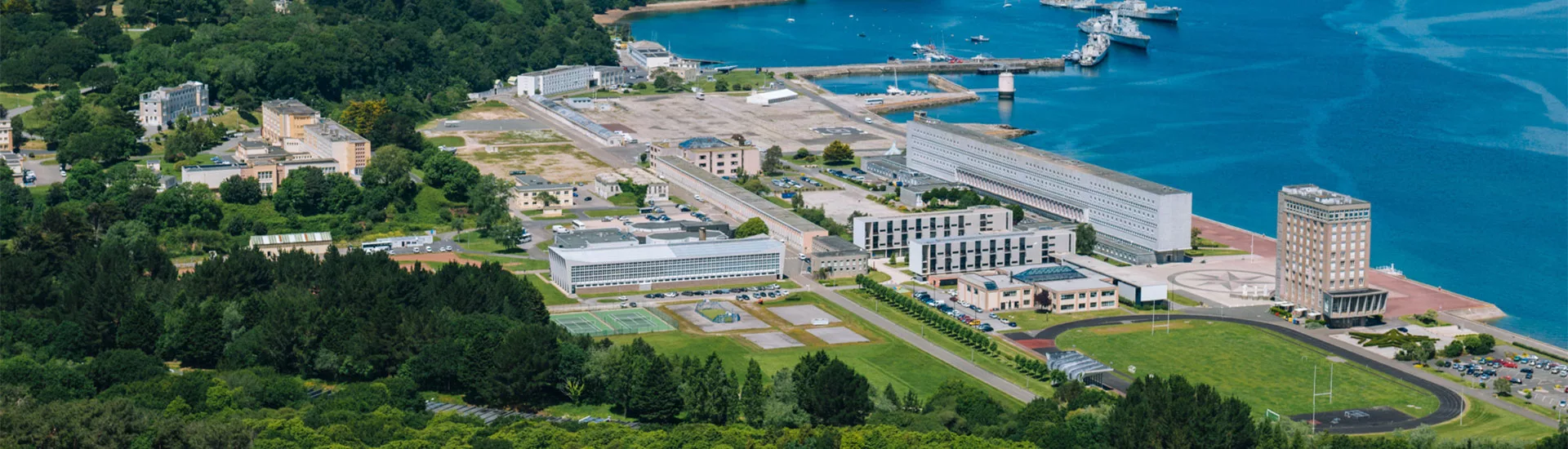
The school stands on a campus of more than 100 hectares at Lanvéoc-Poulmic, on the Crozon peninsula in Finistère (Route du Poulmic, 29160 Lanvéoc), reached from Brest in about 45 minutes by car or 30 minutes by boat, with daily shuttles between the two. All teaching, sport, accommodation and research facilities are inside a military enclosure.
The main programme is the three-year engineer course for career naval officers, delivered in two streams: Opérations/Énergie (energy and propulsion, with later options in nuclear or aeronautical energy) and Opérations/Navigation (conduct of air-sea operations, with specialisms such as anti-submarine warfare, pilot, clearance diver or commando). Alongside it the school runs a one-year course for contract officers, bi-diploma routes with partner schools, short courses for other officer corps, and civilian higher-education programmes at master and doctoral level, including the master 2 Mécanique et énergie en environnement naval, the English-taught master AMASONE and a management qualification in maritime projects and ship maintenance.
Research is carried out by the Institut de Recherche et d'Études Navales (IRENav), created in 2000, with four research axes and several industrial chairs (cyber-defence of naval systems, NAIADE on artificial intelligence for decision support, Prospective et Innovation, Résilience et Leadership). Experimental facilities include a hydrodynamic tunnel and the G3E embedded energy management platform.
Student life is collective and maritime. Officer cadets live on campus in rooms of about 110 m2 with a sea view, sleeping in dormitories of up to eight, and have a sailing marina, swimming pool, gymnasium, 400 m track, rugby stadium, tennis courts, obstacle course, navigation simulator, media library and Fablab. The student union (BDE) and clubs such as light sailing, surf, diving, fishing, choir, oenology and rugby support projects like the 4L Trophy and the Nijmegen march. The school welcomes foreign cadets through partner-country competitions, the Franco-German EFENA exchange, EMILYO and Erasmus+, and hosts foreign doctoral students and researchers.
Browse the scholarships listed for École navale and check each award’s eligibility.
View scholarships for École navale →French students enter in year 1 from scientific classes préparatoires aux grandes écoles (competitive entrance exam), in year 2 through the bi-diploma route with a partner school, or in year 3 as students of the École Polytechnique. The course lasts three years, leads to the engineer title and carries a commitment to serve as a career officer for at least 27 years. Recruitment information is available through lamarinerecrute.fr, the CIRFA recruiting offices and the Bureau Recrutement Officiers ([email protected]).
Foreign cadets enter year 1 by competitive examination organised within partner countries and follow the three-year École navale master-level curriculum, with an exchange semester in years 1 and 2. Franco-German cadets can follow the cross-training EFENA scheme: two years of military and maritime training in Germany, four years of science at a Bundeswehr university, then the application year at the École navale (contact: [email protected]). General international enquiries: [email protected].
Contract officers (one year at the school, first contract of eight years) are recruited internally (officiers mariniers, OSC COSER, volontaires officiers aspirants) or externally with a diploma at bac+3 minimum via marinerecrute.fr. Students who have validated two years in a partner school may join the last two years of the engineer course and obtain a double diploma. Other officer corps (OSM-SC, OSM, OSC COSER, VOA, reserve officers) and the naval aviation pilot course (EOPAN, ages 17 to 25) follow shorter courses of four weeks to four months.
A one-year master 2 attached to the Energy mention of the ENSAM master. Admission at bac+4; pre-selection file on the ENSAM website before June. Semester 1 is taught at the École navale; semester 2 is an R&D placement in a laboratory or company.
A two-year international master taught in English with Centrale Nantes (M1 at Centrale Nantes, M2 at the École navale), aimed mainly at foreign students. Admission at bac+3 (BSc or BTech in mechanical, electrical, ocean or naval engineering); selection by file and interview.
One-year diploma accredited by the Conférence des grandes écoles and awarded with ENSTA. Admission with a master 2 (bac+5), a master 1 with at least three years of professional experience, or a licence with at least ten years; selection by file and interview.
Three-year doctorates are supervised through IRENav. Candidates hold a bac+5 level; selection is by hearing before an internal commission, and positions are advertised on the school's website. Contact: [email protected].
Master students, doctoral and post-doctoral researchers can apply for Erasmus+ mobility grants for study or placements, as can officer cadets abroad for their synthesis project; priority destinations are the European Union and several associated countries ([email protected]).
Lanvéoc-Poulmic (Crozon peninsula, Finistère) is the single campus of more than 100 hectares, within a military enclosure on the shore of the Brest roads, about 45 minutes by car or 30 minutes by boat from Brest. All teaching and research take place here.
Study programmes offered at École navale.
Experiences shared by students of École navale.
Studied here? Share your experience to help other applicants.

Book a free consultation with our expert counsellors and take the first step towards your dream university.
Copyrights © 2026 StudyMapped. All rights reserved.

Enter your credentials to continue.
Join us and start your study abroad journey.


