
University in Canada
Montreal, Quebec, Canada
University profile
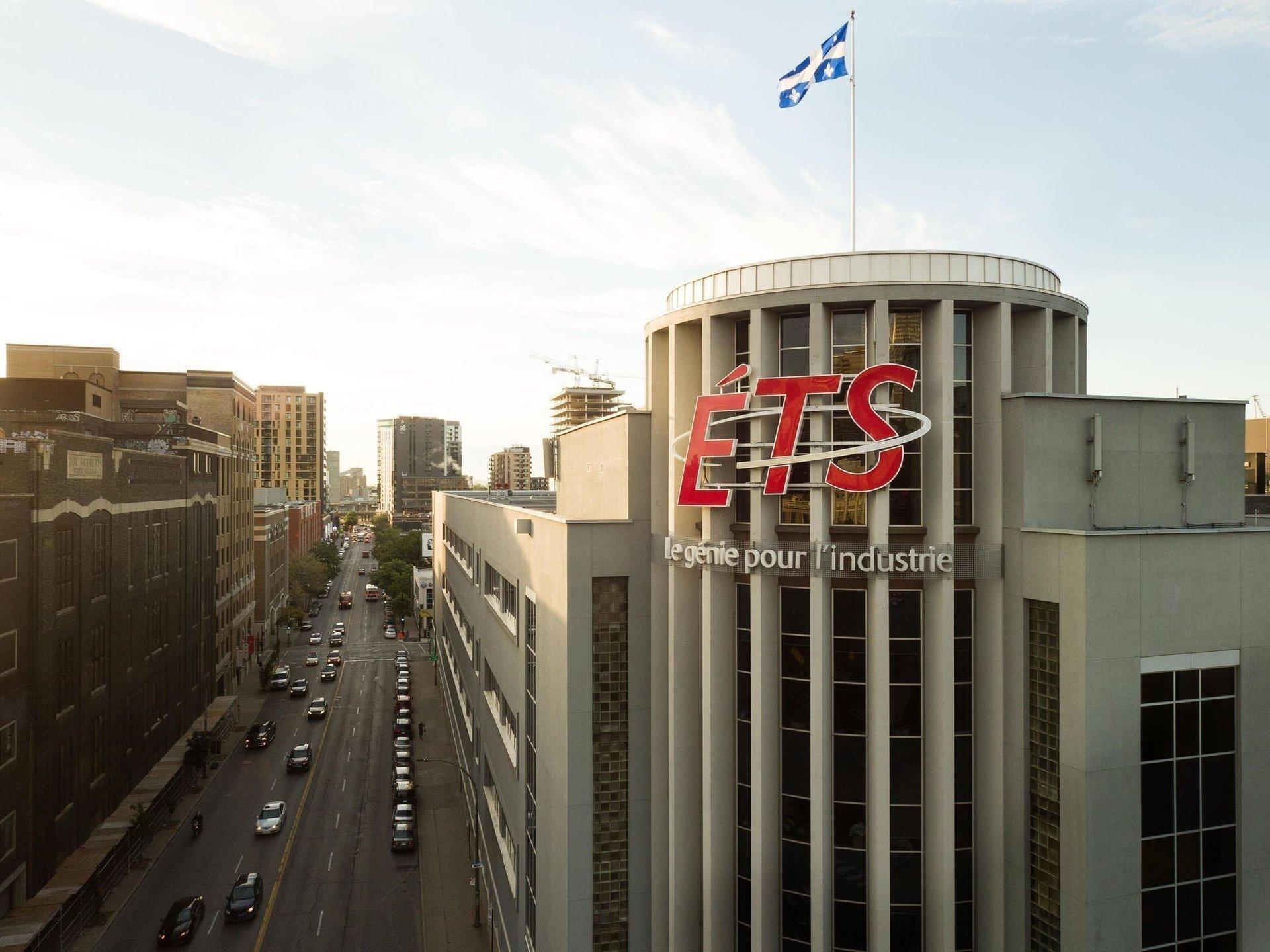
École de technologie supérieure (ÉTS) is an engineering university in Montréal, Québec, and a constituent of the Université du Québec network. Founded in 1974 to meet the need for practical engineers able to take on strategic and technical roles, it is dedicated to the technological and economic development of Québec. ÉTS trains more than 25% of the engineers in Québec and ranks second in Canada for the number of bachelor's degrees in engineering awarded. Co-operative education, applied research, collaboration, innovation and entrepreneurship are the pillars of its mission.
The main campus lies on Notre-Dame Street West in the Griffintown and Peel area, minutes from downtown, Old Montréal and the Lachine Canal, in a set of lettered pavilions (A, B, D, E and others) that house classrooms, labs, a library, a cafeteria, a sports centre, a childcare centre and student services. A campus in Longueuil, opened in 2025 at the École nationale d'aérotechnique, specializes in aerospace technologies. ÉTS has more than 12,000 students, 39,000 graduates, about 2,000 employees including over 380 professors and teaching professors, and offers more than 95 programs: 24 undergraduate programs (including 10 bachelor's degrees) and 71 graduate programs.
Teaching is organized in six engineering departments plus a General Education Department: Construction Engineering, Electrical Engineering, Mechanical Engineering, Systems Engineering, Software and IT Engineering, Aerospace Engineering and Design. Bachelor's programs include aerospace, construction, electrical, software, mechanical, environmental, IT, operations and logistics, and automated manufacturing engineering, plus distributed computing and user experience (UX) design. Graduate offerings include master's degrees (project-based M.Eng. and thesis-based M.A.Sc.), specialized graduate diplomas (DESS), short programs, microprograms and a PhD in engineering. Bachelor of Engineering degrees are accredited by Engineers Canada. Every bachelor's student completes paid co-op work terms, with more than 1,200 companies offering internships each year, and the School states it offers more lab and practical work than any other engineering program in Québec.
Student life centres on the Office of Student Clubs, which oversees some sixty clubs and student groups and more than 1,000 students, with 3,300 m2 of dedicated workshop and design space and participation in international competitions. ÉTS residences house 1,100 students near campus. Centech, the ÉTS business incubator and accelerator, ranks among the top 10 accelerators in the world by UBI Global. ÉTS has been carbon-neutral since 2021.
More than 4,300 international students from 86 countries study at ÉTS, and the School has more than 100 partner universities in 28 countries. International applicants need a Certificat d'acceptation du Québec (CAQ) and a study permit. Undergraduate teaching is in French; graduate programs may be taken in French or English depending on the program, and the PhD is offered in French and English.
More than a hundred scholarships are awarded each year to ÉTS engineering students, recognizing academic excellence, perseverance, career choice and extracurricular involvement; some are for Canadian citizens and permanent residents and others for international students. Private foundations and granting agencies also offer awards. Details and application tips are on the ÉTS scholarships page, with new opportunities announced through Info Bourses. Many ÉTS professors pay a bursary to doctoral students they supervise from their research funds, and many ÉTS doctoral candidates receive approximately $20,000 annually.
One-time bursaries for students facing a budget deficit or precarious financial situation. Eligibility: full-time registration, one completed full-time ÉTS session, minimum 2.0 average (undergraduate) or 3.0 (graduate), previous fees paid, Canadian citizen, permanent resident or international student present in Canada, a Social Insurance Number on file, and no bursary received in the past year. The maximum total per academic year (September to August) is $1,000. Apply through the Forms menu in MonÉTS (Bourse de soutien financier); processing can take up to six weeks. Questions: [email protected].
The Office of Student Life Emergency Assistance Fund provides one-time last-resort help for basic necessities to students registered in at least one course, after a mandatory interview. The Food Bank provides baskets of groceries worth up to $100 for a $5 cost to students under set household income limits (for example $22,801 for one person), limited to 150 people per semester.
Canadian citizens, permanent residents, refugees and protected persons may use the Government of Québec Loans and Bursaries Program (Aide financière aux études), with ÉTS Office of Student Life staff advising on applications. Institution code 978010; program codes include 40050 (Bachelor of Engineering) and 40000 (master's, doctorate, certificates). Loans and Bursaries Program and Financial Support.
Browse the scholarships listed for École de technologie supérieure and check each award’s eligibility.
View scholarships for École de technologie supérieure →The academic year has three semesters. Deadlines for Canadian applicants: summer semester April 1, fall semester August 1, winter semester December 1. International applicants: summer December 1, fall March 1, winter July 1. For PhD applicants (international), the deadlines are January 15 (summer), May 15 (fall) and September 15 (winter). International master's thesis and doctoral students may be eligible for late admission on the recommendation of the research supervisor, subject to immigration processing times. Some programs do not admit in the summer semester. The fall deadline may differ for the Preparatory Year and the UX Design bachelor's. Except for UX Design, ÉTS programs have no admission quotas. Applications are submitted online through the ÉTS admission portal (etsmtl-admission.omnivox.ca); attachments must be under 5 MB each in pdf, gif, jpg, jpeg, png, tiff, bmp, doc or docx format.
Bachelor of Engineering degrees comprise about 120 credits over four years of full-time study (Distributed Computing: 90 credits, 7 semesters), plus three paid four-month co-op work terms. Undergraduate teaching is in French. Admission is based on a Québec DEC (technical or pre-university science, depending on the program; applicants with non-matching DECs complete the Technological Academic Path first), a Canadian community college diploma from recognized programs, a French Baccalauréat scientifique from a Québec lycée, a French BUT/DUT, an international technical diploma at Bac+2 level, or professional experience (a Québec AEC with 30 technical units and two years of relevant experience). For the software engineering bachelor's, applicants from a pre-university DEC in natural sciences or computer science and mathematics enter directly or after the Technological Academic Path with a minimum average of 2.30/4.30. Applicants admitted on a technical DEC take diagnostic tests. Applicants with certain qualifications may need preparatory chemistry (CHM015), mathematics (MAT015) and physics (PHY015) or college-level calculus, linear algebra, chemistry, mechanics, electricity and waves courses. A Preparatory Year and a one-year Technological Academic Path (32 credits, French, fall admission) are available for applicants who do not meet entry requirements directly.
Transcripts and diplomas in a language other than English or French must come with a certified French translation (consulate, embassy, or a member of OTTIAQ). Applicants from a French DUT/BUT provide university transcripts and a birth certificate; Canadian community college applicants provide transcripts, a birth certificate, and proof of citizenship or permanent residence. Immigration documents are required after admission.
Undergraduate applicants must show sufficient French: a Québec DEC meeting French requirements, a French-language secondary diploma, a Québec university degree from a francophone university, or a recognized test. TFI 800 or more satisfies the policy (700-799 admission conditional on a French course; under 700 refused). TCF C1/C2 satisfies it (B2 conditional; B1 or lower refused). DALF C1/C2 satisfies it (DELF B2 conditional; B1 or lower refused). Tests must be less than 24 months old. Study completed in French in certain exempted countries (including France, Belgium (French system), Benin, Burkina Faso, Burundi, Cameroon (French system), Comoros, Congo, Côte d'Ivoire, Djibouti, Gabon, Guinea, Luxembourg, Madagascar, Mali, Niger, Central African Republic, Rwanda, Senegal, Switzerland (French system), Chad and Togo) exempts the candidate. Applicants who do not meet any option take the ÉTS-prescribed French test (administered by the UQAM École de langues) and, if needed, a remedial French course before the end of the second semester.
Master's with project, DESS and short programs require the same type of French evidence (secondary studies in French, three years of university studies in French, or a recognized test; at graduate level TFI 605 or more, TCF B2 or higher, DELF B2/DALF C1-C2 satisfy the policy). Thesis-based master's and doctoral applicants may demonstrate sufficient French or English: TOEIC 725, TOEFL iBT 75 (PBT 549) or Academic IELTS 6.5, or secondary studies in English, or a degree with three years of university study entirely in English. For the master's in information technology engineering, applicants need a bachelor's degree in engineering, computer science or applied sciences with a significant computing component and a cumulative average of at least 3.0/4.3 (between 2.8 and 3.0 considered after review); bridging courses may be imposed. The PhD (90 credits, French and English, full-time) requires a master's degree (M.A.Sc. or M.Eng.) or equivalent in an appropriate field, with a letter of recommendation depending on the profile; in exceptional cases an outstanding bachelor's graduate may be admitted, and some thesis-master's students may transfer directly to the doctorate.
International students need a Certificat d'acceptation du Québec (CAQ) issued per level of study, a study permit and, where required, a visa or eTA. The process begins when the ÉTS letter of admission is received (a conditional letter is sufficient to start), and a new CAQ is needed on changing level of study. Health and hospitalization insurance must be maintained. Engineers Canada accreditation of ÉTS bachelor's degrees is recognized as substantially equivalent to French CTI-accredited engineering degrees. Under agreements with Québec, French and French-speaking Belgian undergraduates pay the Canadian non-resident rate and graduate students the Québec rate. Exchange, dual-degree, IUT exchange and 3-12 month research laboratory internship programs exist for students from partner institutions.
Québec residents: bachelor's about $20,400; master's about $7,000; DESS about $4,100; PhD about $14,000. Canadian students not resident in Québec: bachelor's about $52,000; master's about $17,100. International students: bachelor's about $165,100 (about $38,950 a year); thesis master's about $37,100; project master's about $50,400; DESS about $32,000-32,500; PhD about $17,900 total, with international doctoral students receiving an exemption bursary for the fixed amount if not funded by another Québec ministry program, so they pay close to Québec rates. Tuition is billed per credit each semester, with a single payment around the sixth week of the semester; international students can pay through the CIBC International Student Pay portal. Fees are set by the Government of Québec and may change yearly.
The Montréal campus emphasizes green roofs, pollinator gardens and native trees, and the student clubs occupy 3,300 m2 of design, manufacturing and testing space.
Study programmes offered at École de technologie supérieure.
Experiences shared by students of École de technologie supérieure.
Studied here? Share your experience to help other applicants.

Book a free consultation with our expert counsellors and take the first step towards your dream university.
Copyrights © 2026 StudyMapped. All rights reserved.

Enter your credentials to continue.
Join us and start your study abroad journey.


