
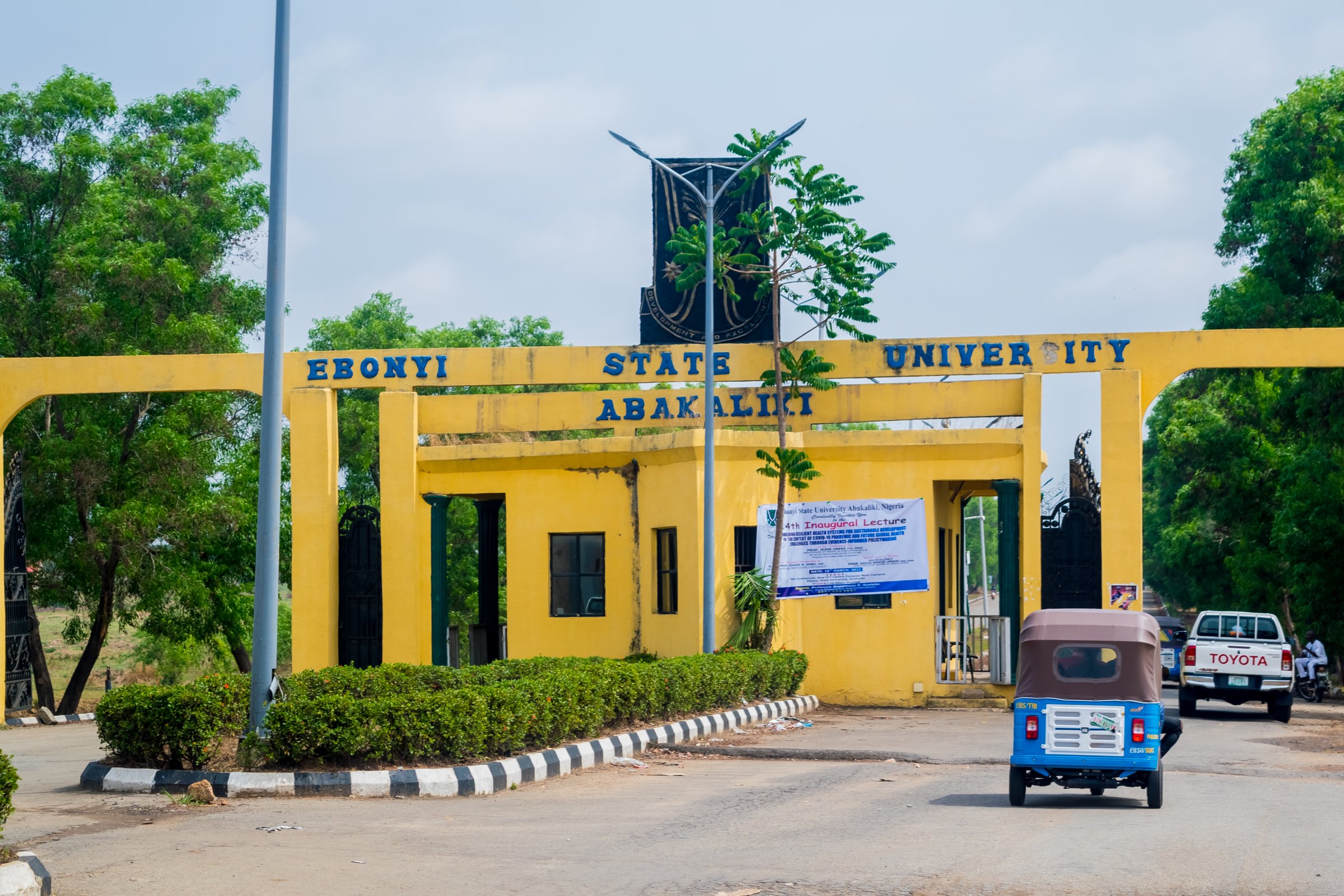

University in Nigeria
Abakaliki, Ebonyi State
University profile
Ebonyi State University (EBSU) is a state government university in Abakaliki, the capital of Ebonyi State in south-eastern Nigeria. It was established under Ebonyi State University Law No. 7 of 1999 (assented to on 14 January 2000) and grew out of the Abakaliki campus of the former Anambra State University of Science and Technology. Its vision is to rank among the best citadels of learning in the world, with excellence in learning, research and community service, and its mission is to provide a conducive atmosphere for teaching, learning, research and rapid development that turns the state's human resources into skilled power.
The university is organised into ten faculties: Science; Agricultural and Natural Resource Management; Health Science and Technology; Social Sciences and Humanities; Basic Medical Sciences; Clinical Medicine; Education; Management Sciences; Law; and Engineering (which also covers Environmental Sciences). Departments include Applied Biology, Applied Microbiology, Biochemistry, Biotechnology, Computer Science, Geology and Exploration, Industrial Chemistry, Industrial Mathematics and Statistics and Industrial Physics in Science; Agricultural Economics and Extension, Animal Science, Fishery and Aquaculture, Food Science and Technology and Soil Science in Agriculture; Medical Laboratory Science and Nursing Science in Health Science and Technology; Anatomy, Physiology and Medicine and Surgery in the medical faculties; Accountancy, Banking and Finance, Business Management, Marketing and Public Administration in Management Sciences; and Chemical, Civil and Electrical and Electronics Engineering, Architecture, Building Technology and Estate Management in Engineering.
The Faculty of Social Sciences and Humanities covers Economics, English Language and Literature, History and International Relations, Language and Linguistics, Library and Information Science, Mass Communication, Philosophy and Religion, Political Science, Psychology, Social Work and Sociology and Anthropology. The Faculty of Education offers programmes in Arts and Social Science, Business, Educational Foundations, Guidance and Counselling, Home Economics, Human Kinetics and Health Education, Science Education, and Technology and Vocational Education. The Faculty of Law has Business Law, Civil Law, International Law and Jurisprudence, Private and Property Law and Public Law departments.
Beyond regular undergraduate degrees, EBSU runs a School of Postgraduate Studies, a Work and Study Programme (WASP) and a weekend programme for workers who wish to study while keeping their jobs (both set up in 2000), a Pre-Degree programme in science and arts, and JUPEB. Directorates and centres include the ICT/Research Centre, the Biotech Research and Development Centre, the Directorate of General Studies, the Entrepreneur Development Centre, Research, Innovation and Commercialization, the Directorate of Works and the Directorate of Consultancy. The university also hosts a health policy and systems research initiative and has TETFund-supported intervention programmes.
Student support services include a health service and a counselling and psychological service, a university security unit, a Central Library with an e-library and digital library, and a Moodle e-learning platform for students. The university celebrates its Law faculty's success at African moot court competitions among its recent achievements.
Browse the scholarships listed for Ebonyi State University, Abakaliki and check each award’s eligibility.
View scholarships for Ebonyi State University, Abakaliki →Admission is through UTME and Direct Entry, followed by an online Post-UTME screening exercise. Candidates who chose EBSU as first choice, and those who chose other institutions but wish to change to EBSU, and who scored 150 and above in the 2026/2027 UTME may apply.
The general university cut-off is 150. Programme minimum scores: Medicine and Surgery 250; Anatomy 160; Physiology 160; Nursing Science 230; Medical Laboratory Science 200; Law 240; Accountancy 160; Mass Communication 180; Computer Science 170; Chemical Engineering 170; Civil Engineering 160; Electrical and Electronics Engineering 170. Other Management Sciences, Social Sciences and Humanities, and Science courses, and the faculties of Agriculture and Natural Resources Management, Education and Environmental Sciences are set at 150.
Candidates must upload their O-Level results to the EBSU portal and to the JAMB portal before they can be recommended for admission. Candidates awaiting 2026 NABTEB, WAEC (May/June) or NECO (June/July) results are eligible to apply. Names on O-Level certificates, UTME results and other registration documents must be identical; inconsistency may lead to disqualification.
For 2026/2027 the application period ran from 22 May 2026 to 22 June 2026. The screening is online and candidates are not required to appear physically. A non-refundable processing fee of N2,000 applies. To apply: log in to the EBSU Post-UTME portal, choose Online Application Forms, select the Post-UTME form (or the Direct Entry form), enter the JAMB registration number, log in to generate a payment invoice, pay at any bank or online by debit card, then return to the portal to complete the form using a personal email address and phone number. Admission status is communicated through the EBSU portal, and an offer must be accepted on JAMB CAPS within two weeks or it is withdrawn.
Direct Entry candidates who chose EBSU are also screened online and must ask their institutions to verify their A-Level certificate on the JAMB portal so that EBSU can recommend them to JAMB for admission.
Newly admitted candidates must accept admission on JAMB CAPS before paying the acceptance fee, and acceptance and school fee invoices must be generated through the university portal. Documentation requires the original JAMB result slip, O-Level result slips (WAEC/NECO/NABTEB), pre-degree result slip where applicable, acceptance fee slip, Local Government identification letter, bursary receipt, and birth certificate or age declaration.
Postgraduate applications are made through the university's postgraduate application portal. Pre-Degree, Work and Study and JUPEB applications are made through the online application portal.
Abakaliki (main campus): the university is located on the Enugu-Abakaliki Road, Abakaliki, Ebonyi State (P.M.B. 053). Faculties, the postgraduate school, the Pre-Degree school and the Work and Study programmes are served from the university's Abakaliki sites.
Central Library: a two-storey building housing subject libraries for Science, Education, Social Sciences, Agriculture, Engineering and Management Sciences, a second-floor e-library with 50 desktop computers, and a digital library. It serves a student population of 16,500, has a total seating capacity of 10,000 and opens from 8:00 AM to 4:00 PM. Academic staff may borrow 2 books per month and students 1 book for one to two weeks. E-libraries are provided in most campuses and faculties.
Health and welfare: a health service and a counselling and psychological service are available, together with an institution security unit. The university also runs a bookshop, a dairy and poultry farm and an automobile maintenance unit.
Study programmes offered at Ebonyi State University, Abakaliki.
Experiences shared by students of Ebonyi State University, Abakaliki.
Studied here? Share your experience to help other applicants.

Book a free consultation with our expert counsellors and take the first step towards your dream university.
Copyrights © 2026 StudyMapped. All rights reserved.

Enter your credentials to continue.
Join us and start your study abroad journey.


