
University in South Africa
Durban, KwaZulu-Natal, South Africa
University profile
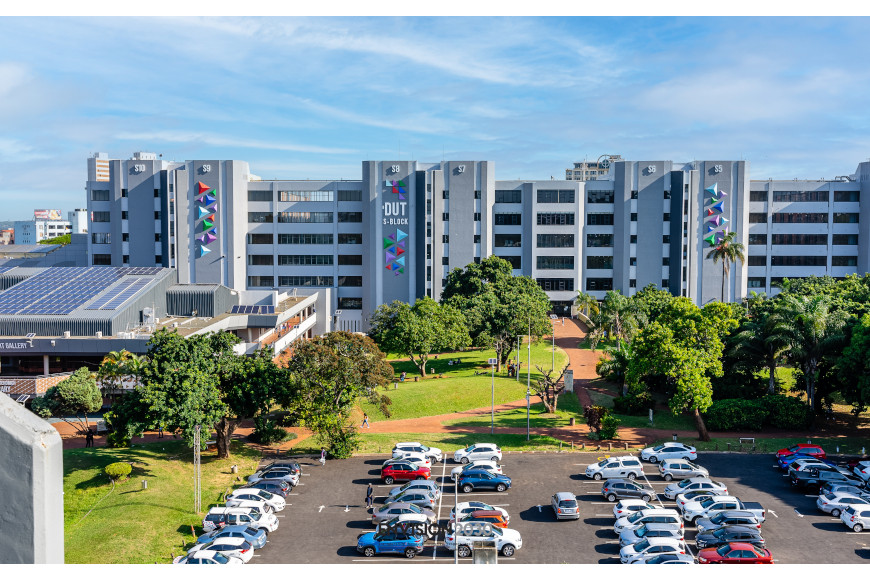
The Durban University of Technology (DUT) is a public university of technology in KwaZulu-Natal that describes itself as having over 34 400 students. It traces its roots to 1907 and operates as a multi-campus metropolitan university, with five campuses in Durban and two in the provincial capital, Pietermaritzburg. Its qualifications range from higher certificates and diplomas to bachelor's degrees, postgraduate diplomas, honours, master's and doctoral degrees, and the 2027 Study Opportunities guide lists 187 programmes across six faculties. Undergraduate programmes include a compulsory period of work-integrated learning, supported by the Cooperative Education Directorate.
The six faculties are Accounting and Informatics, Applied Sciences, Arts and Design, Engineering and the Built Environment, Health Sciences and Management Sciences. The DUT Business School sits within the Faculty of Management Sciences and offers academic programmes, executive education and short learning programmes. The guide notes that some qualifications are only offered on the Durban campuses.
DUT's research areas named on its About page include Food Science and Nutrition, Green Engineering, Smart Grids and Global Health and Sustainability. The university hosts the Institute for Water and Wastewater Technology, the Institute for Systems Science, the Urban Futures Centre and a Confucius Institute, and two University Technology Stations (the Energy Technology Station and the Reinforced and Moulded Plastics Technology Station). Entrepreneurship support includes the Invotech business incubator and DUT Enactus.
Student life is organised through Student Services, which includes Student Housing and Residence Life, Student Counselling and Health, Student Governance and Development, Sports Administration and a Disability Rights Unit. Student housing figures published by the university are 2 253 DUT-owned beds, 7 DUT-owned residences in Durban and 5 in Pietermaritzburg, and a larger number of leased residences. Accommodation is limited and is not guaranteed, and the university says students living within 30 km of the campus do not qualify for residence. The Faculty of Health Sciences runs public clinics in chiropractic, homoeopathy, somatology, dental care and radiography that also serve as training sites.
International applicants are supported by the International Education and Partnerships directorate at ML Sultan Campus. The international admissions policy sets a target of at least 7% international students and aligns with the SADC Protocol on Education and Training. The medium of instruction is English. DUT states that it is a member of the International Association of Universities and of the Association of Commonwealth Universities, and says its qualifications are recognised nationally and internationally.
Under the DUT Scholarship Policy administered by the Finance Department, a new full-time South African first-year student with an NSC aggregate of 80% or higher is eligible for a 100% remission of first-year tuition fees, and one with 70-79% for a 50% remission. Returning students who passed the full curriculum with distinctions on the first attempt can receive 100% remission of tuition for the next level, and 50% for an overall pass with distinction. The Student Services page also invites Grade 11 and 12 learners to complete an online scholarship grant form, noting that only students with an A or B aggregate are eligible.
The DUT Postgraduate Scholarship Scheme, run by Research and Postgraduate Support, offers a maximum of R70 000 for master's study (two years) and R100 000 for doctoral study (three years), with tuition waived for the official study period. Applicants must be full-time registered master's or doctoral students (acceptance letters are considered), hold at least 60% in the most recent relevant qualification and be within the official study period; South African citizens are prioritised and only first-time qualifications at a level are eligible. The 2026 call opened 27 September 2025 and closed 31 July 2026, with monthly processing cycles; applications are made online and help is available from [email protected] or 031 373 2946. Renewal needs an approved progress report submitted between 1 and 12 November. DUT may decide not to fund any application.
The Financial Aid Unit administers donor bursaries and NSFAS funding for full-time South African students; donor bursaries are advertised on notice boards in Financial Aid, targeted academic departments and faculty offices. NSFAS applications are made at nsfas.org.za (the prospectus gives household income thresholds of R350 000, R600 000 for persons with disabilities, and SASSA recipients). Contact: Durban 031 373 2553, [email protected]; Pietermaritzburg 033 845 8889/8890, [email protected].
DUT Financial Aid and Scholarships | Postgraduate scholarships call | Funding guideline (PDF)
DUT Undergraduate Scholarship Award for New Students (USAS) →
DUT Undergraduate Scholarship Award for Returning Students (Fee Remission) →
Browse the scholarships listed for Durban University of Technology and check each award’s eligibility.
View scholarships for Durban University of Technology →Per the 2027 Study Opportunities guide, minimum requirements under the HEQSF are: Higher Certificate, an NSC with a rating of 3 (40-49%) for English; Diploma, an NSC with a rating of 3 for English and a rating of 3 in four recognised 20-credit subjects; Bachelor's degree, an NSC with a rating of 3 for English and a rating of 4 (50-59%) in four 20-credit subjects from the NSC designated subject list. NSC achievement levels are calculated for the top six subjects excluding Life Orientation. Each department also sets programme-specific requirements, applicants are ranked on a points system, and meeting the minimum does not guarantee a place. Selection may include interviews, aptitude tests or portfolio assessments, and some programmes have extended-curriculum routes.
Higher Certificate: at least 50% in English. Diploma: at least 50% in three fundamental subjects including English and at least 60% in three compulsory vocational subjects. Bachelor's degree: at least 60% in three fundamental subjects including English and at least 70% in four compulsory vocational subjects.
Under Rule G7(3), applicants aged 23 in the first year of registration with at least three years of appropriate work experience and/or demonstrated capacity may be admitted to degree or diploma and certificate studies. Capacity is assessed through the DUT Standardised Assessment Test for Access and Placement, Academic Literacies and English for Academic Purposes tests and/or programme-specific assessments, and applications under this rule must be submitted at least four months before the academic year starts. Recognition of Prior Learning applications carry a non-refundable R290 fee (2026 Fees Booklet) and are handled by the Centre for Excellence in Learning and Teaching (031 373 2904 / 2386).
First-time undergraduate applicants apply through the Central Applications Office (CAO) at www.cao.ac.za. How to Apply 2027 gives a closing date of 30 September 2026 (some programmes close earlier) and lists an application fee of R250 for South African citizens and R300 for international applicants. The prospectus lists the CAO fee as R250 (R300 international) if the form and fee reach the CAO on or before 31 October 2026, and R470 (R580 international) from 1 November 2026, with a R140 fee to change programme choices. Applicants upload certified copies of their ID and Grade 11 and 12 results (or June/trial results). Applicants who have studied at DUT or another university apply through the DUT online application. Residence is requested on the CAO application and accommodation is not guaranteed.
International applicants must hold a study permit from a South African mission in their home country and provide proof of medical cover registered under the Medical Schemes Act (not required for asylum seekers or refugees). Cambridge GCE or GCSE holders need at least five approved O Level subjects, at least four at A, B or C, no more than one D, and English Language or Literature. Other international qualifications must be evaluated by SAQA, and Bachelor's applicants must also obtain Matriculation Board evaluation through Universities South Africa (mb.usaf.ac.za). Contact the International Education and Partnerships office: +27 31 373 5474 or [email protected]. Per the 2026 Fees Booklet, SADC undergraduates pay local fees plus a foreign levy (R7 190 annual or R3 600 per semester in the levy table), non-SADC African students pay local fees plus 25%, and non-African students pay local fees plus 100%. Master's and doctoral international students pay local fees and the student admin services levy, with the foreign levy exempted.
Postgraduate diploma, master's and doctoral applications go through the faculty; the Study Opportunities guide lists a postgraduate contact person per faculty. After the research proposal is approved by the Faculty Research Committee a master's or doctoral student formally registers and re-registers annually. International postgraduate applicants must obtain a study permit in their country of origin.
DUT lists seven campuses. Addresses are as published on its Maps and Directions page.
Facilities published by the university include the DUT Library with site libraries, group study rooms, laptop loans and subject librarians; a Writing Centre; five campus clinics in Durban and two in the Midlands; residences owned by the university in Durban and Pietermaritzburg; restaurants; an art gallery; and the Faculty of Health Sciences clinics. Residence offices are at Gate 5, 79 Steve Biko Road in Durban and 13 FJ Sithole Road, Imbali in Pietermaritzburg.
Study programmes offered at Durban University of Technology.
Experiences shared by students of Durban University of Technology.
Studied here? Share your experience to help other applicants.

Book a free consultation with our expert counsellors and take the first step towards your dream university.
Copyrights © 2026 StudyMapped. All rights reserved.

Enter your credentials to continue.
Join us and start your study abroad journey.


