

University in United States
Durham, NC, United States
University profile
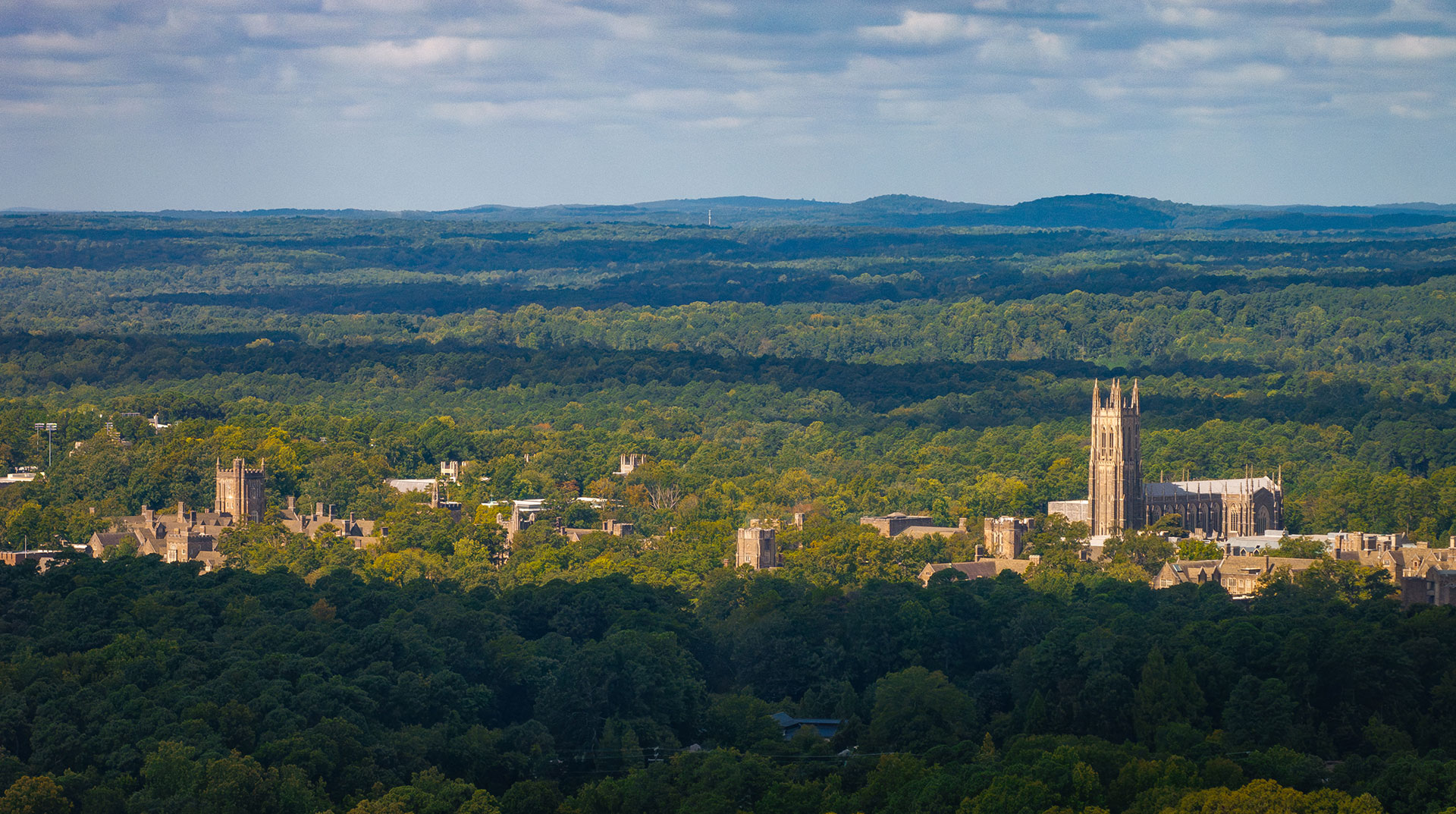
Duke University is a private research university in Durham, North Carolina, United States. Its origins go back to a small school opened in 1838 in Randolph County, North Carolina; the institution moved to Durham as Trinity College in 1892 and became Duke University in 1924 through the Duke Endowment established by James Buchanan Duke as a memorial to his father, Washington Duke. Fall 2025 enrolment was 17,325 students, including about 6,400 to 6,500 undergraduates and 10,200 graduate and professional students, taught by roughly 4,100 faculty.
Undergraduates enrol in either Trinity College of Arts & Sciences or the Pratt School of Engineering. Graduate and professional study is organised through the Graduate School, the Divinity School, the School of Law, the School of Medicine, the School of Nursing, the Fuqua School of Business, the Nicholas School of the Environment and the Sanford School of Public Policy. Duke also operates Duke Kunshan University in China and is affiliated with Duke-NUS Medical School in Singapore. The Duke University Marine Lab in Beaufort, North Carolina, is the university's year-round coastal campus.
Cross-disciplinary work is organised through university-wide institutes and centres, among them the John Hope Franklin Humanities Institute, the Kenan Institute for Ethics, the Social Science Research Institute, the Nicholas Institute for Energy, Environment & Sustainability, the Duke Global Health Institute, the Duke Institute for Brain Sciences, Duke Innovation & Entrepreneurship, the Rhodes Information Initiative at Duke, Duke Science & Society and the Duke Margolis Institute for Health Policy. Duke Health brings together the Duke University Health System, the School of Medicine, the School of Nursing, Duke-NUS, the Global Health Institute and the Margolis Institute.
Undergraduate life centres on a student-to-faculty ratio of 7:1, with 54% of undergraduates taking part in faculty-mentored research and 54% studying away. East Campus has been home to all first-year students since 1995. The university has 36 residence halls and apartment buildings on its Durham campus, 25 athletics and recreation buildings and 27 varsity teams that compete as the Blue Devils; Duke counts 17 NCAA national championships.
International students are part of the undergraduate and graduate community. The Karsh International Scholarship is open to non-U.S. citizens with demonstrated financial need, and the university expects to meet the full demonstrated need of 20 to 25 international undergraduates each year. English proficiency tests are recommended for non-native speakers applying to undergraduate study, and required for graduate applicants whose first language is not English.
Undergraduate financial aid is awarded on demonstrated financial need and Duke meets 100% of demonstrated need for eight semesters of undergraduate study. Aid is calculated as cost of attendance minus expected family contribution, and an offer typically combines grant aid, a federal loan and work-study. Roughly 50% of undergraduates receive aid. U.S. citizens, permanent residents and a limited number of international students are admitted without regard to financial circumstance. Undergraduate tuition is $70,265 for 2025-26, with estimated fees of $2,907, housing of $10,910 and food of $10,075; the estimated total cost before aid is $98,549. Apply with the CSS Profile and the FAFSA (students who are not U.S. citizens or permanent residents may skip the FAFSA): November 3 for Early Decision and February 1 for Regular Decision. Details: Karsh Office of Undergraduate Financial Support.
All admitted first-year students are automatically considered for Duke merit scholarships selected by the Office of University Scholars and Fellows; there is no separate application, except for the Robertson Scholars Program, which has its own application, and the Nakayama Scholarship, awarded to rising seniors. Merit scholarships cover tuition, mandatory fees, room and board for four years: Alumni Endowed, Angier B. Duke, Benjamin N. Duke, Karsh International, Trinity and University scholarships. Finalists are notified in April. See Merit Scholarships.
Duke expects to enrol 20 to 25 international undergraduates each year whose full demonstrated need is met. International applicants must tick the financial aid interest box on the admissions application; applicants admitted with no financial aid interest and all international transfer students are ineligible for aid for any year of undergraduate study. Federal loans are not available to international students. Aided international students are automatically renewed each year and are enrolled in the Duke Student Medical Insurance plan, covered by grant aid. The Karsh International Scholarship is open to citizens of any country outside the U.S. (not dual U.S. citizens) with demonstrated need, and covers tuition, room and board, mandatory fees, demonstrated need exceeding those costs and three summers of funding for research, unpaid internships and other opportunities; the application is simply the Duke application with financial aid requested. See Karsh International Scholars Program.
Karsh International Scholarship →
Duke Need-Based Financial Aid for International Undergraduates →
Duke University Merit Scholarships (A.B. Duke, B.N. Duke, Alumni Endowed, Trinity, University) →
Robertson Scholars Leadership Program (Duke and UNC-Chapel Hill) →
Browse the scholarships listed for Duke University and check each award’s eligibility.
View scholarships for Duke University →Applicants apply through the Common Application, or the QuestBridge Application for eligible students. Applicants choose between Trinity College of Arts & Sciences and the Pratt School of Engineering. Required materials: Common Application, high school transcript, Secondary School Report with counselor recommendation, two teacher recommendations (at least one from a math or science teacher for Pratt), Duke short essays, and the application fee. First-quarter grades are required for Early Decision, and midyear grades by February 15 for all applicants. Final transcripts are required of admitted students.
Duke recommends four years of English and at least three years of mathematics, natural sciences, world language and social studies, with about five academic courses per year. Pratt applicants must have calculus; physics is strongly recommended. Advanced coursework (AP, IB, honors, accelerated or college courses) is encouraged. Limited credit and advanced placement are granted for AP, IB and pre-matriculation college work after admission.
Duke is test-optional for first-year and transfer applicants in the 2026-2027 cycle. SAT or ACT scores are considered if submitted, self-reported scores are accepted, and official scores are required only from students who enrol.
$85, nonrefundable; fee waivers are available for students with high financial need.
Applicants must have attended college within the past four years and completed at least one full year of transferable college work at an accredited degree-granting institution by August of entry. Applications are made through the Duke Transfer Application or the Scoir Coalition Application. About 70 students transfer in each fall, mostly as sophomores. Required: college report, college and final high school transcripts, two instructor evaluations (at least one from a college instructor), essays and financial aid forms. Applicants with a completed bachelor's degree are not eligible.
Transcripts that need translation into English may be translated by an official service, an EducationUSA adviser or a school official, with the original documents also submitted. English proficiency tests are recommended, not required, for non-native speakers or those not in an English-medium curriculum; the highest score is used and no test is preferred. Minimum scores expected: TOEFL iBT 100 (or 75 on the paper-delivered test), IELTS band 7, Duolingo 130, PTE Academic 70, Cambridge C1 Advanced or C2 Proficiency 180. Interviews from InitialView are also considered for international applicants. Admitted international students must document funding by completing the Certificate of Financial Responsibility, sent by the Admissions Office on admission.
Graduate applications are made online through the Duke University Graduate School, with programme-specific requirements. Applicants whose first language is not English submit TOEFL, IELTS Academic or Duolingo English Test (with subscores) results; the Graduate School generally seeks at least 90 on the TOEFL iBT, 7.0 on the IELTS Academic and 125 on the Duolingo English Test. A waiver is available to applicants who studied full-time for two years or more at a college or university where the sole language of instruction is English, in a country where English is the primary spoken language. Admitted international students whose first language is not English take English placement exams on arrival. Professional schools (Law, Medicine, Business, Divinity, Nursing, Environment, Public Policy, Engineering) have their own application procedures.
Apply: Undergraduate admissions; Graduate School admissions.
The Durham campus has 245 buildings (excluding maintenance and support facilities): 118 academic and research buildings, 66 in the Medical Center, 25 for athletics and recreation and 36 residence halls and apartments. The Business, Divinity, Law and Medicine schools run their own libraries.
Study programmes offered at Duke University.
Experiences shared by students of Duke University.
Studied here? Share your experience to help other applicants.

Book a free consultation with our expert counsellors and take the first step towards your dream university.
Copyrights © 2026 StudyMapped. All rights reserved.

Enter your credentials to continue.
Join us and start your study abroad journey.


