
University in Germany
Berlin, Berlin, Germany
University profile
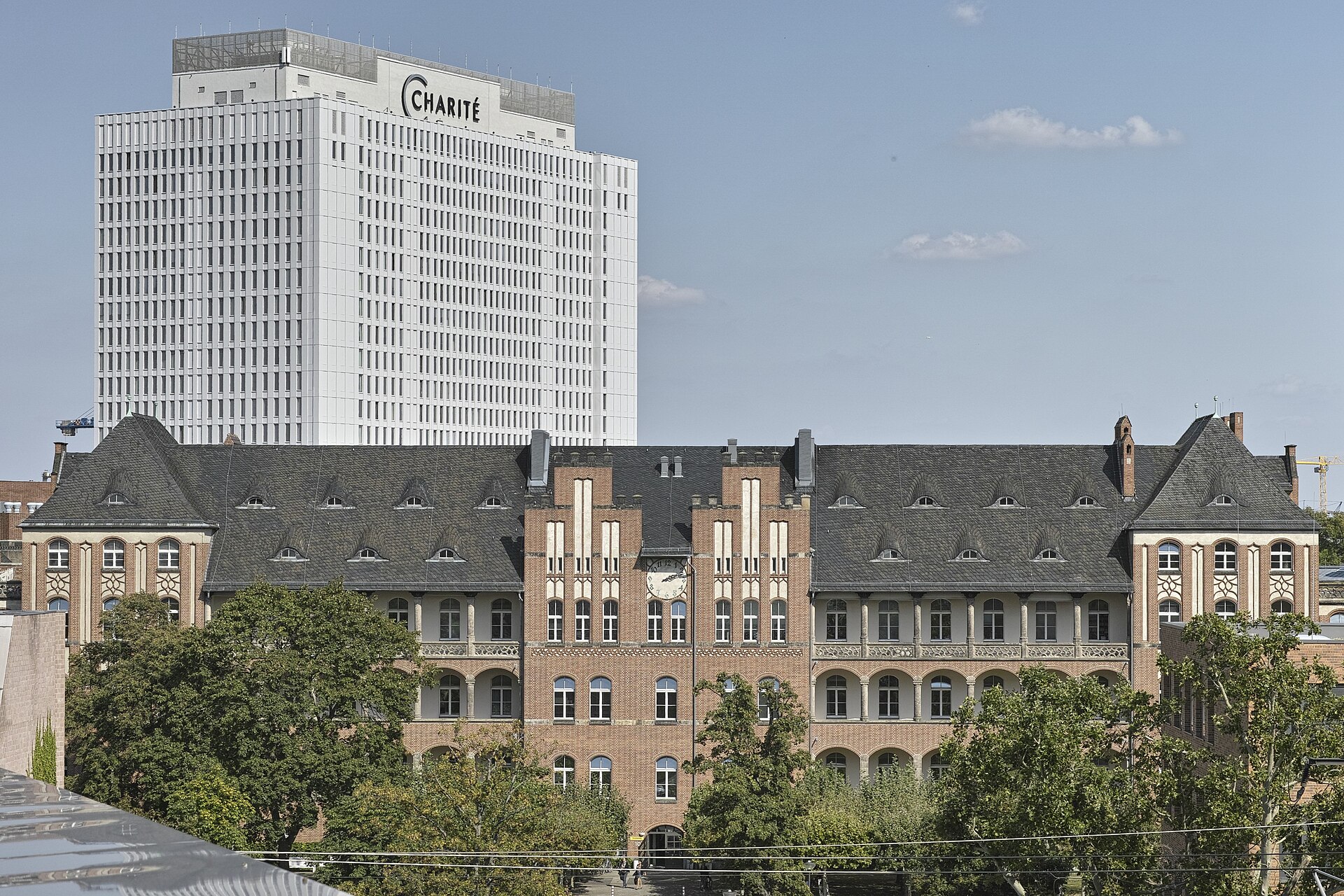
Charité – Universitätsmedizin Berlin is the joint medical faculty of Freie Universität Berlin and Humboldt-Universität zu Berlin and one of the largest university hospitals in Europe. It is wholly owned by the Federal State of Berlin and combines teaching, research and patient care in one institution.
Charité is organised into 17 CharitéCenters that house about 100 departments and institutes, for example the CharitéCenter for Basic Sciences, the CharitéCenter for Biomedicine, the CharitéCenter for Oral Health Sciences, the CharitéCenter for Global Health and the CharitéCenter for Tumor Medicine. Alongside the medical faculty and the university hospital, the Berlin Institute of Health at Charité (BIH) forms the third pillar as a translational research unit. Since 2023 the cardiac facilities of Charité and the German Heart Center Berlin have been united in the Deutsches Herzzentrum der Charité (DHZC).
The institution works on four campuses in different parts of Berlin: Campus Charité Mitte, Campus Virchow-Klinikum in Wedding, Campus Benjamin Franklin in the south of the city and the research-focused Campus Berlin Buch in the north-east. About 10,182 students are enrolled, more than 2,000 of them from abroad. The flagship programmes are the state-examination courses in Medicine (about 288 places per intake) and Dentistry (about 38), taught in German, supplemented by the Bachelor in Health Sciences, dual Bachelor programmes in Nursing Care and Applied Midwifery, and Master programmes including Public Health, Health Professions Education, Epidemiology, International Health, Medical Neurosciences and Molecular Medicine.
Research concentrates on six foci: infection, immunology and inflammation; cardiovascular research and metabolism; oncology; regenerative therapies; rare diseases and genetics; and neuroscience. Dedicated research centres include the Neuroscience Research Center, the Max Rubner Center for Cardiovascular Metabolic Renal Research, the Molecular Cancer Research Center, the BIH Center for Regenerative Therapies, the Experimental and Clinical Research Center and the National Center for Tumor Diseases Berlin. Charité belongs to the Berlin University Alliance with Freie Universität, Humboldt-Universität and Technische Universität Berlin.
Student life is supported by a Medical Library with three locations, a Learning Center (training and simulation centre), the Office of Student Affairs, student committees and councils, and the Dieter Scheffner Fachzentrum for curriculum development and advice. The Virchow Guest House at Campus Virchow-Klinikum offers accommodation near the campus. Students may take part in exchange programmes: about 160 Charité students go abroad each year and there are 71 Erasmus partner universities in Europe. Charité employs people from 133 countries and has been certified as a family-friendly employer (audit berufundfamilie and audit familienfreundliche hochschule) since 2007.
The state-examination programmes in Medicine and Dentistry, the Bachelor in Health Sciences and the Public Health Master carry no tuition fees; students pay enrolment and re-registration fees (Semesterbeitrag), which include the Deutschlandsemesterticket. For the Preparatory course, enrolment fees are currently approx. €380 including a Germany semester ticket. A late re-registration payment incurs a €19.94 fee. Some Master programmes charge tuition: the Molecular Medicine Master charges €2,500 per semester for 2026/27 plus a €150 matriculation fee and €215 for the travel ticket; the Medical Neurosciences Master charges €2,500 per semester plus an administrative fee of roughly €315 per semester that includes the travel ticket.
Charité has awarded Deutschlandstipendium grants to selected students since 2011, for students with outstanding achievements and social commitment. Information: Deutschlandstipendium at Charité.
The Promotionsstipendium I is a final scholarship of up to one year for Charité doctoral students who already have research results and wish to complete the dissertation. Calls are issued twice a year and awarded competitively by the Academic Grants' Committee (Kommission für Nachwuchsförderung); applications are accepted only during a call. Details: Support and Funding for Students and Early Career Researchers.
The Molecular Medicine Master offers no stipends of its own and points students to the Deutschlandstipendium and DAAD. Living expenses in Berlin are given as at least €900 per month. Details: Financing and scholarships.
Browse the scholarships listed for Charité – Universitätsmedizin Berlin and check each award’s eligibility.
View scholarships for Charité – Universitätsmedizin Berlin →Medicine (13 semesters, 300 ECTS, about 288 places) and Dentistry (11 semesters, 300 ECTS, about 38 places) are taught in German, full-time, and admit for both summer and winter semester. Both are admission-restricted.
Applications go through uni-assist e. V. Deadlines are 15 January for the summer semester and 15 July for the winter semester. Charité does not issue conditional admissions, so all requirements must be proven by the end of the application period. Documents: certificates of previous education, proof of German language skills, translations into German or English, passport and, for applicants from China, Vietnam and India, an APS certificate. Selection among the places open to this group is based solely on the average grade, with a lottery within equal grades; TestAS results, internships and letters of recommendation are not considered and no waiting semesters count.
There is no direct application to the Studienkolleg: applicants apply for medicine or dentistry via uni-assist, for the winter semester only, by 15 July (by 15 June for Bachelor programmes). The M-course normally lasts two semesters with German, biology, chemistry, mathematics and physics as compulsory subjects. Passing the test does not guarantee admission.
Applicants with a foreign entrance qualification or degree must prove German by the deadline. Accepted for study: DSH 2 or DSH 3; telc Deutsch C1 Hochschule; Goethe Certificate C2; ÖSD C2; the German Language Diploma (Level II) of the KMK with C1; TestDaF with at least level 4 in all four parts. Certificates older than three years are not accepted. Admitted applicants lacking a certificate may sit the DSH at the Humboldt-Universität language centre. Charité does not offer German preparatory courses.
Health Sciences (B.Sc., 180 ECTS, 6 semesters, winter start, about 80 places) and Public Health (M.Sc., 120 ECTS, 4 semesters, winter start, about 66 places) are taught in German and admission-restricted. Dual Bachelor programmes exist in Nursing Care and Applied Midwifery.
Medical Neurosciences (M.Sc.): deadline 15 January for an October start, 25 to 30 places; first degree in medicine, psychology or natural sciences, at least one year of practical experience, degree completed by 30 September of the intake year; English proficiency IELTS 6.5 minimum, or TOEFL paper 580, computer 237 or internet 92; APS certificate for China, India, Vietnam, Mongolia and Bhutan. Molecular Medicine (M.Sc.): up to 20 students a year; Bachelor, Diplom or Fachhochschule degree in a related science such as molecular medicine, biology or biochemistry; hands-on laboratory experience desirable; the portal opens in December for the following year's intake.
The doctoral project is registered with the Doctoral Office before work begins, with a doctoral agreement signed by the candidate and supervisors and the degree certificate (or proof of enrolment in medicine or dentistry at Charité). Routes are the individual procedure (Dr. med., Dr. med. dent., Dr. rer. medic.; Standard Track) or structured programmes and graduate schools (PhD, MD/PhD; Advanced Track), which have their own admission rules. Doctoral candidates enrol after approval of the project. The Medical Neurosciences doctoral programme requires an MSc in Medical Neurosciences (others via an evaluation exam) and a doctoral position or scholarship; deadlines 15 January, 15 May and 15 September.
Admissions office, Hannoversche Straße 19, 3rd floor, Room 074, 10115 Berlin; drop-in consultation Tuesdays 9:30-12:30; [email protected].
Teaching facilities include the Learning Center (training and simulation), the Medical Library with three locations, and the central e-learning platforms Campusnet and Moodle.
Study programmes offered at Charité – Universitätsmedizin Berlin.
Experiences shared by students of Charité – Universitätsmedizin Berlin.
Studied here? Share your experience to help other applicants.

Book a free consultation with our expert counsellors and take the first step towards your dream university.
Copyrights © 2026 StudyMapped. All rights reserved.

Enter your credentials to continue.
Join us and start your study abroad journey.


