
University in France
Gif-sur-Yvette, Île-de-France, France
University profile
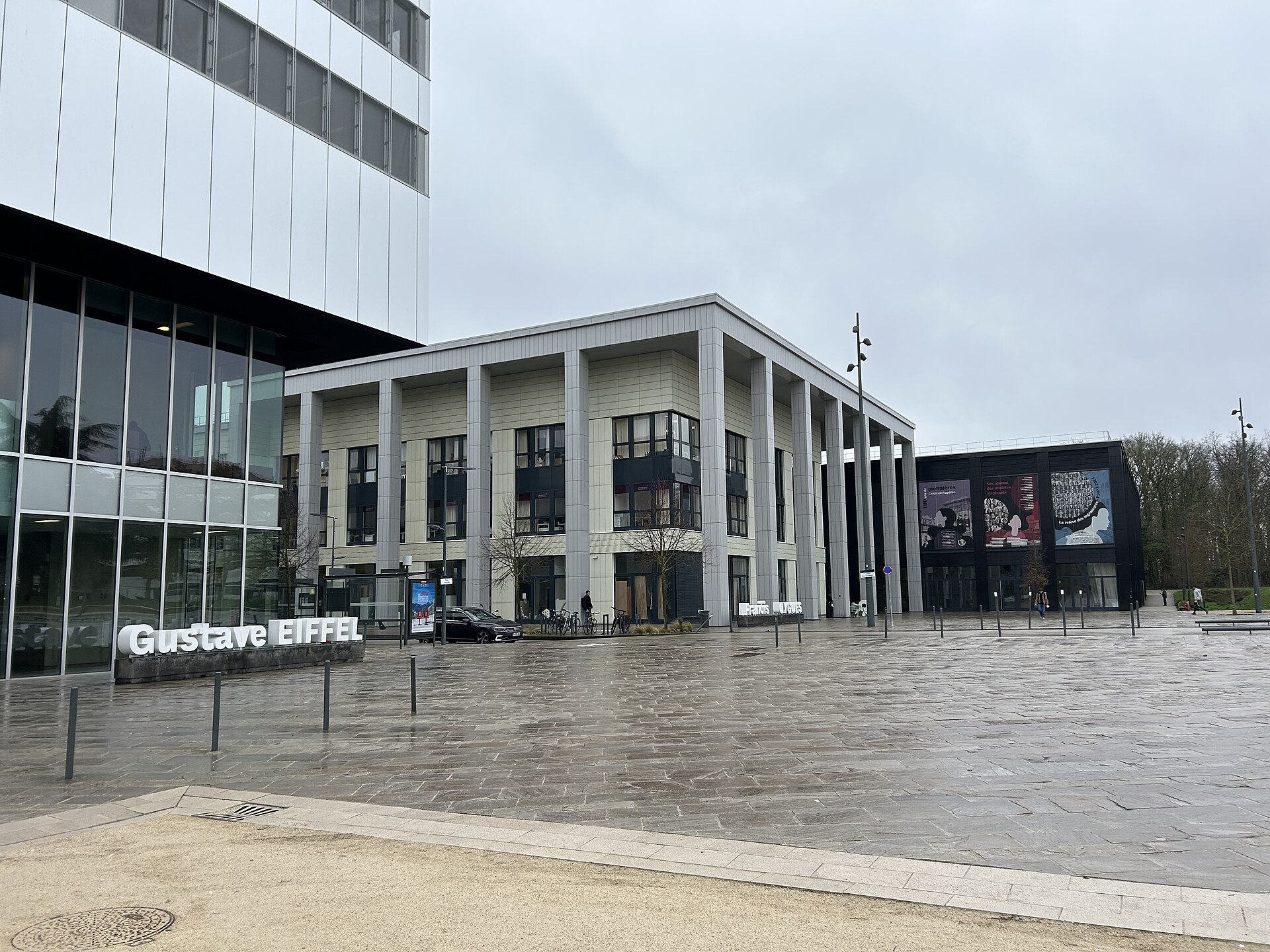
CentraleSupélec is a French grande école d'ingénieurs and a public establishment of a scientific, cultural and professional character, created on 1 January 2015 from the merger of the École Centrale Paris (1829) and the École Supérieure d'Électricité, known as Supélec (1894). Its main campus is on the Plateau de Moulon in Gif-sur-Yvette, in the Paris-Saclay cluster south of Paris, and it is a founding member of the Université Paris-Saclay, alongside the ENS Paris-Saclay, AgroParisTech and the Institut d'Optique Graduate School.
The school teaches on three established campuses: Paris-Saclay (Gif-sur-Yvette), Metz and Rennes (Cesson-Sévigné). A fourth, urban campus named Sébastienne Guyot, at 7 rue de Sainte-Hélène in Paris 13e, opens in February 2027 and is dedicated to digital sciences, artificial intelligence and innovation. The research centre brings together 18 laboratories and research teams, five joint laboratories and research chairs, with 532 teachers and teacher-researchers and 105 patents, working across computer science and AI, electrical engineering, electronics and photonics, applied physics and materials, mechanics and energy, process engineering and bioengineering, and industrial engineering and economics.
The flagship programme is the three-year Ingénieur Généraliste degree (Bac+5, taught in French, on all three campuses, full-time or by apprenticeship), supplemented by six specialist engineering curricula: Cybersecurity, Electrical Engineering (Energy and Systems), Electronics, Computer Science, Physical Engineering (quantum systems, photonics, nanotechnology) and Digital Systems. The engineering diploma is a national diploma accredited by the Commission des Titres d'Ingénieur and carries the EUR-ACE label. For international applicants, the school also runs English-taught joint Bachelors of Engineering (with McGill University, City University of Hong Kong and BITS Pilani), a Bachelor in AI, Data and Management Sciences with ESSEC, MSc programmes in Artificial Intelligence, DataSciences and Business Analytics (with ESSEC), Industry Transformation Management and Space Business Strategy, doctorates and executive education.
Physical education is compulsory, housing includes the Césal residence at Paris-Saclay, CROUS residences and campus residences in Metz and Rennes, and students use the Lumen learning centre at Paris-Saclay, shared with the Université Paris-Saclay and the ENS Paris-Saclay. The 21st by CentraleSupélec accelerator supports student entrepreneurs.
The school has an international orientation: its Erasmus+ code is F GIF-YVE03, it reports close to 200 partner universities and 80 double-degree agreements for the engineering programme, and it operates the Centrale Pékin programme with Beihang University. Its 2023-2032 strategic plan targets 4,000 graduates a year, and the school counts more than 55,000 alumni working in 80 countries.
For the engineering curriculum, non-scholarship students who are EU, EEA or Swiss nationals pay a progressive amount of between 2,500 € and 5,000 € per year, depending on household reference tax income per share; the amount fixed at entry is kept for the whole course. The school applies this scheme from 2026-2027 and continues it for 2027-2028. Students on CROUS social-criteria grants are exempt and apprentices pay no registration fees. A half rate applies in some cases (50% of the modulated amount). Students from outside the EU, EEA and Switzerland pay 6,180 €, or 3,090 € at the half rate, unless they meet an exemption (such as being the child or spouse of an EU national, holding long-term resident status in the EU, or holding a temporary residence permit and belonging to a tax household in France for at least two years). Partner-programme students pay the fees set in the partnership agreement. An online calculator is available.
MSc in Artificial Intelligence: 15,000 € for M1 (including a 1,500 € deposit) and 25,000 € for M2 (including a 2,000 € deposit); the deposit is paid on acceptance and deducted from the fees, and the balance is paid in one to three instalments before December. Students holding a CROUS scholarship pay 0 €. Bachelor in Global Engineering (2027 registrations): 44,000 € per year at CentraleSupélec, or 13,000 € for EU (including French) and Canadian students, plus the CVEC (contribution vie étudiante et de campus) of 103 €; at McGill in years 3 and 4 the indicative fees are 3,000 CAD (Quebec), 15,000 CAD (French and non-Quebec Canadian) and 64,000 CAD (international) per year. Access to a room in the Césal residence for the Bachelor is billed at 1,800 €.
CROUS social-criteria bursaries are awarded on household income, with exemption from registration fees and a monthly grant by level; applications are made, generally from March to May, on messervices.etudiant.gouv.fr. The annual specific allowance for students in lasting financial difficulty is available to those without a social-criteria bursary.
The Fondation CentraleSupélec supports more than 300 engineering students a year on top of State aid. In first year, each CROUS scholarship holder (levels 1 to 7) receives a 2,000 € living grant covering the integration weekend; women in a difficult financial situation can apply for the Sébastienne Guyot scholarships of 8,000 € a year for three years, awarded by a jury within the available number; students on bursaries or in financial difficulty can receive on average 5,000 € towards fees or living costs after commission review; and CROUS or international scholarship holders can borrow a computer for up to four months. In second year, CROUS scholarship holders receive a 1,000 € grant and can obtain a loan guarantee. Loan guarantees and tailored emergency aid are available in third year.
MSc in Artificial Intelligence: scholarships based on academic excellence and financial need, personalised, with applications opened after an admission offer and instructions given in the admission letter. Bachelor in Global Engineering with McGill: a one-year entrance scholarship, automatically considered with the application; a renewable Major entrance scholarship (up to three or four years) with a separate application; and the Entrance Bursary Program for need-based aid, applied for after an offer of admission. Applicants may also look at French government scholarships listed on Campus France. Erasmus+ mobility grants are available for study and traineeship periods abroad (Erasmus+ code F GIF-YVE03).
Fondation CentraleSupélec Bourses de vie and Loan Guarantees for Engineering and MS Students →
IDEX Paris-Saclay International Master Scholarship at CentraleSupélec →
Browse the scholarships listed for CentraleSupélec and check each award’s eligibility.
View scholarships for CentraleSupélec →Entry is at Bac+2 or Bac+3 and is competitive. Routes: the Concours Centrale-Supélec for students in classes préparatoires (MP, MPI, PC, PSI, TSI), including a concours reserved for non-French nationals enrolled in a French classe préparatoire and the Cycle international for students in preparatory classes abroad who have not studied in France (written tests in countries where the Concours Commun Mines-Ponts has centres, orals at CentraleSupélec); the PT bank (banque filière PT); the A BIO concours for BCPST; the ATS concours run by ENSEA; and the Concours Universitaire des Écoles Centrale for students in the final year of a Licence, a Bachelor or a BUT (48 places for student status and 5 for apprentices), plus a route for national and international-level athletes and artists with three years of scientific study.
Admissions parallèles also include recruitment on file from the double-degree Licences of the Université Paris-Saclay, double-degree admission for international students selected by their home university (at least two years at the home university followed by two years at CentraleSupélec; 45 places in first year and 45 in second year) and national dual-degree admissions (40 places). Apprenticeship status is chosen among the options when registering for the concours.
The Bachelor in Global Engineering (with McGill University, four years, two at CentraleSupélec and two at McGill) is entered after the baccalauréat or equivalent; applications for the 2027 intake are made on the McGill website. The City University of Hong Kong joint Bachelor of Engineering is also open for 2027, and the ESSEC joint Bachelor in AI, Data and Management Sciences opens applications at the end of October 2026.
MSc in Artificial Intelligence, M1: L3 in science or a 3- or 4-year Bachelor of Science, business school, BUT or health studies (LAS); minimum B2 English (for example TOEFL iBT 95, IELTS Academic 6.5, Cambridge B2 First 175). M2: at least 4 years of higher education (240 ECTS) in engineering, mathematics, statistics, informatics or physics with little or no work experience; minimum C1 English (for example TOEFL iBT 95, IELTS Academic 7). Applications run in five rounds for the 2027 intake; M1 round 1 closes with results by 25 November 2026 and the final M1 results come by 7 July 2027; M2 round 1 results are due by 18 November 2026, with the last round results by 30 June 2027. A 3-year Bachelor or Licence 3 leads to the two-year route (M1+M2) of the MSc in DataSciences and Business Analytics, while a 4-year Bachelor or Master leads to the one-year route (M2); applications for 2027 open at the end of October 2026.
Doctoral research is undertaken in a laboratory within one of the partner doctoral schools: at Paris-Saclay the doctorate is awarded by the Université Paris-Saclay through the schools EOBE, INTERFACES, SMEMAG, STIC and Hadamard; in Rennes through the Matisse school; and in Metz through the C2MP and IAEM schools. Cotutelle agreements with foreign institutions are possible and the Université Paris-Saclay awards a European Doctorate label for at least three months of mobility in Europe.
Sport is compulsory for all students (at least 1h30 per week), with 24 disciplines at Paris-Saclay. The 21st by CentraleSupélec accelerator operates at the Startup Campus on Paris-Saclay, at STATION F in Paris and at The Cave in Rennes.
Study programmes offered at CentraleSupélec.
Experiences shared by students of CentraleSupélec.
Studied here? Share your experience to help other applicants.

Book a free consultation with our expert counsellors and take the first step towards your dream university.
Copyrights © 2026 StudyMapped. All rights reserved.

Enter your credentials to continue.
Join us and start your study abroad journey.


