

University in Canada
Ottawa, Ontario, Canada
University profile
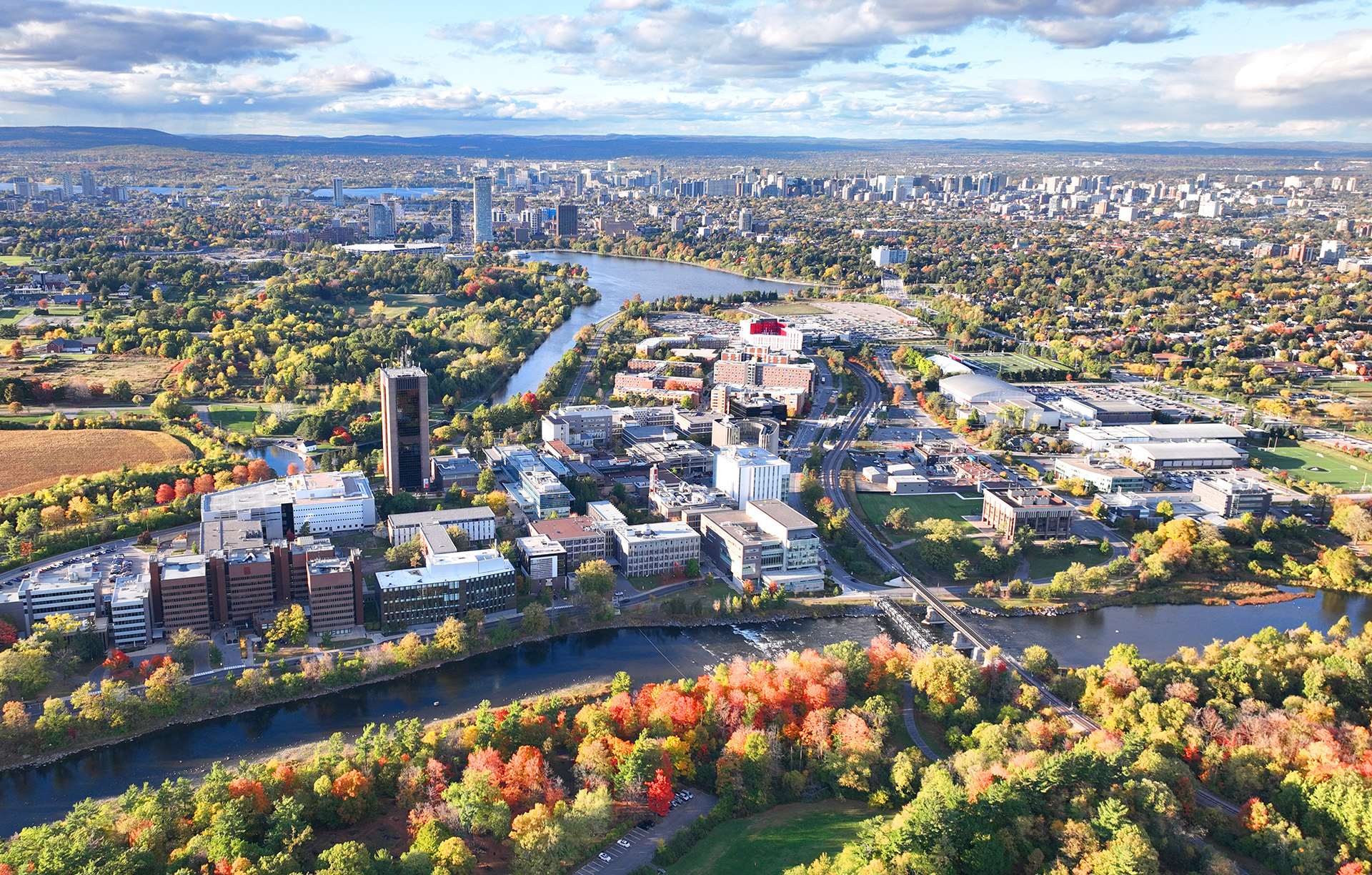
Carleton University is a public, research-intensive university in Ottawa, Ontario, Canada's capital. Established in 1942 as Carleton College, it is a non-denominational institution on a campus of about 100 acres between the Rideau River and the Rideau Canal, on unceded Algonquin Anishinàbeg territory and a short transit ride from downtown Ottawa. It is known for journalism, international affairs, engineering, architecture and high technology, and for interdisciplinary programs and strategic partnerships with the federal government, other universities and industry.
Enrolment is 30,675 students (24,847 undergraduate and 5,828 graduate), including 2,935 international students, from more than 160 countries. The faculty complement is 1,058. Undergraduate programs are delivered across five faculties: Arts and Social Sciences, the Sprott School of Business, Engineering and Design, Public Affairs, and Science. Degrees include Architectural Studies, Computer Science, Cybersecurity, Data Science, Engineering, Global and International Studies, Health Sciences, Industrial Design, Information Technology, Journalism, Media Production and Design, Music, Nursing with RN prescribing, Public Affairs and Policy Management and Social Work. More than 200 programs and streams offer co-op options.
Student life centres on the campus community: 170+ active clubs and societies, more than 350 varsity athletes competing as the Ravens, and the MacOdrum Library. A network of tunnels connects the campus buildings. About 4,000 residence spaces are available in 12 residence buildings linked by Teraanga Commons, the outdoor residence quad and a large dining hall. Common spaces include a fitness centre, games rooms, a multi-faith space, a community kitchen, the Mashkikì Pakesàyà Medicine Room and the Black Student Hub. Secondary school and CEGEP students entering first year in the fall who receive an offer of admission on or before May 31, 2027 are guaranteed a double traditional room, and international and nursing students are offered guaranteed 12-month residence.
International students apply directly through Carleton 360 or through the Ontario Universities' Application Centre (OUAC). International Undergraduate Admissions offers virtual meetings and live chat with admissions staff and current students, and the admissions office provides guidance on study permit applications. The graduate level is administered by Graduate Studies, offering master's, doctoral, diploma and collaborative specialization programs. Carleton is recognised as a National Capital Region Top Employer and is ranked #4 among comprehensive universities in Canada in the Maclean's 2025 comprehensive university category rankings.
Applicants admitted for fall entry with an admission average of 85% or better are automatically considered for a renewable Entrance Scholarship, provided they enter directly from high school or CEGEP with no previous post-secondary attendance. The complete application and all required grades must be received by June 15. Transfer students are considered for general in-course scholarships after one full academic year of full-time study at Carleton.
The highest awards go to applicants entering directly from high school or CEGEP with an admission average of 90% or better; the selection committee also assesses extracurricular activities. An application and a letter of reference are required by March 1.
International undergraduates entering directly from high school and paying international fees are automatically considered for CAD 2,000 to 5,000, depending on grades at admission, in addition to other Entrance Scholarships.
The Carleton University Entrance Bursary is need-based; apply online by June 30. The Leadership Entrance Bursary recognises school and community leadership and requires an application (deadline May 1). Work Study positions are available to students with demonstrated financial need, and on-campus jobs are supported by Career Services. Indigenous students may apply for awards including the Joyce Family Foundation Bursary (CAD 5,000) and the Humphrey Law Bursary for Indigenous Students in Business (CAD 5,000), and the Awards Office works with the Paul Menton Centre on awards for students with disabilities. Ontario residents may use OSAP. Graduate students are automatically considered for funding on application, which may include teaching assistantships, research stipends and assistantships, and admission scholarships. Across the university, more than 12,600 undergraduate scholarships and bursaries totalling over CAD 26.5 million were awarded in the last reported year.
Details: Scholarships and Bursaries; international costs; graduate funding.
Carleton University Renewable Entrance Scholarships →
Carleton University Prestige Scholarships →
President's Welcome Award for International Students →
Carleton University Entrance Bursaries (including Leadership Entrance Bursary awards) →
Browse the scholarships listed for Carleton University and check each award’s eligibility.
View scholarships for Carleton University →Admission is assessed by education background: Ontario high school, Canadian high school outside Ontario, CEGEP, American high school, International Baccalaureate, international high school (including Caribbean CAPE, Chinese, French Baccalaureate, Indian, UK/British A-Levels, West African WAEC and other national curricula), college or university transfer, home-schooled and mature applicants. Course and grade requirements differ by program and some programs have earlier deadlines, additional admission material or portfolio requirements.
English is the language of instruction. Applicants can show proficiency with transcripts for the past three years of full-time study at a Canadian high school taught in English, or at a high school, college or university in an eligible English-speaking country or territory; ESL courses do not count toward the three years and letters from educators do not waive the requirement. Test results are sent electronically using Carleton's institution number 0854.
Minimums for admission with no further ESL requirement: IELTS Academic 6.5 overall with 6.0 in each band; TOEFL iBT 86 for tests taken before January 21, 2026 (minimum 22 writing and speaking, 20 reading and listening), or 4.5 with 4.0 in each band for tests after that date; Duolingo English Test 120 (minimum 110 in writing, reading and speaking, 105 in listening); PTE Academic 55 (minimum 47 in each skill); CAEL 70 with 60 in each band; Cambridge C1 Advanced or C2 Proficiency 176 or above (minimum 169 in each component); AP English Language and Composition or Literature and Composition grade 4 or better; GCSE/IGCSE/GCE O-Level English grade B (6 in reformed qualifications); GCE A/AS Level English grade C; IB English A Standard or Higher Level grade 4. One year of full-time university study in Canada or two years at a Canadian public college also qualify.
Admission with an ESL requirement, where Academic ESL courses are taken alongside a limited number of degree courses: IELTS 5.0 (minimum 4.5 in each band); TOEFL iBT 51 (tests before January 21, 2026) or 3.0 with 2.5 in each band (after); Duolingo 80; PTE Academic 31 (minimum 24 in each skill); CAEL 40 (minimum 30 in each band); Cambridge 154 or above (minimum 148 in each component).
International applicants apply through the International Student Application in a Carleton 360 account (processing fee CAD 100) or through the OUAC application. Transcripts from the most recent or highest level of education and an English test score, if required, are uploaded to Carleton 360. Offers are mostly conditional; the offer package includes information needed to obtain a study permit and details of any scholarship or residence offer.
Applicants with prior college or university study can apply for transfer credit. Mature, home-schooled, internal transfer, re-admission and special (non-degree) applicants have separate admission categories.
Tuition is frozen for 2026/2027, 2027/2028 and 2028/2029 at CAD 39,000 per year for Arts, Communication and Media Studies, Global and International Studies, Public Affairs and Policy Management and Nursing with RN Prescribing; CAD 45,000 for Accounting and Media Production and Design; and CAD 55,000 for Architectural Studies and Information Technology. Estimated miscellaneous mandatory fees (UHIP, U-Pass, health services, athletics pass) are about CAD 2,500, and CAD 4,300 for Nursing.
Master's applicants normally need a four-year honours bachelor's degree with B+ or better in the major subjects and overall courses; each program sets its own minimums, and qualifying-year programs exist for a small number of master's programs. Most programs have two deadlines per term: the first for guaranteed consideration of admission and funding, the second if space and funds remain. Fall (September) is the normal start, with winter and summer entry in some programs. Applications from outside Canada should be completed five to six months before the intended start. Applications are submitted online with a non-refundable fee, followed by document uploads in Carleton Central (transcripts, referees, statement of intent, CV and English test scores as required).
Main campus, Ottawa, Ontario (1125 Colonel By Drive): about 100 acres between the Rideau River and the Rideau Canal, centrally located and accessible by transit, with campus buildings connected by tunnels. Teaching, research and all five undergraduate faculties are based here.
Study programmes offered at Carleton University.
Experiences shared by students of Carleton University.
Studied here? Share your experience to help other applicants.

Book a free consultation with our expert counsellors and take the first step towards your dream university.
Copyrights © 2026 StudyMapped. All rights reserved.

Enter your credentials to continue.
Join us and start your study abroad journey.


