

University in United States
Pasadena, CA, United States
University profile
The California Institute of Technology (Caltech) is an independent, privately supported science and engineering institute on a 124-acre campus in Pasadena, California. Its mission is to expand human knowledge and benefit society through research integrated with education, and it describes itself as small but committed to excellence and ambition, with one of the nation's lowest student-to-faculty ratios (3:1).
Academic work is organised in six divisions: Biology and Biological Engineering; Chemistry and Chemical Engineering; Engineering and Applied Science; Geological and Planetary Sciences; Humanities and Social Sciences; and Physics, Mathematics and Astronomy. Majors are called options, and every undergraduate takes a core curriculum spanning the basic sciences, humanities and social science. About 1,000 undergraduates and 1,400 graduate students study with more than 300 professorial faculty (323 professorial faculty and 558 postdoctoral scholars in the current at-a-glance figures).
Caltech manages the Jet Propulsion Laboratory (JPL) for NASA, owns and operates the Seismological Laboratory and a global network of astronomical observatories including the Palomar and W. M. Keck Observatories, and cofounded and co-manages LIGO, which observed gravitational waves for the first time in 2016. The institution cites 49 Nobel Prizes connected with its faculty and alumni. More than 50 research centres and institutes operate on campus, and about 90 percent of undergraduates take part in research, notably through the paid Summer Undergraduate Research Fellowship (SURF).
Student life centres on the residential community. Caltech guarantees housing and requires undergraduates to live on campus for their first two years; there are 11 residence halls, made up of eight traditional undergraduate Houses and three unaffiliated halls, with singles, doubles, triples and suites. New students choose a House through a process called Rotation. There are more than 100 student clubs, nine residential communities and 16 NCAA Division III teams, and student conduct is governed by an Honor Code.
The Institute welcomes international students: they are admitted under the same review as other applicants, with first-year applicants defined as non-U.S. citizens or permanent residents attending secondary school outside the United States. Need-based aid for international students is limited to those who apply for it as incoming first-year students.
Caltech meets 100% of demonstrated financial need for admitted students through grants and scholarships, work-study and loans. It does not award merit scholarships; aid is need-based, and named scholarships (some with a merit component) are considered automatically. Admissions is need-blind for domestic students and need-aware for international students because international aid funds are limited. For the incoming fall 2026 class the average grant was just under $69,000. Most students from families earning under $200,000 (with typical assets) can expect a package that covers tuition, and most from families under $100,000 can expect a no-loan package covering tuition, fees, housing and food.
International students may apply for aid only as incoming first-years and must declare this on the admissions application; those who do not apply or do not qualify then cannot apply later. No aid is available for international transfer or 3/2 applicants. International students are not eligible for federal student aid. Caltech Work-Study (typically $2,500 a year) is available to students who do not qualify for federal aid, including most international students.
Priority deadlines for 2026-27: December 15, 2025 (Restrictive Early Action), March 16, 2026 (Regular Decision), May 20, 2026 (continuing students).
All PhD students receive full tuition and mandatory fees plus a stipend ($50,000 for 12 months from September 1, 2026), with no separate aid application. Master's students are generally not funded by the Institute but may hold teaching or research assistantships.
Caltech Scholarships (Need-Based Financial Aid) →
Browse the scholarships listed for California Institute of Technology and check each award’s eligibility.
View scholarships for California Institute of Technology →Applicants apply with the Common App or the QuestBridge Application; Caltech has no preference between them. Applicants are expected to have completed four years of mathematics including one year of calculus, one year of physics, one year of chemistry, four years of English and two years of history and/or social sciences (three or more recommended); one year of biology is recommended. Applicants who could not take calculus, chemistry or physics because it was unavailable may substitute a score of 5 on AP Calculus AB/BC, Chemistry, Physics 1, 2 or C, a 6 or 7 on IB Mathematics HL, Chemistry or Physics, or a Schoolhouse.world course challenge, with counselor documentation.
First-year applicants must submit either the SAT or the ACT. For fall 2027 applicants, ACT writing and science subscores are not required and Caltech considers individual subscores rather than the composite. Scores of 750 to 800 SAT (33 to 36 ACT) are shown to the admissions committee only as a bucket; scores below 750 SAT or 33 ACT are shown individually. All AP and IB examinations taken must be reported.
One transfer application is accepted for fall entry only (Fall 2026 cycle: due February 1, 2027; math and physics entrance examinations due February 15, 2027; notification mid-April; reply by June 1, 2027). Requirements: $85 fee or waiver, two college faculty recommendations from math, science or engineering professors, official college and secondary transcripts, and the entrance examinations.
International first-year applicants submit the same application and need official transcripts with English translation where needed, two teacher recommendations (one STEM, one humanities/social science) and the SAT or ACT. IB students need Higher Level Mathematics; A-Level students need A-Level Mathematics. For transfer applicants, English proficiency is required unless English is the native language or the main language of instruction; minimums are IELTS 7 overall and 7 in each area, TOEFL iBT 100 overall and 25 in each area, or Duolingo English Test 130 overall and 130 in each area (accepted tests: Duolingo, IELTS, TOEFL).
Applicants need a bachelor's degree or equivalent; a PhD holder is not considered for a second PhD. The application requires transcripts, three letters of recommendation, a CV and essays. There is no minimum GPA. Applications are for fall entry only, with department deadlines from December 1 to January 15 for 2026-27 and a fee of $100 (limited waivers). GRE policy varies by programme (for example mandatory for Chemistry, Geology and Social Science, not accepted for Mathematics, recommended in most others), with no minimum score. English proficiency (TOEFL, PTE, IELTS, Duolingo) is evaluated for admitted international applicants whose prior degree was not taught in English. Applicants may apply to only one option per cycle, and PhD matriculation requires evidence of work authorization.
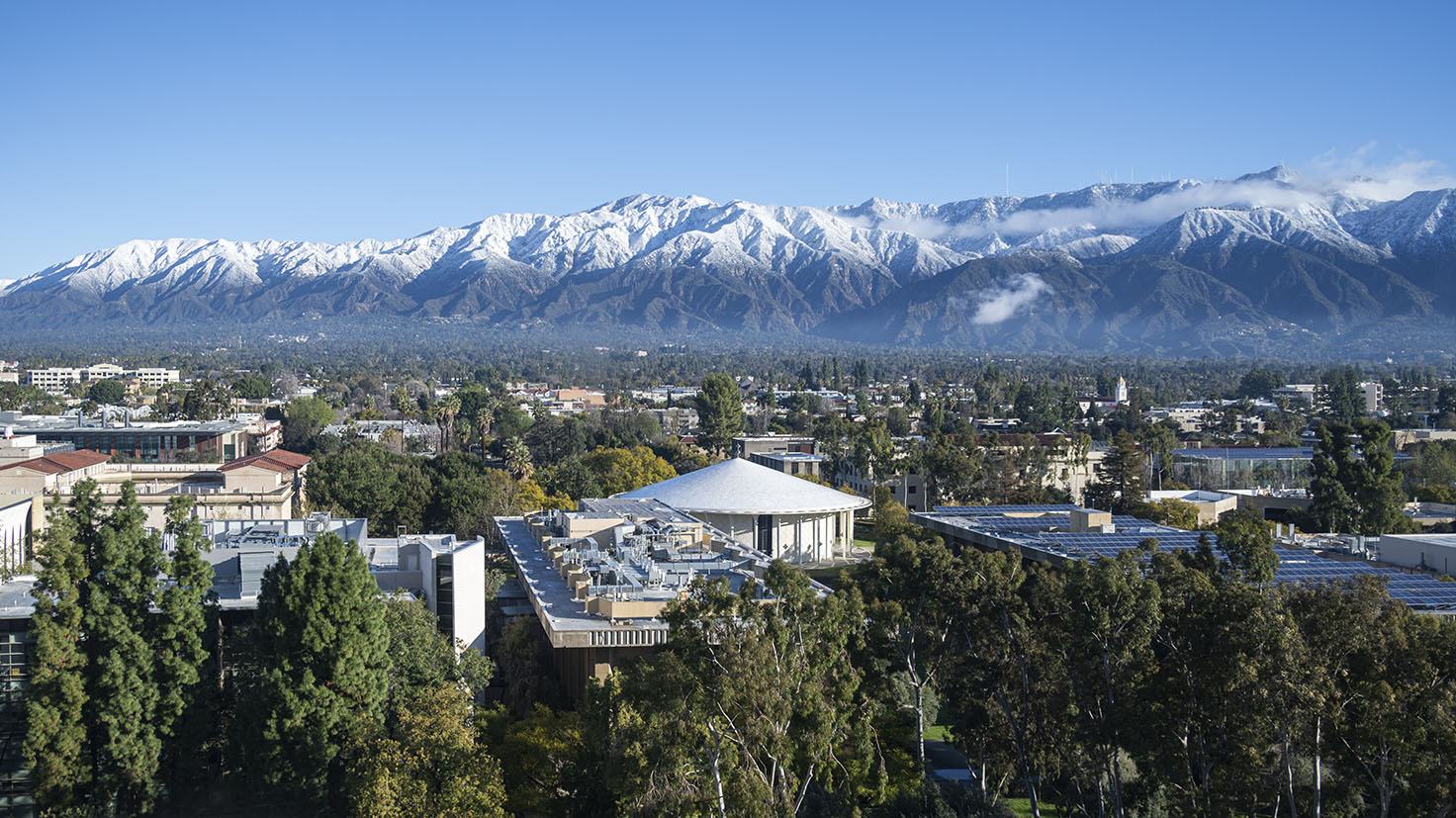
Pasadena main campus, 1200 East California Boulevard, Pasadena, California: 124 acres housing the six academic divisions, laboratories, 11 undergraduate residence halls, dining and student facilities, and five NASA facilities on campus.
Study programmes offered at California Institute of Technology.
Experiences shared by students of California Institute of Technology.
Studied here? Share your experience to help other applicants.

Book a free consultation with our expert counsellors and take the first step towards your dream university.
Copyrights © 2026 StudyMapped. All rights reserved.

Enter your credentials to continue.
Join us and start your study abroad journey.


