

University in Canada
Sherbrooke, Quebec, Canada
University profile
Bishop's University is a primarily undergraduate, English-language university founded in 1843 and located in Lennoxville, part of Sherbrooke, in the Eastern Townships of Quebec. It is the smallest of Quebec's English-language universities and the only one outside Montreal. About 2,800 full-time students attend, many living on campus, and more than 80 countries are represented in the student body. Its motto, Recti cultus pectora roborant, is translated as "sound learning strengthens the spirit".
The university is organised into five faculties and schools: the Faculty of Humanities, the Faculty of Natural Sciences and Mathematics, the Faculty of Social Sciences, the School of Education and the Williams School of Business, with twenty-five departments and over 100 programs. Teaching follows a liberal education model in which students take courses outside their main field; typically over 50% graduate with more than one concentration. Average class size in first and second year is about 40.
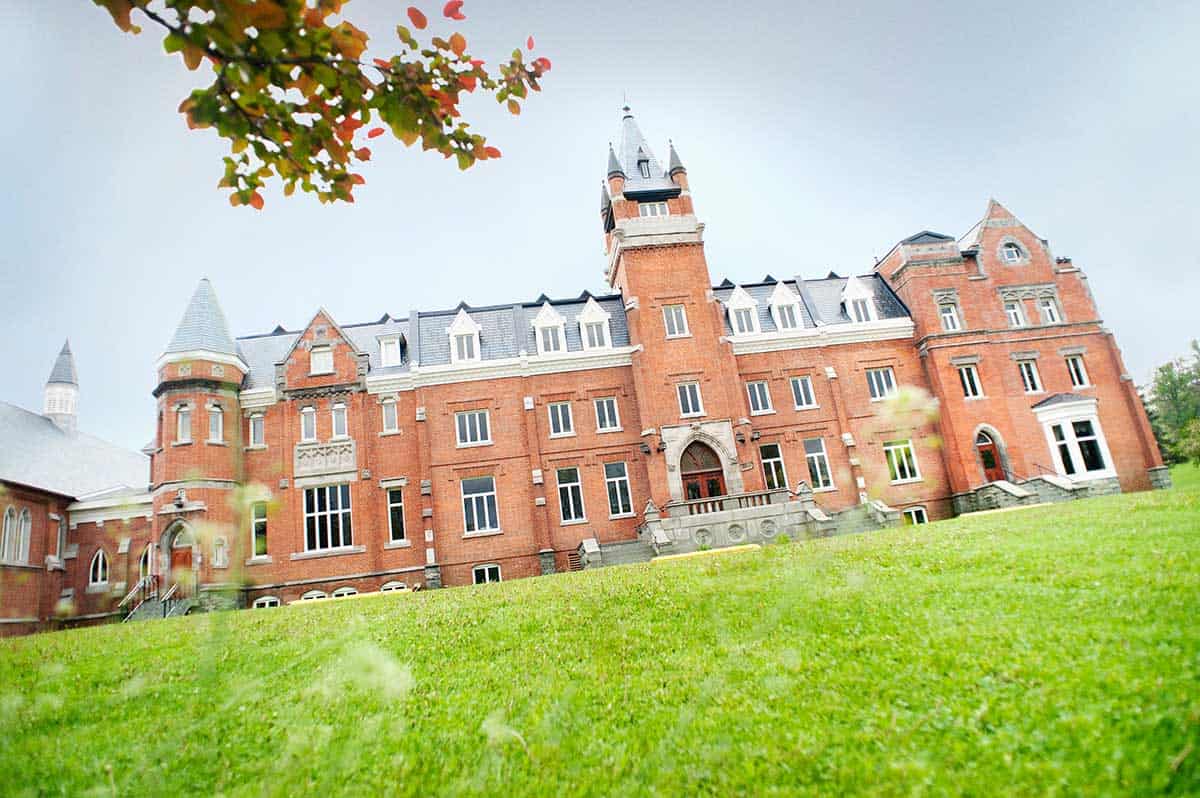
The 550-acre campus on the traditional and unceded territory of the Abenaki includes classrooms, art studios, theatres, laboratories, libraries, an observatory, an art gallery, the John H. Price Sports and Recreation Centre, a greenhouse and laboratories in the Johnson building, the Peter Curry marsh wetlands and a 140-acre educational farm used for the Sustainable Agriculture and Food Systems program. Campus operations have been carbon neutral since spring 2023, and the campus uses a geothermal heating system.
Student life centres on residence and more than 60 student-run clubs, associations, academic societies and sports groups. Gaiters varsity athletics, Homecoming and Winterfest are central traditions. Residence is guaranteed for first-year students who apply on time, with seven residence buildings and unlimited meal plans in the dining hall (Dewies). Experiential learning includes co-operative education in the Williams School of Business and Computer Science, internships in several humanities programs and four practica in the School of Education.
International students study in English while living in a French-speaking province; Bishop's International provides immigration advice and the Admissions Office assesses curricula from outside Canada. Admission is open to applicants from international secondary systems including the IB, A-level, French baccalaureate and CAPE. It holds Canada Research Chairs and offers undergraduate degrees, master's programs in Computer Science and Physics, Education graduate programs and a Doctor of Psychology.
Bishop's distributes more than $7 million a year in endowed scholarships, awards, bursaries, grants and financial aid, and about 55% of students receive assistance ranging from $500 to $12,000. Awards are paid in two equal instalments, Fall and Winter, after each add/drop deadline. See the Scholarships, Awards and Bursaries page.
Entering students are considered automatically for scholarships of $1,000 to $4,000 per year, some renewable (conditions apply), by submitting the admission application by March 31 and all documents by April 15.
Valued at $10,000 per year and renewable. Applicants must be in their final year of high school or CEGEP, Canadian citizens or permanent residents, hold a Grade 11 cumulative admission average of at least 90% or a CEGEP R-Score of 33, and be admitted to a full-time bachelor's program starting in Fall. The application needs two referees, a 500-word essay and a video of up to two minutes. Renewal requires full-time status and an 85% average in the best 24 credits; it is renewable up to three years from high school or two years from CEGEP. It cannot be combined with other Bishop's scholarships. Details.
$500 to $12,000 per year, mostly one-time and non-renewable, based on academic merit and possibly leadership, extracurricular activities and financial need. Apply with the admission application and the online entrance awards and bursaries form by March 31; the form opens at the fall Open House.
First-degree undergraduates registered full-time (minimum 12 credits) in Fall and Winter, with a cumulative average of at least 55% and at least 24 credits remaining to complete the degree, may submit one application for all returning awards and bursaries (2026 deadline May 1, 4:00 p.m.).
The McConnell Student Opportunity Fund supports student-initiated projects and job-related experiences, and the Tomlinson Internship Program funds up to $20,000 a year in on-campus internships. Opportunity funds. Government aid for Canadian students (Quebec, OSAP) and U.S. student aid are explained on the financial aid page.
Michael Goldbloom Excellence Scholarships →
Undergraduate Entrance Awards & Bursaries →
Browse the scholarships listed for Bishop's University and check each award’s eligibility.
View scholarships for Bishop's University →Bishop's accepts applications for Fall (September) and Winter (January) entry through its online application portal, with a non-refundable $75 CAD application fee. Fall 2027 deadlines are May 1, 2027 for Quebec, Canadian and U.S. students and March 1, 2027 for international students; Winter deadlines are November 1, 2026 and September 1, 2026 respectively. Some programs admit for only Fall or Winter. Most applicants receive a decision within 10 business days of a complete file. Bachelor's degrees are 3 years for CEGEP graduates and 4 years for most others; some programs such as Education are longer. Meeting minimum requirements does not guarantee admission, as there are more applicants than places.
Applicants normally need 12 years of formal schooling and a secondary credential giving access to university in their country; applicants from systems with 11 years are assessed individually. The minimum average depends on the curriculum followed and transcripts are reviewed individually. Program prerequisites: Williams School of Business, Grade 11 mathematics; B.Sc. Natural Sciences and Mathematics, university-entrance mathematics and two university-entrance sciences (usually biology, chemistry or physics); B.A. science programs, university-entrance mathematics; Humanities, Social Sciences and Education, none specified (Education with a math or science teachable requires mathematics and two sciences). Documents: high school transcript with mid-term grades if available, proof of English proficiency and identification; a personal statement, letter of intent, references or CV may be requested. Music applicants have additional requirements.
Canadian applicants are assessed by province; for British Columbia and Yukon the estimated minimum admission average is 80% with five Grade 12 university-preparatory courses including English 12. IB Diploma applicants need a minimum predicted score of 30 excluding EE/TOK/CAS bonus points, and 30 advanced credits are awarded for the completed diploma. Separate requirement and transfer-credit pages exist for CEGEP, USA high school, BACF, A-level, CAPE, AP, home-schooled, college-transfer and university-transfer applicants.
All applicants must show English proficiency regardless of citizenship, unless they completed a Quebec CEGEP DEC, three years of secondary instruction in English or French, or at least 30 post-secondary credits taught in English or French. Accepted tests: TOEFL iBT 90 with no component below 20 (taken before January 21, 2026), or 4.5 overall with no score below 4.0 (taken January 21, 2026 or later); IELTS Academic 6.5 with no band below 6.0; Cambridge English 176 (B2 First, C1 Advanced or C2 Proficient, valid four years); PTE Academic 65 with no sub-score under 60; Duolingo English Test 115 with no sub-score under 90; LanguageCert Academic band 70-74 with no score below 65. English language pathway programs with partner schools are available.
Applicants aged 21 or over by September 1 (Fall) or January 1 (Winter) who have been out of full-time CEGEP, high school or college studies for at least two academic years (five years if previously at university) are assessed case by case, usually on three university-level courses taken part-time, prior studies or professional experience. A transcript and CV are required.
The M.Sc. in Computer Science or Physics requires an undergraduate degree in a related field with high academic standing, a transcript, statement of research interests, program pre-approval form and proof of English proficiency. Graduate programs also exist in Education (M.Ed., M.A.), a micro-program in Climate Change and the Doctor of Psychology (Clinical Psychology Profile).
Quebec residents pay $103.92 per credit ($3,117.60 for 30 credits) plus $1,913.85 compulsory fees, $5,031.45 in total. Out-of-province Canadians pay $324.35 per credit ($9,730.50 for 30 credits), $11,644.35 in total. International undergraduates of the 2026 cohort pay $983.68 per credit ($29,510.43 for 30 credits) plus compulsory fees, $32,221.28 in total; international thesis-based graduate students pay $711.62 per credit, $24,059.45 in total with fees. International students also pay a health insurance fee ($443 Fall, $358 Winter, $530 for new Winter students).
Main campus, Lennoxville (Sherbrooke), Quebec. The single 550-acre campus, about a 10-minute drive from central Sherbrooke, has 25 buildings.
Study programmes offered at Bishop's University.
Experiences shared by students of Bishop's University.
Studied here? Share your experience to help other applicants.

Book a free consultation with our expert counsellors and take the first step towards your dream university.
Copyrights © 2026 StudyMapped. All rights reserved.

Enter your credentials to continue.
Join us and start your study abroad journey.


