


Engineering
BA (Hons) Environment, Culture and Communication
Birkbeck, University of London, United Kingdom
- Degree
- Bachelor's
- Next intake
- October 2027

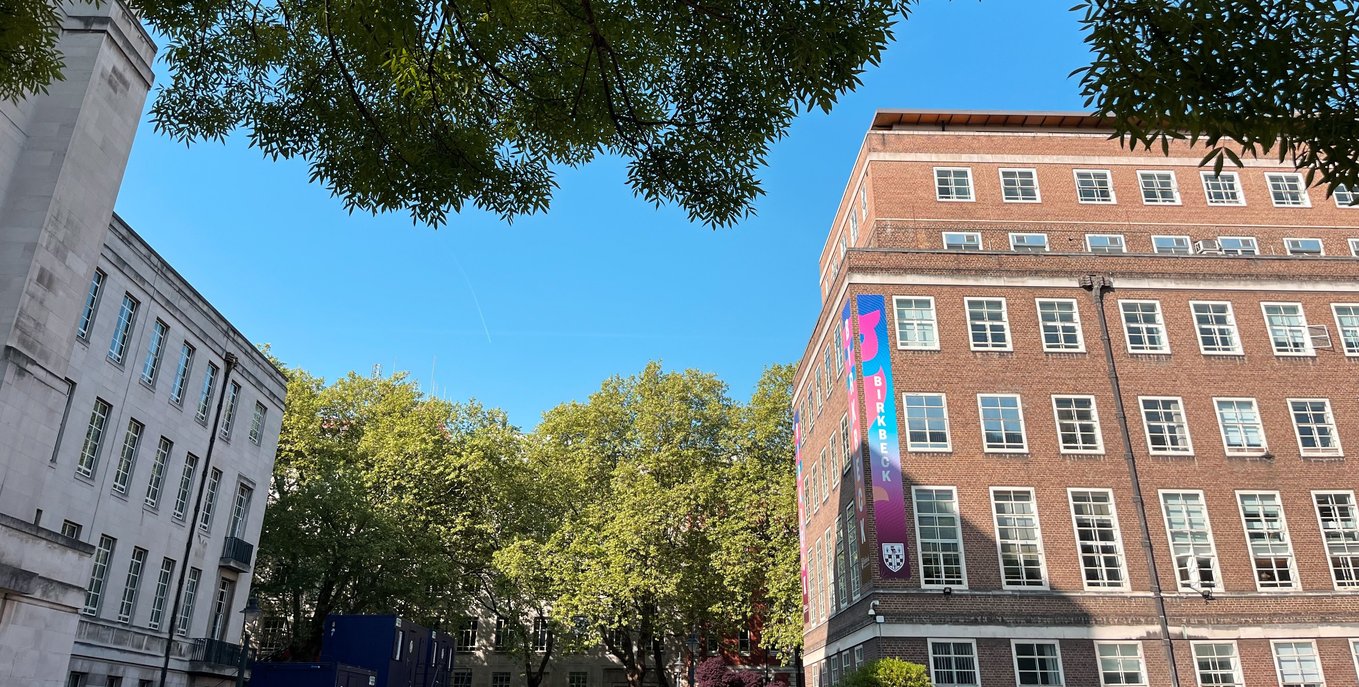

Engineering
Birkbeck, University of London, United Kingdom
This MSc Quantitative Finance with Data Science continues Birkbeck’s long and successful history of addressing in-demand skills in the financial sector. It provides you with a comprehensive curriculum that delivers fundamental quantitative knowledge for financial markets, practical programming skills in Python and R, a solid foundation in statistics and the application of data science tools in a financial context.
Faculty: Birkbeck Business School | Duration: One year full-time, on campus; Two years part-time, on campus | Study mode: full-time, part-time | Intake: October 2027 | Location: London, England, United Kingdom
With an emphasis on practical application, this MSc is designed to equip you with the necessary skills to embark on an exciting career within the modern financial landscape. You will gain in-depth knowledge of data science tools alongside quantitative and statistical techniques and specialist knowledge of financial modelling and risk quantification, including: identifying and managing major sources of risk in financial markets understanding the role of financial derivatives, their use (and misuse) and how they are modelled using Python and R to perform mathematical and statistical investigations using data science tools analysing financial data with a view to detecting trends, forecasting financial variables and building risk models. Compulsory modules include a 6000-word dissertation (30 credits)..
Some of our recent graduates have gone on to be employed at: Ofgem, Moodys, Quilter.
As this MSc is a quantitative programme, the standard entry requirement is a second-class honours degree (2:2) or above, or an equivalent international qualification, in a quantitative subject such as mathematics, physics, statistics, economics or engineering. We may accept applicants from other disciplines if their degree contains a substantial quantitative element. We also welcome alternative entry pathways: Graduate Diplomas – a Merit or higher in a quantitative subject non-traditional qualifications – we judge applications on overall academic potential, knowledge and relevant work experience, and may waive formal requirements accordingly. To help you succeed, the course provides a Quantitative Techniques module to refresh and build upon your mathematical background. You will still be expected to have some prior exposure to core calculus (differentiation and integration), linear algebra (matrices and vectors), and statistics (mean, variance, covariance and probability distributions). When applying please describe your academic background and upload a detailed transcript of your relevant qualifications. English language: IELTS Academic 6.5 overall with at least 6.0 in each component.
Domestic applicants: GBP 7,665 a year (2027/28). Part-time home students; One year full-time or two years part-time, on campus, starting in October 2027 Source
International applicants: GBP 13,170 a year (2027/28). Part-time international students; One year full-time or two years part-time, on campus, starting in October 2027 Source
Intake: October 2027
Duration: One year full-time, on campus; Two years part-time, on campus
Apply through the official page: https://www.bbk.ac.uk/student-services/admissions/postgraduate/applications
Engineering
Birkbeck, University of London, United Kingdom
Engineering
Birkbeck, University of London, United Kingdom
Engineering
Birkbeck, University of London, United Kingdom
Engineering
Birkbeck, University of London, United Kingdom
Engineering
Birkbeck, University of London, United Kingdom
Engineering
Birkbeck, University of London, United Kingdom
Engineering
Birkbeck, University of London, United Kingdom
Engineering
Birkbeck, University of London, United Kingdom

Book a free consultation with our expert counsellors and take the first step towards your dream university.
Copyrights © 2026 StudyMapped. All rights reserved.

Enter your credentials to continue.
Join us and start your study abroad journey.