

University in Germany
Weimar, Thüringen, Germany
University profile
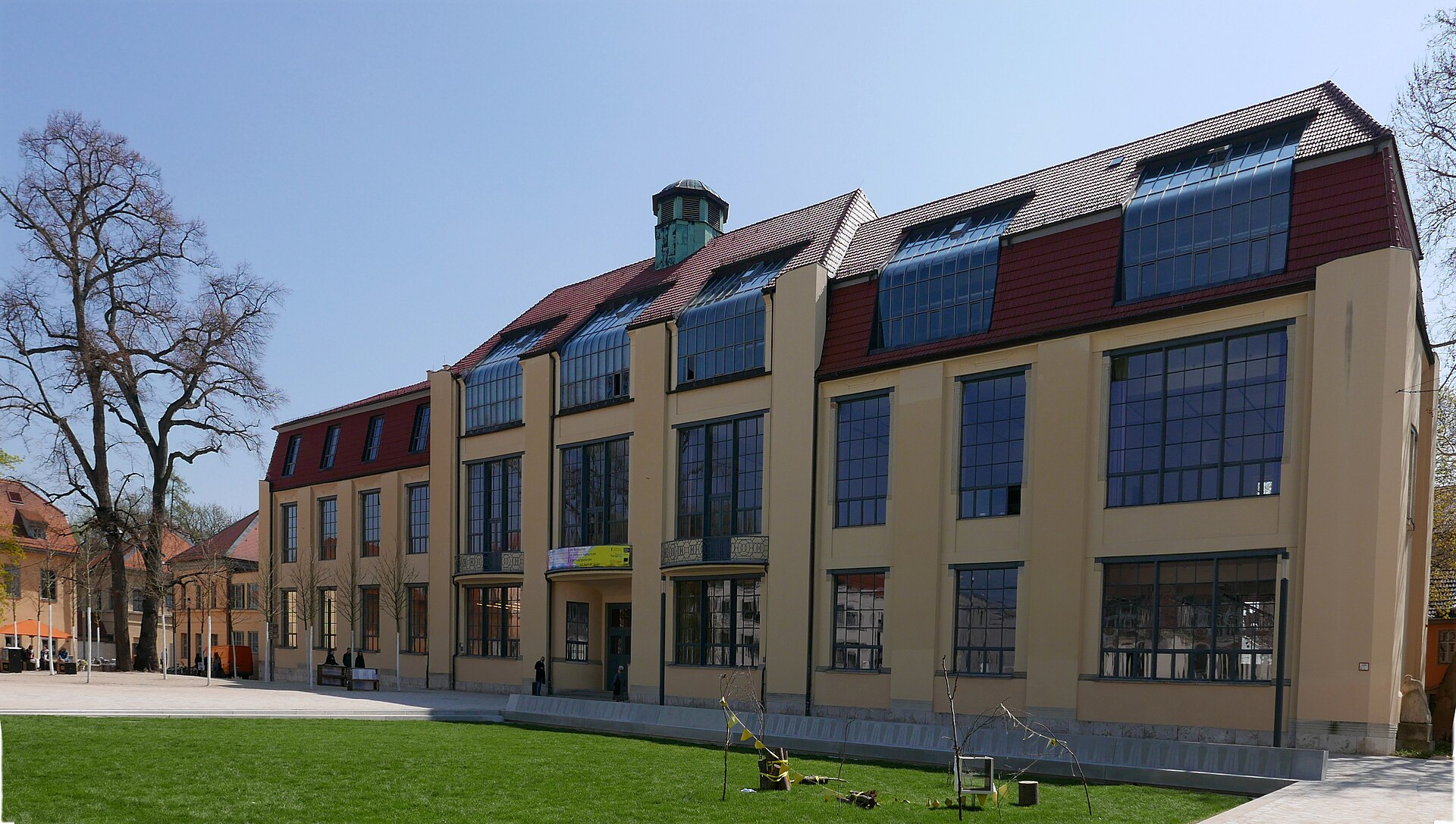
The Bauhaus-Universität Weimar is a public university in Weimar, Thuringia, whose main building housed the Staatliches Bauhaus founded by Walter Gropius in 1919. It took its present name in 1996 and describes itself as an international university at home in the cultural city of Weimar, working on questions of art and culture, technology, science and society.
Study and research are organised in four faculties: Architecture and Urbanism, Civil and Environmental Engineering, Art and Design, and Media. In 2025 the university counted 42 degree programmes and 4,024 students, including doctoral students and students on leave. By faculty these were 1,171 in Architecture and Urbanism, 868 in Art and Design, 768 in Civil and Environmental Engineering and 684 in Media, with a further 244 in interdisciplinary programmes. There are 67 professors and 20 junior professors, roughly 220 research and artistic associates and over 160 project employees.
Research is concentrated in institutes and centres such as the Bauhaus-Institut für Geschichte und Theorie der Architektur und Planung, the Institut für Europäische Urbanistik, the F.A. Finger-Institut für Baustoffkunde, the Institut für Konstruktiven Ingenieurbau, the Erdbebenzentrum and the Digital Bauhaus Lab. The Bauhaus Research School is the central body for doctoral candidates of all four faculties.
The campus lies within Weimar's town centre, and the university's historic buildings include the Main Building and the Van-de-Velde-Bau, both part of the UNESCO World Heritage Bauhaus sites, along with Haus Am Horn, which belongs to the Klassik Stiftung Weimar. Student life is shaped by the student council StuKo and its initiatives, the Bauhaus Internationals group and the annual summaery, the university's yearly show. Housing, meals and BAföG are handled by the Studierendenwerk Thüringen, and international students may live in a student residence, a shared flat or a private apartment.
About 32 per cent of students are international, against a national average of 17.2 per cent, and the university has more than 200 partner universities and more than 500 student exchanges. It belongs to the European University Alliance BAUHAUS4EU. All degree programmes are accredited except the Diplom in Freie Kunst and the Lehramt an Gymnasien in Art Education, which end with a state examination.
There are no tuition fees for regular study. Students pay a Semesterbeitrag (semester contribution, not tuition) every semester, which covers the student council (StuKo), the Studierendenwerk Thüringen and the semester ticket. A long-term study fee of 500 euros per semester, in addition to the Semesterbeitrag, applies when the standard period of study of the current programme is exceeded by more than four semesters.
A federal initiative co-funded half by private sponsors and half by the Bund, awarding 300 euros per month regardless of BAföG or income to talented, high-achieving students. It usually starts in April and runs for at least two semesters, normally until the end of the standard period of study. At least 20 awards are made from April 2026. The 2026/27 deadline was 31 January 2026; the next call is planned for 15 January 2027. Applicants may apply for a maximum of two scholarship formats.
For students of the Faculty of Civil and Environmental Engineering and the Medieninformatik department with above-average sporting achievement or engagement and good grades: three awards per year of 200 euros per month for 12 months, starting usually in October. Applications are made online with a motivation letter, CV, Abitur certificate, transcripts and proof of sporting achievement.
Up to four awards of 450 euros per month for nine months for outstanding Master students in the Faculty of Civil and Environmental Engineering and Medieninformatik, funded by the Professorinnenprogramm. The 2026 deadline was 31 January 2026.
Completion scholarships for international students are awarded usually in April and October.
The Thüringer Graduiertenförderung grants up to five new scholarships for 2026/27 of 1,400 euros per month for up to three 12-month periods for doctorates, or 12 months for alumni art and design projects, plus a family supplement of 300 euros for the first child and 150 euros for each further child. Its next call is planned for 15 January 2027. Several other formats, including the Bauhaus-Stipendien, Bauhaus-Abschlussstipendien, the Stipendium des Präsidiums and the Bauhaus-Promotionsstipendien, have been suspended since April 2026.
Calls for 2027/28 begin in November or December 2026; the awarding committee decides usually in March. Students can also use BAföG, part-time work and student loans, with advice from the Studierendenwerk Thüringen. Details: Finanzierungsmöglichkeiten and Deutschlandstipendien.
Deutschlandstipendium at Bauhaus-Universität Weimar →
MINT/STEM Scholarships for Female Master's Students (Bauhaus-Universität Weimar) →
SPORT-MINT Scholarship (Bauhaus-Universität Weimar) →
Bauhaus Scholarships for Students (Bauhaus-Universität Weimar) →
Browse the scholarships listed for Bauhaus-Universität Weimar and check each award’s eligibility.
View scholarships for Bauhaus-Universität Weimar →Entry requires the general or subject-specific higher education entrance qualification (Abitur), a Meisterprüfung, a state technician or business-economist examination, or an equivalent qualification. Applicants with a vocational qualification of at least two years plus three years of work experience may begin a trial study in a related programme; after two successful semesters they are fully enrolled. Some programmes have no admission restriction, so applicants who meet the entry requirements can enrol straight away. Art and design programmes require an artistic aptitude test (künstlerische Eignungsprüfung), registered automatically when applying for the programme in the Bauhaus.CampusPortal. Other programmes use an aptitude procedure (Eignungsfeststellungsverfahren) that weighs the average grade and may include a homework task, motivation letter, practical experience and interviews. A pre-study internship is not required for admission.
Applications go through the Bauhaus.CampusPortal or uni-assist. Applicants whose school leaving certificate or first degree was obtained outside the EU (except Switzerland) must apply through uni-assist for certain programmes. Deadlines depend on the programme. For the winter semester, Bachelor programmes in Architecture, Urbanism and Media list 15 July; non-EU applicants via uni-assist have winter-semester deadlines between 15 May and 31 August depending on the programme, and 15 January for the summer semester. The semester runs 1 October to 31 March (winter) and 1 April to 30 September (summer).
Applicants must have a recognised entrance qualification. Requirements differ by country and can be checked in the DAAD and anabin databases. Applicants from certain countries must attend a Studienkolleg; Studienkolleg Nordhausen is responsible for Bauhaus-Universität applicants. Applicants with Chinese, Indian or Vietnamese qualifications must submit an APS certificate, except for doctoral applications, and for Master programmes where the qualifying degree was not obtained in those countries. Non-EU students generally need an entry visa; a tourist visa cannot be converted into a student visa.
Most programmes require German. Non-native speakers must show proof by enrolment with DSH-2, TestDaF (at least TDN 4), Goethe-Zertifikat C2, telc C1 Hochschule or equivalent, unless they hold a German entrance qualification or a first degree from a German-taught programme. For English-taught programmes, proof is by Cambridge Certificate, TOEFL, IELTS, PTE Academic or a comparable test; the required level is set in each programme's pages. The Language Centre runs intensive preparation courses ending with the DSH examination in March and September.
Applicants need a first academic degree (Bachelor, Master or Diplom) from a university, university of applied sciences, art academy or Berufsakademie in a related subject, generally with above-average results. The faculty examination board checks the subject prerequisites, by reviewing the application documents or through an artistic aptitude test in art and design programmes. Master deadlines vary by programme, for example 15 July for the winter semester and 15 January for the summer semester in some Architecture programmes, and 30 September (winter) and 31 March (summer) for some Media programmes.
Doctoral candidates are accepted by the graduation commission of the relevant faculty and then enrol as Promotionsstudierende through the Bauhaus.CampusPortal. The Bauhaus Research School advises on admission, and international candidates without a German degree are checked by the International Office ([email protected]). Application procedures and deadlines for individual doctoral programmes differ by faculty.
The university is based in Weimar, with its buildings and workshops spread across the town centre.
Central facilities include the University Library, the Language Centre, the Sports Centre and a canteen, with the Studierendenwerk Thüringen responsible for housing and catering.
Experiences shared by students of Bauhaus-Universität Weimar.
Studied here? Share your experience to help other applicants.

Book a free consultation with our expert counsellors and take the first step towards your dream university.
Copyrights © 2026 StudyMapped. All rights reserved.

Enter your credentials to continue.
Join us and start your study abroad journey.


